Fresh capital for a broader robotics push
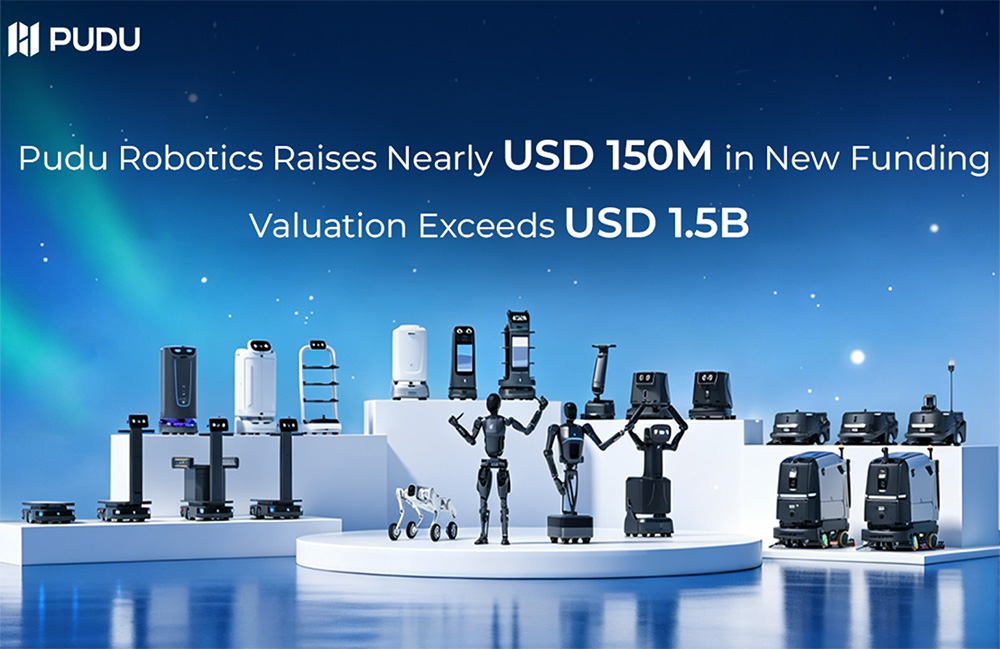
Pudu Robotics has raised nearly $150 million in a new funding round, according to the company’s announcement reported by The Robot Report. The company said the financing pushes its valuation above $1.5 billion and lifts cumulative funding past $300 million.
On its face, the round is a straightforward capital event. But the more telling point is where Pudu says it is heading next. The Shenzhen-based company built its name in service robotics, especially delivery and cleaning systems, yet it is now positioning itself more aggressively around industrial applications and embodied AI.
From service robots to industrial logistics
Since its 2016 founding, Pudu has focused primarily on mobile service robots. The source text says that in recent years it has expanded into warehousing and manufacturing. That shift is visible in two products highlighted in the report: the PUDU T300, a mobile robot released in 2024 for tight aisles and heavy payloads, and the PUDU T150, a lighter delivery robot introduced earlier this year for material handling in manufacturing and warehouse environments.
This is an important progression. Service robotics has offered one route to scale, but industrial environments often promise larger, more repeatable operational use cases. Moving from restaurants and commercial spaces into factories and warehouses also pushes a robotics company toward different demands in navigation, payload, integration and uptime.

What Pudu says it will do with the money
According to the report, Pudu plans to deploy the new proceeds to accelerate embodied AI development, expand its product portfolio, deepen global market expansion, scale manufacturing capacity and strengthen supply-chain capabilities.
That list matters because it shows the company is not treating embodied AI as a research label detached from hardware operations. It is pairing AI ambition with the less glamorous requirements of manufacturing scale and supply-chain execution. For robotics companies, that combination is often where market credibility is won or lost.
Pudu describes its business around three core technologies: mobility, manipulation and artificial intelligence. It also says its products are already deployed across 10 sectors, including food and beverage, retail, hospitality, healthcare, entertainment and sports, industrial facilities and education. The company is trying to use that installed base and operating experience as a platform for expansion rather than remaining boxed into one narrow robotics segment.
Regional expansion is part of the strategy
The source gives specific details on the initial availability of the T150. The system will first be available in mainland China and in Hong Kong, Macao and Taiwan, followed by selected high-growth markets including Vietnam, Thailand, Singapore, Malaysia, Indonesia, South Korea and Turkey.
Those market choices suggest a targeted regional growth model rather than a uniform global rollout. They also reflect where warehouse automation and industrial handling demand may be expanding quickly enough to justify a faster go-to-market effort.
A wider funding signal from China’s robotics sector
The report notes that Pudu is not alone among Chinese robotics companies in bringing in large financing rounds. Even without a long list of comparables in the supplied text, that observation helps place the round in context. Capital is still flowing into robotics businesses that can frame themselves not only as hardware vendors but as AI-enabled automation platforms with plausible paths into large commercial and industrial markets.
Pudu’s own messaging reinforces that framing. Founder and CEO Felix Zhang said the round validates the company’s technology, product strength, brand and commercial infrastructure. That is standard executive language in a funding announcement, but it aligns with what the company now needs to prove: that its next phase is not just bigger, but more operationally demanding and strategically important.
The bigger question
The central question is whether service-robotics incumbents can make the jump into heavier-duty industrial automation without losing focus. Pudu’s new funding gives it room to try. The company is betting that embodied AI, warehouse and manufacturing use cases, and a strengthened manufacturing base can reinforce each other.
If that works, the round will look less like another headline valuation event and more like a marker of where commercial robotics capital is concentrating. Investors are not just backing robots that can move trays or clean floors. They are backing companies that claim they can carry those capabilities into broader industrial systems and do so at scale.
This article is based on reporting by The Robot Report. Read the original article.
Originally published on therobotreport.com