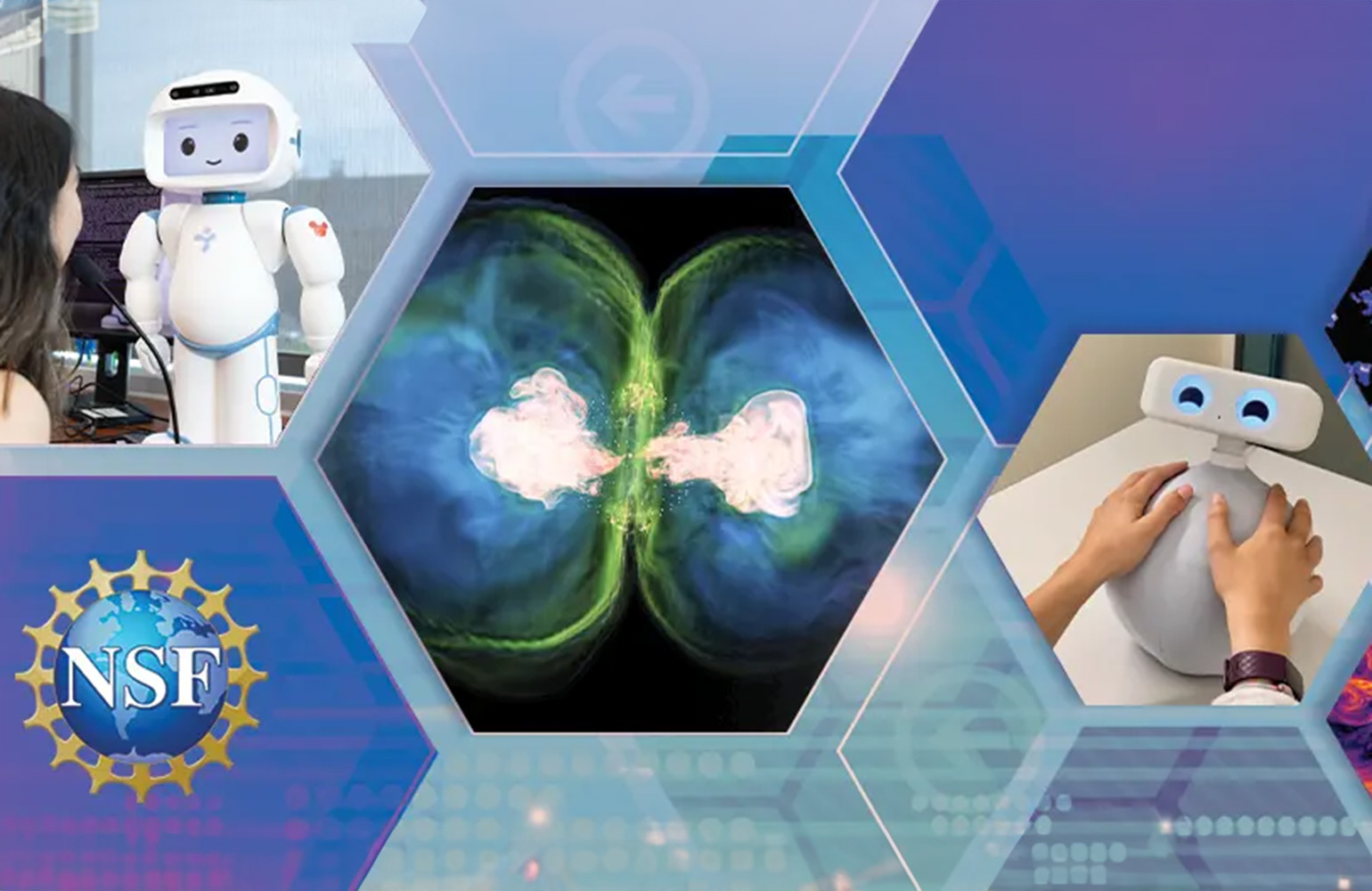
NSF is placing a five-year bet on research centers built for scale
The U.S. National Science Foundation is investing $90 million over five years in three new Science and Technology Centers, including one focused on human-robot co-adaptation. The move combines research funding, workforce development, and institutional partnerships in a format designed to produce longer-lived capability rather than one-off projects.
According to The Robot Report’s account of the August 27 announcement, each of the three centers will receive $6 million annually for an initial five-year period. After that, the centers can compete for up to five additional years of support. In practical terms, NSF is setting up a structure that rewards both early momentum and the ability to build durable collaborations across universities, industry, and government.
That matters because many high-impact technology fields now depend on exactly that kind of cross-sector continuity. Robotics, AI, turbulence modeling, and genome engineering are not research areas where isolated grants easily translate into deployable systems or broad national capability. They typically require shared infrastructure, multi-disciplinary teams, and training pipelines that run for years.
The robotics center is built around adaptation between people and machines
The most directly relevant center for the AI and robotics landscape is the Center for Human and Robot Co-Adaptation, which will be led by the University of Texas at Austin. Its mandate is focused on how people and robots can securely and effectively adapt to one another as service and assistive robots become more common in homes, hospitals, workplaces, and public spaces.
That framing is important. A large share of robotics progress is no longer just about improving hardware or motion planning in isolation. The harder challenge is designing systems that can operate around varied human behaviors, preferences, trust levels, and physical needs. In those settings, the robot is not simply executing a fixed task in a controlled environment. It is learning from people, responding to changing conditions, and functioning inside social and practical constraints that differ from one user and one context to the next.
The source text says the center will combine robotics, AI, and human factors to develop methods that help robots with embodied intelligence learn from people, understand needs and preferences, and adapt both physically and cognitively to changing environments and different individuals. That is a broad but strategically coherent agenda. It connects machine learning, user-centered design, assistive technologies, and real-world deployment challenges under a single research umbrella.
Why “co-adaptation” is a stronger goal than simple automation
The center’s title points to a subtle but meaningful shift in robotics thinking. Traditional automation often assumes the machine is optimized and the human adjusts to it. Co-adaptation implies a two-way process: robots must become better at fitting into human environments, and humans must be able to work with them in ways that are safe, intelligible, and useful.
That is especially relevant in healthcare and independent living, two application areas named in the source text. In those domains, a technically capable robot is not sufficient. It must also be legible to users, responsive to changing needs, and robust enough for settings where mistakes, confusion, or brittle behavior can have serious consequences. By funding research that explicitly joins AI, robotics, and human factors, NSF is backing a model that treats usability and adaptation as core technical requirements rather than secondary design issues.
The broader portfolio shows NSF’s view of strategic science
The other two newly funded centers are the Center for Transformative Explorations in Multi-Physics and Engineering of Scientific Turbulence, known as TEMPEST, led by Michigan State University, and the Center for Genome Intelligence Engineering, or GENIE, led by Northwestern University.
Even from the abbreviated descriptions in the supplied source text, the three-center mix says a lot about federal priorities. One center targets robotics and AI in human-centered environments. Another focuses on turbulence and multi-physics science, a domain central to engineering, climate-related modeling, energy systems, and advanced simulation. The third concentrates on genome intelligence engineering, a phrase that signals a computational and systems-oriented approach to biological design.
Together, the package reflects a view that foundational science leadership depends on connecting digital methods with physical systems and life sciences. It is not a narrow commercialization program, nor is it basic science detached from application. Instead, NSF appears to be funding institutions that can move between discovery, method-building, and eventual use.
Workforce development is part of the point
NSF’s statement, as quoted in the source text, framed the centers as a way to maintain U.S. leadership in science and technology through bold research, strong partnerships, and a skilled workforce. That is consistent with how Science and Technology Centers have historically functioned: not just as places where papers are produced, but as training grounds where students, researchers, and partners learn to work across disciplines and sectors.
For robotics in particular, that matters as much as any individual technical milestone. The field has a persistent integration problem. Mechanical design, perception, learning, controls, safety, human-computer interaction, and deployment economics all have to connect. Centers that can train researchers across those seams may have outsized long-term impact, even when their most visible outputs are early-stage prototypes or methods.
The University of Texas-led center’s focus on service and assistive robots suggests NSF is also trying to align research with demographics and labor realities. Aging populations, healthcare staffing pressures, accessibility demands, and expectations for automation in public-facing environments all create demand for systems that are not only capable, but trustworthy and adaptable.
A signal to the U.S. robotics ecosystem
Although $90 million spread across three centers will not by itself transform the national robotics landscape, the announcement is still meaningful. Federal research dollars help define what kinds of problems are considered important enough to organize around. In this case, NSF is signaling that human-robot collaboration, embodied intelligence, and secure adaptation deserve sustained institutional backing.
That could influence talent flows, university hiring, startup formation, industry partnerships, and follow-on grant activity. It also gives participating institutions a platform to shape standards and expectations for how robots should interact with people outside tightly controlled industrial settings.
What to watch next
The immediate announcement is about funding and structure, not product launches or near-term deployment metrics. The key question over the next several years will be whether the centers can translate their long time horizon into distinctive technical frameworks, testbeds, and partner networks.
For the robotics center, the most important outputs may not be a single breakthrough machine. They may instead be methods for secure learning from users, repeatable ways to measure adaptation and trust, and system designs that make robots more practical across homes, clinics, workplaces, and public environments. If that happens, the center could influence a wide range of future platforms even without directly commercializing them.
- NSF is investing $90 million over five years across three new centers.
- Each center will receive $6 million per year for an initial five-year period.
- The robotics center is led by the University of Texas at Austin.
- Its focus is secure and effective adaptation between humans and robots.
- NSF says the centers are intended to strengthen research leadership, partnerships, and the STEM workforce.
This article is based on reporting by The Robot Report. Read the original article.
Originally published on therobotreport.com