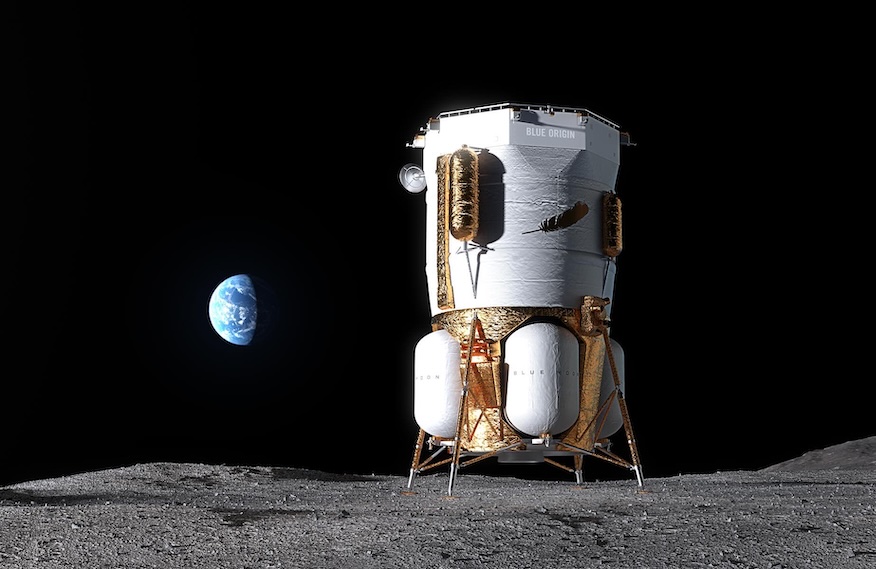
NASA is separating the lander from the rocket setback
NASA is urging Blue Origin to move the first Blue Moon lunar landers to a launcher other than New Glenn after the company’s May 28 testing explosion damaged Launch Complex 36 at Cape Canaveral. The shift is not a small procurement adjustment. It reflects a broader decision by the agency to protect the lunar landing program from a failure in one part of the transportation stack.
NASA Administrator Jared Isaacman said the agency is “de-coupling the lander from the launch vehicle and the pad itself,” a formulation that captures the urgency behind the move. NASA’s priority, he said, is to keep the lander in development so it can remain available for a 2027 test mission tied to Artemis 3 and potentially support landing objectives in 2028.
The pressure comes from schedule, not just damage
The supplied report makes clear that NASA is responding to more than the optics of a launch-site accident. It is acting under schedule pressure. Artemis already operates under tight timing assumptions, and the agency does not want a single rocket program’s recovery path to dictate whether a lunar lander reaches readiness.
That logic matters because lunar missions are systems of systems. A delay in one major element can cascade across training, mission design, integration, launch windows, and political support. NASA’s answer, at least in this case, is to separate lander progress from launcher uncertainty where possible.
An agency spokesperson confirmed to Spaceflight Now that NASA would like the Blue Moon Mark 1 cargo lander, and potentially the Blue Moon Mark 2 crewed lander, to launch on something other than New Glenn.
The scale of the setback
The May 28 anomaly was severe. According to the report, Col. Brian Chatman of Space Launch Delta 45 described it as the largest explosion seen at Cape Canaveral Space Force Station. That description gives a sense of the scale of the event, even before a root-cause investigation is completed.
Blue Origin and local officials confirmed that there were no injuries or fatalities, which is significant given the damage described. Still, the physical impact on the pad and surrounding infrastructure appears serious enough that NASA is unwilling to treat the incident as a short-term interruption with an easy return-to-flight path.
Isaacman and senior NASA engineers traveled to Florida the following day to speak with Blue Origin personnel and review the damage directly. That rapid engagement shows NASA is not observing passively from the sidelines. It is taking an active role in assessing how to preserve national lunar objectives while commercial partners work through failure recovery.
What this means for Blue Origin
For Blue Origin, the message is mixed. On one hand, NASA’s public stance keeps the Blue Moon program alive inside the Artemis architecture. The agency is not stepping away from the lander. On the other hand, the preferred workaround amounts to a loss of confidence in using New Glenn as the near-term launch solution for those missions.
That distinction matters strategically. Blue Origin’s value to the lunar effort has included both spacecraft capability and launch capacity. If NASA now sees those as separable, Blue Origin may preserve its role in lander development while losing a crucial opportunity to demonstrate end-to-end mission execution with its own heavy-lift rocket.
Why NASA is acting this way
Isaacman framed the incident as a setback typical of a difficult business, noting that rockets involve enormous energy and that failures will happen. But his more consequential statement is the one about not sitting on hands waiting for needed capabilities. NASA is signaling that commercial partnership does not mean schedule passivity. If a program obstacle appears, the agency intends to intervene, restructure dependencies, and move forward with whichever path best protects mission goals.
That approach echoes the broader Artemis reality. The United States wants astronauts back on the lunar surface before 2028, and NASA does not appear willing to let a launch-pad recovery schedule become the pacing item for that objective if alternatives exist.
A larger lesson for Artemis
The Blue Moon launcher question also highlights a deeper issue in the Artemis era: resilience comes from interchangeability. When vehicles, landers, and infrastructure are too tightly bound together, every failure becomes a program-level threat. When they can be separated, at least some setbacks can be contained.
NASA’s move suggests it is trying to build that kind of flexibility in real time. The agency still needs Blue Origin’s lander progress. It still needs safe launch systems. But it is no longer assuming those must arrive as a single package on the original plan.
The immediate implication is straightforward. Blue Origin’s lunar landers may fly on another rocket so development can continue on schedule. The broader implication is even more important: Artemis is increasingly being managed as a portfolio of recoverable risks, not as a rigid sequence where one explosion can halt the entire return-to-the-Moon effort.
This article is based on reporting by Spaceflight Now. Read the original article.
Originally published on spaceflightnow.com


.png/jcr:content/renditions/cq5dam.web.1280.1280.png)