A rare nighttime portrait of Earth from the road to the Moon
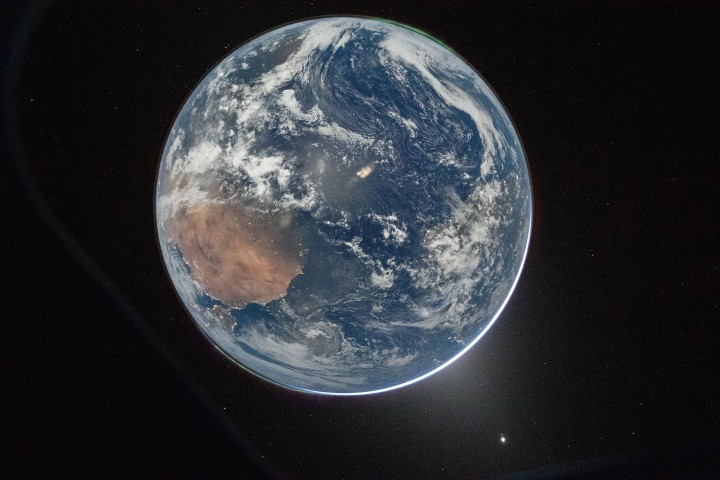
One of the first images sent back during the Artemis II mission offered something unusual even by spaceflight standards: a full-disk view of Earth that looks sunlit, but is actually illuminated by moonlight. In a new Earth Observatory feature, NASA explains why the photograph matters not just as an image, but as a revealing view of Earth’s place in the solar system.
The picture was taken by an Artemis II crew member aboard the Orion spacecraft after the translunar injection burn, the maneuver that sent the vehicle out of Earth orbit and onto a trajectory toward the Moon. From that vantage point, Earth eclipsed the Sun from Orion’s perspective, leaving only a thin bright sliver of sunlight around the planet’s lower-right edge.
That geometry created the conditions for a rare kind of nighttime image. Although the visible face of the planet appears bright, NASA says it was lit by a full Moon. The result is a view of Earth at night from far beyond low Earth orbit, with human-made lighting and atmospheric phenomena visible at planetary scale.
What the image shows
The photograph captures more than the planet itself. Green auroras glow around both poles, created by charged particles from the Sun interacting with Earth’s upper atmosphere. To the lower right of Earth, a fuzzy band of zodiacal light appears, produced when sunlight reflects off interplanetary dust.
NASA notes that zodiacal light can sometimes be seen from Earth at dawn or dusk as a faint column above the horizon. In the Artemis II image, the phenomenon becomes part of a larger composition that situates Earth amid the dust, light and charged-particle activity of the inner solar system.
Venus also appears in the lower-right portion of the image as a bright object, adding another planetary reference point. Taken together, the elements make the photograph less like a standard Earth portrait and more like a map of relationships: Earth, Sun, Moon, nearby planets and space environment all rendered in a single frame.
Why the city lights matter
NASA highlights one especially striking detail: the visibility of city lights from a deep-space perspective. Bright areas can be seen in Spain, Portugal and northern Africa, as well as in sub-Saharan Africa and Brazil. According to the agency, digital camera technology combined with the illumination from a full Moon made those nighttime human signatures visible.
That feature gives the image a dual identity. On one level, it is a scientific and observational photograph showing atmospheric and interplanetary phenomena. On another, it is a human image, recording the distributed glow of civilization on the night side of a planet seen from the path to another world.
Images of Earth from space are now common enough that they can lose their shock value. But this one stands apart because it is not just another full-disk shot. It presents Earth under lighting conditions that are rarely available and from a mission profile that few crews have occupied.
An image that fits the mission
Artemis II is designed to carry humans beyond Earth orbit again, and the image reflects that threshold status. It looks outward toward the Moon while also looking back at home in a way that low-orbit missions cannot easily reproduce. NASA’s description makes clear that the photograph is not only visually arresting but also technically revealing, capturing auroras, zodiacal light, Venus and human settlement patterns in one frame.
The larger significance of the image is perspective. Earth appears both full and vulnerable, surrounded by solar-system effects that are usually invisible in everyday life. Moonlight, auroral particles, dust-scattered sunlight and distant city lighting all coexist in a single scene.
That is why the photograph resonates beyond aesthetics. It shows the planet not as an isolated blue sphere, but as an inhabited world embedded in a dynamic celestial environment, seen by astronauts already on their way to the Moon.
This article is based on reporting by science.nasa.gov. Read the original article.
Originally published on science.nasa.gov