Ancient instruments are offering a rare molecular glimpse into premodern surgery
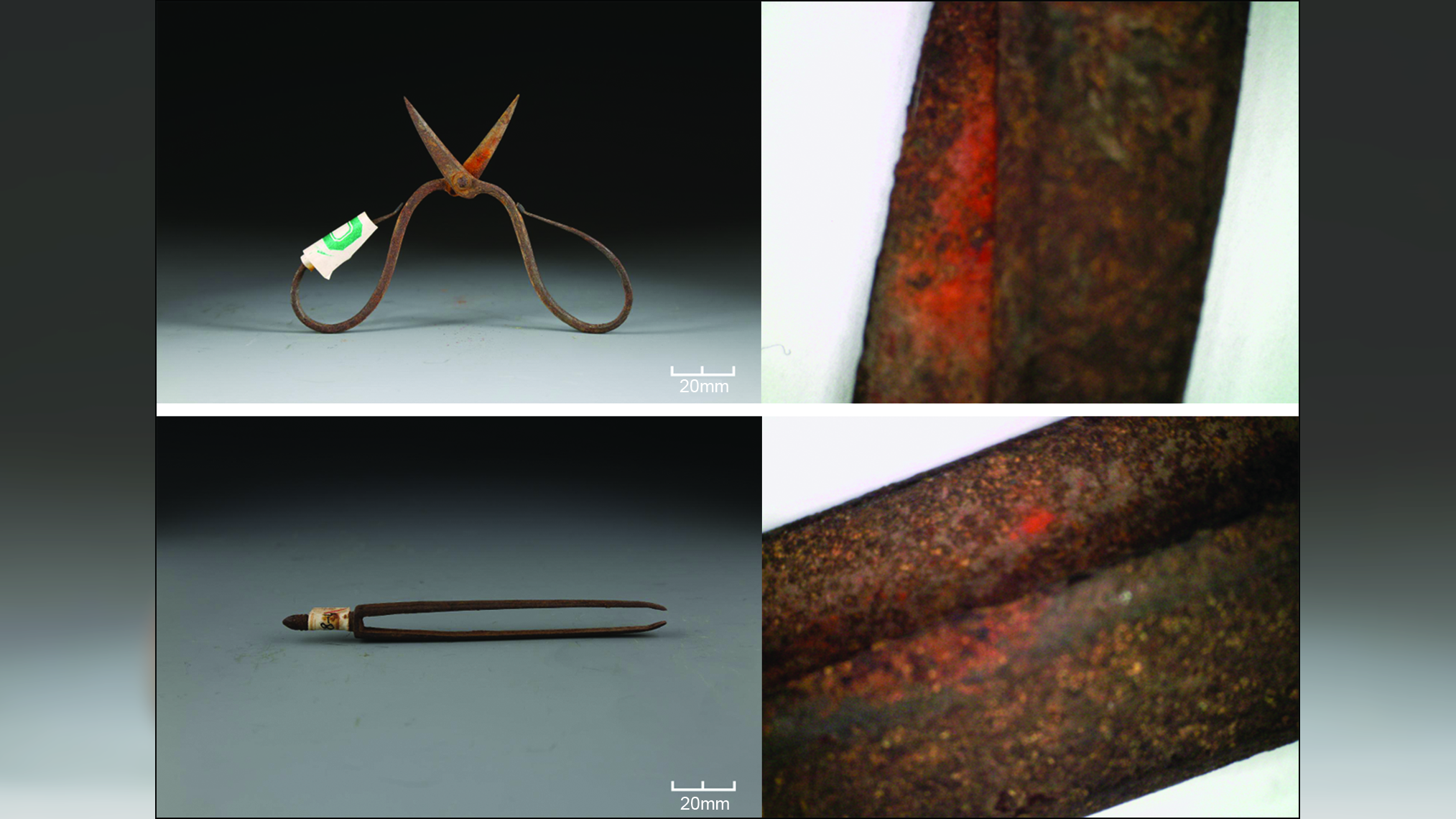
A 600-year-old set of surgical tools discovered in a Ming dynasty tomb in China may contain what researchers describe as the world’s first chemical evidence of a topical anesthetic. The finding comes from residue analysis performed on iron scissors and tweezers associated with a surgeon named Xia Quan, and it gives unusual material support to historical accounts of sophisticated medical practice in late imperial China.
The study, published in Antiquity, does not merely infer the use of anesthesia from texts or tool form. Instead, it identifies chemical traces left on the instruments themselves, making the claim especially notable for historians of medicine and archaeology alike.
Laser-based analysis was used to study residue on iron tools
The instruments were found decades ago in Xia Quan’s tomb in Jiangyin, near Shanghai, but new analytical techniques allowed researchers to revisit them in greater detail. According to the source text, the team first used X-ray fluorescence to confirm that both the scissors and tweezers were made of iron. Researchers then selected tiny rust-colored residue particles from the surfaces in hopes of detecting preserved organic compounds.
To characterize those residues, the team used micro-Raman spectroscopy, a non-destructive method that relies on laser-induced scattering to generate a molecular fingerprint. That approach revealed the presence of a cyano functional group, identified in the source text as being found in hydrogen cyanide, along with evidence supporting use of Chinese wolfsbane.
Chinese wolfsbane is highly toxic. Yet historical practice appears to have involved detoxifying the plant before use, including with urine and other materials, according to the summary supplied in the candidate text. That detail underscores the complexity of the medical knowledge involved: a poisonous substance was not simply applied as-is, but processed into something usable in a surgical context.
Why this matters: direct chemistry is different from textual history
Historians have long known that premodern physicians employed substances intended to dull pain, but direct chemical proof is rare. Written sources can describe ingredients and procedures, but they cannot always show whether a tool was actually used with a specific preparation. Residue analysis closes that gap.
That is why the claim of “oldest chemical evidence” is significant. It is not necessarily saying this was the first topical anesthetic ever used anywhere. Rather, it suggests this may be the earliest known case in which the chemistry has survived on surgical instruments and can now be read with modern methods.
Study co-author Congcang Zhao captured that point in the source text by describing how traces of anesthetic medicine left on the tools were read today using a beam of laser light. The pairing of ancient surgery and modern spectroscopy gives the discovery unusual force: the evidence is not reconstructed only from narrative, but from matter.
A window into Ming medical practice
The tools themselves also help ground the finding in practical medicine. Scissors and tweezers imply procedures requiring precision and controlled tissue handling, not just herbal preparation. When combined with topical numbing, they point to a clinical setting in which pain management and manual technique were both part of the surgeon’s work.
The source text does not claim a full reconstruction of the operation or all compounds present in the anesthetic mixture. But it does suggest that practitioners in Ming-era China had access to processed pharmacological preparations and applied them in ways that left detectable traces centuries later.
That matters because discussions of historical medicine can drift toward either romanticism or dismissal. Findings like this support a more exacting middle ground. They show that premodern practitioners operated with empirically developed methods, some of them potent, risky and technically demanding.

The broader scientific value of the discovery
Beyond its medical history appeal, the study highlights how archaeological science continues to widen the range of questions researchers can ask of old objects. Instead of treating artifacts mainly as static visual evidence, scientists can now analyze elemental composition, molecular residues and microscopic traces to recover aspects of use that were once invisible.
In this case, the payoff is especially striking because anesthesia is central to the history of surgery. Pain control determines what procedures are bearable, feasible and ethically defensible. Evidence that a topical anesthetic was being used six centuries ago, and that it involved a carefully managed toxic plant, adds texture to that history.
- Researchers analyzed 600-year-old Ming dynasty surgical tools from the tomb of Xia Quan.
- X-ray fluorescence confirmed the tools were iron, while micro-Raman spectroscopy identified molecular traces in residue.
- The findings point to a topical anesthetic made from Chinese wolfsbane, a toxic plant likely detoxified before use.
- The study may provide the oldest direct chemical evidence of a topical anesthetic on surgical instruments.
The result is a rare convergence of archaeology, chemistry and medical history. A pair of old tools has become more than a museum object. It has become evidence that a surgeon working six centuries ago used a pharmacological method whose traces were durable enough for modern science to detect, interpret and place back into the story of human attempts to reduce pain.
This article is based on reporting by Live Science. Read the original article.
Originally published on livescience.com

