Automakers Race to Put Humanoids on the Factory Floor
Renault Group has announced plans to deploy 350 humanoid robots in its factories by 2027, making it one of the first major automakers to bring humanoid technology to industrial production at meaningful scale. The robots, named Calvin-40, were developed in partnership with Wandercraft, a French startup in which Renault holds a minority stake. The deployment is a central pillar of Renault's futuREady strategic plan and is intended to cut production hours per vehicle by 30 percent.
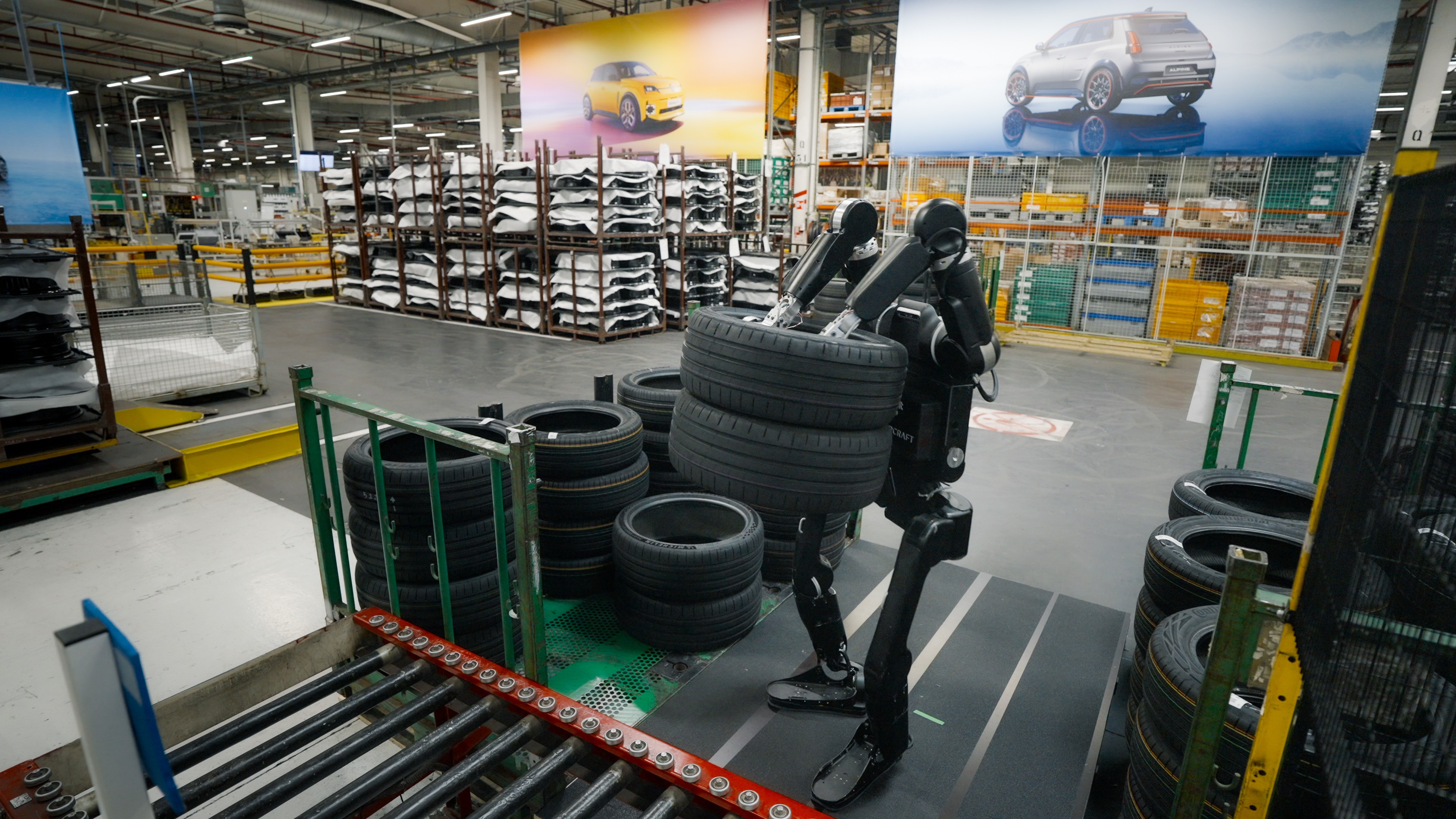
The Calvin-40 robots are matte black, headless units designed for pragmatic utility. They can carry loads of up to 40 kilograms, incorporate cameras at their midsection, and use LED lights to communicate operational status to human workers. Footage shown by Renault's head of production, Thierry Charvet, depicted Calvin robots repeatedly lifting sets of tires at the company's Douai facility in northern France.
The Engineering Case for Humanoid Form
Charvet was candid about why Renault chose a humanoid design despite current limitations. The bipedal form factor offers a practical advantage that wheeled robots cannot match in existing factory layouts: the ability to carry heavy loads into tight spaces without requiring a wide base for stability. If you imagine the same robot with wheels carrying 30 kilograms at the end of its arms, you need a very wide base — humanoid form allows automation of many workstations where it was previously impossible.
The Calvin robots can also be trained to pick mixed parts from bins — a task requiring human dexterity and visual recognition that traditional industrial robots struggle to replicate economically. The first Calvin prototype appeared in April 2025 and was assigned simple tasks at Douai. A second unit followed in October 2025 and was already performing those same tasks twice as fast, reflecting rapid AI-driven capability improvements between generations.

Renault's Broader Automation Ambitions
Renault has been working to reduce production time on newer models including the Renault 5 and Twingo EVs to 10 hours per vehicle or less. The 30 percent production hour reduction targeted through the Calvin deployment would represent a substantial structural cost improvement — critical as European automakers face intensifying pressure from lower-cost Chinese manufacturers.
Renault views Calvin as the first of a family of humanoid platforms. The company and Wandercraft plan to industrialize the robots and reduce costs through volume production, with future units expected to incorporate more capable hands and expanded task repertoires. Personal exoskeletons named Eve are also part of the partnership, designed to reduce physical strain on human workers performing demanding tasks.
The Competitive Landscape
Renault is entering a competitive field. Tesla has announced a pivot away from Model S and Model X production in favor of manufacturing its Optimus humanoid robots. Hyundai is deploying robots from its Boston Dynamics subsidiary. BMW and Mercedes-Benz have established pilot programs with humanoid startups.
What distinguishes Renault's approach is depth of commitment to a single partner. By taking a minority stake in Wandercraft and co-developing Calvin specifically for its production environment, Renault positions itself as both customer and development partner. Wandercraft was founded in Paris in 2012, initially focused on medical exoskeletons for hospital rehabilitation. The June 2025 funding round worth $75 million, with Renault and Bpifrance as lead investors, funded the pivot to industrial automation.

Near-Term Limitations and the Path Forward
For now, Calvin units handle simple repetitive tasks — lifting tires, carrying body shop panels — because of current limitations in speed and dexterity relative to specialized industrial robots. Human workers continue performing assembly-line operations requiring fine motor coordination. Charvet expects this division to evolve as AI and improved actuator hardware expand what the robots can do reliably.
The 2027 timeline coincides with rapid advancement across the humanoid robotics industry. Multiple competing platforms are expected to reach early commercial deployment around the same window. The performance improvements demonstrated between Calvin's first and second units suggest the technology curve is steep enough to substantially change humanoid robot capabilities within a two-to-three year horizon.
This article is based on reporting by Automotive News. Read the original article.
Originally published on autonews.com

![Volkswagen's new electric hot hatch delivers more power than the Golf GTI [Images]](https://electrek.co/wp-content/uploads/sites/3/2026/09/Volkswagen-ID.3-GTI-EV-side.jpeg?quality=82&strip=all&resize=1200,628)