Nissan is making a bigger claim about assisted driving
Nissan says its next-generation ProPilot Assist system is approaching a new level of automated capability, and the company used a public-road demonstration in Tokyo to make the point. According to Nissan executive chief engineer Tetsuya Iijima, the updated platform is scheduled to launch first in Japan in 2027, with other markets to follow as soon as possible.
The company’s claim is unusually direct. Iijima told The Drive that the new system is “equal to or better than a human” driver, then backed that statement with a 40-minute ride in Tokyo using a prototype Nissan Ariya. The route included both city streets and highways in what the report described as a completely uncontrolled test environment, rather than a closed course or scripted showcase.
If the description holds up in production, the development would mark a major step beyond today’s lane-centering and supervised highway systems, pushing Nissan closer to the same competitive bracket it sees occupied by Tesla and Wayve.
What happened during the Tokyo test
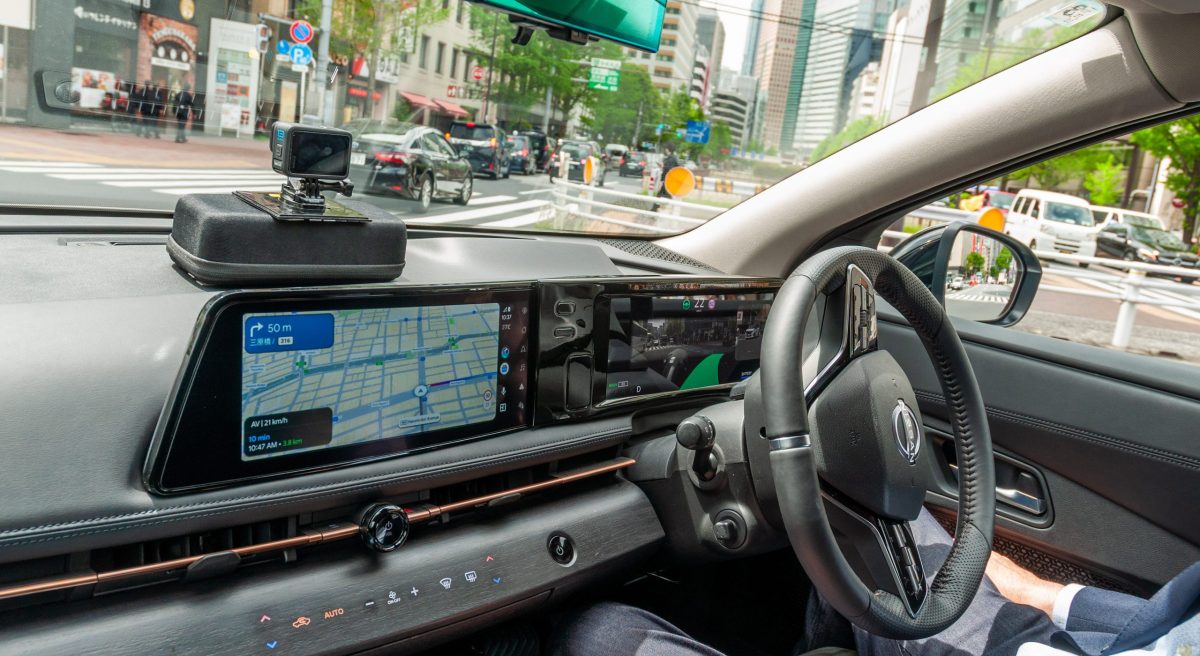
The prototype vehicle used in the demonstration was based on a familiar Ariya, though test hardware remained visible. A black roof-mounted box housed part of the sensor array for development purposes. In the production vehicle, Nissan intends to integrate those sensors into the vehicle itself rather than keeping them exposed as external modules.
The hardware stack described in the report included 11 cameras, five radar units, and one lidar sensor. That combination suggests Nissan is pursuing redundancy across sensing modes rather than depending primarily on cameras alone. It also aligns with a broader industry pattern in which companies trying to deliver more robust automated driving on public roads increasingly combine vision, radar, and lidar rather than treating them as mutually exclusive approaches.
The Ariya demonstration began with a manual maneuver out of a parking spot near the hotel, because Nissan said that element remains disabled in the test setup even though the production system is intended to handle vehicle startup and parking departure on its own. Once the car reached the hotel entrance, Iijima initiated the drive through the touchscreen and the navigation-guided system took over.
From that point forward, according to The Drive, the human in the vehicle did not touch the steering wheel, accelerator, or brake for the remainder of the trip. The route reportedly included stoplights, urban traffic, pedestrians, highway travel, and the kinds of variability that make Tokyo a demanding proving ground.
Why this matters in the automated-driving race
Automakers have been promising safe and convenient automated driving for years, but meaningful differences remain between advanced driver-assistance systems and more capable hands-off, eyes-on or even more autonomous behaviors. The gap between a polished demo and a broadly deployable product is also where many programs have stalled.
Nissan’s announcement matters because it suggests the company is trying to leapfrog from incremental assistance into a more generalized system able to navigate dense, mixed urban traffic. Doing that reliably requires more than keeping a car centered in a lane. It means interpreting traffic lights, negotiating merges, reacting to construction zones, handling pedestrians, and making low-speed urban decisions that are far less predictable than freeway cruising.
The hardware disclosure is also significant. Eleven cameras, five radar units, and one lidar indicate that Nissan sees perception redundancy as necessary for the next stage of capability. That choice may shape cost, packaging, and repair complexity, but it also reflects how difficult real-world automated driving remains. A single sensing modality can perform impressively in favorable conditions, yet public-road deployment has to contend with glare, weather, occlusion, unfamiliar road layouts, and unusual edge cases.
The production timeline is the real test
Nissan says the first launch market will be Japan in 2027. That date matters because it moves the conversation from research claims into the practical domain of validation, regulation, consumer expectations, and liability. A prototype can prove technical potential; a production launch has to prove repeatability.
There are several questions that the demonstration does not fully answer. The report does not establish how often the system still requires fallback intervention in broader internal testing, how it performs in bad weather or at night, or what geofencing and operational limitations will accompany the commercial version. It also remains unclear what driver-monitoring rules, map dependencies, or route constraints Nissan will impose at launch.
Those details will determine whether the system is best understood as a very advanced driver-assist feature or as a more consequential shift in consumer vehicle autonomy. In the auto industry, language often runs ahead of operating boundaries. The distinction between “no intervention during one demo” and “reliable across millions of miles” is where many programs are judged.
A competitive signal as much as a technical one
Nissan’s framing makes clear that this was not simply a product teaser. It was also a signal to the market that the company intends to be part of the next serious conversation about self-driving technology. By explicitly naming Tesla and Wayve as peers at the level Nissan is targeting, Iijima positioned the automaker against companies more commonly associated with aggressive autonomy ambitions.
That matters because legacy automakers have often appeared more cautious, either due to regulatory exposure or because they have to integrate automated-driving systems into global vehicle programs with strict cost and reliability requirements. Nissan is now indicating that it wants to compete not just on driver assistance but on automated urban competence.
The strongest evidence available so far remains limited to the supplied demonstration report. But even on that basis, the company’s message is clear: Nissan believes its next ProPilot platform is not just an iteration. It is intended to be a step change.
Whether that claim survives contact with production reality in 2027 will determine how important this Tokyo drive ultimately becomes. For now, it stands as a notable marker in the industry’s continuing attempt to turn automated-driving promises into everyday vehicle behavior on real streets.
This article is based on reporting by The Drive. Read the original article.
Originally published on thedrive.com