Nissan is pairing cost discipline with product identity
Nissan has laid out a wide-ranging turnaround plan that combines product cuts, platform sharing, and selective investment in high-profile models, signaling a more focused strategy after years of uneven performance. According to reporting from The Drive, the automaker plans to reduce its lineup from 56 models to 45, while reorganizing future vehicles into a smaller number of families built around shared powertrains, platforms, software, and development costs.
The significance of the announcement is not just the reduction itself. Automakers regularly promise simplification. What makes Nissan’s plan worth watching is the way it ties portfolio cuts to a clearer internal hierarchy: some models will be protected as brand-defining “Heartbeat” products, others will serve scale and stability as “Core” models, while separate “Growth” and “Partner” categories are meant to extend share and collaboration opportunities.
That structure suggests Nissan is trying to solve two problems at once. It wants to lower complexity and cost, but it also wants to avoid the perception that streamlining means abandoning the vehicles that give the brand character. In a market where many manufacturers are shifting toward homogenized crossovers and efficiency-first drivetrains, Nissan is trying to argue that focus does not have to mean becoming bland.
The lineup gets smaller, but enthusiast models stay central
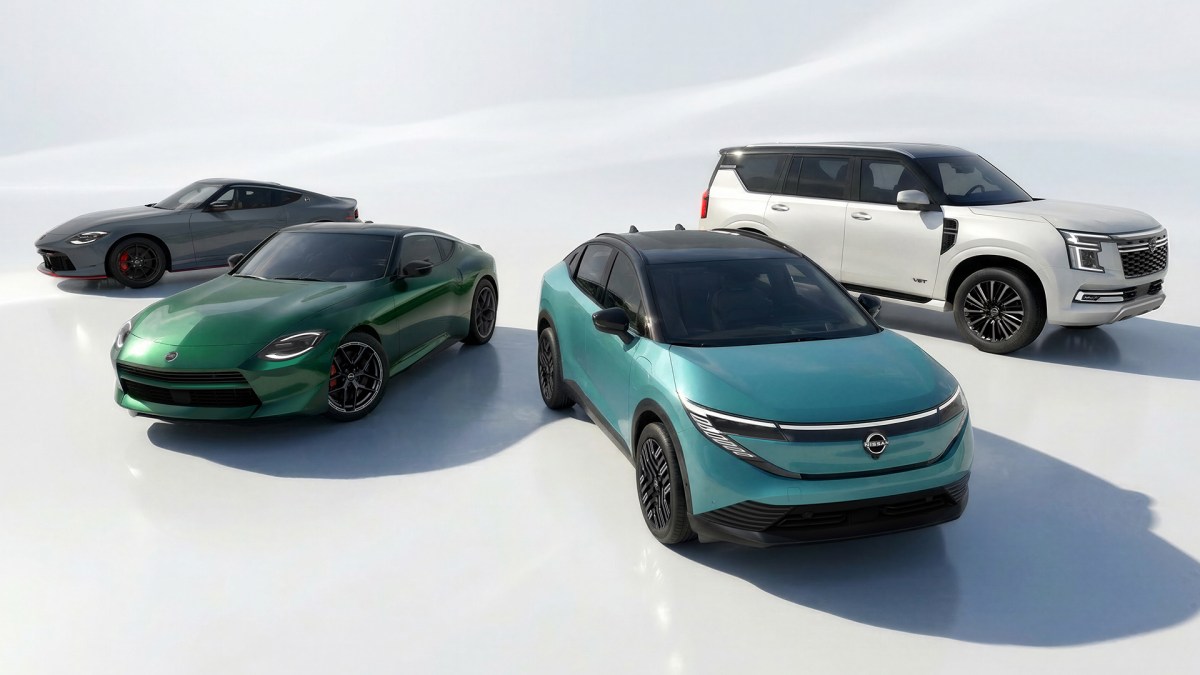
The Drive reports that low-performing models are expected to be cut, but Nissan’s Z and GT-R nameplates are not among them. Instead, they are being explicitly protected under the new Heartbeat grouping. The upcoming Xterra also joins that category as Nissan targets the still-hot off-road market.
This is a notable signal. Performance and halo vehicles can be difficult to justify in narrow financial terms, especially during restructuring. By preserving them, Nissan appears to be saying that some models matter because they define the brand as much as they fill the sales ledger. That is a strategic choice as much as a product one.
The same report says the next-generation GT-R is expected to arrive by 2030 as a hybrid while keeping the VR38 engine block. After that, work on the next-generation Z would begin. Those details point to an incremental rather than purely disruptive electrification approach. Nissan is not presenting hybridization as a clean break from its performance legacy; it is presenting it as a way to extend that legacy under tighter emissions and technology constraints.
The Xterra’s inclusion in the Heartbeat group is also telling. Rather than treat it as a side project, Nissan is positioning the model as one of the vehicles that can help pull attention and market share away from established off-road competitors such as the Jeep Wrangler, Ford Bronco, and Toyota 4Runner.
Shared families are meant to cut cost without flattening the range
The more structural part of Nissan’s plan lies in how future vehicles will be organized. The company intends to group products into families with common platforms, powertrains, and software, a move designed to spread development expense over a broader base. That is standard logic in global automotive manufacturing, but Nissan is now making it central to its turnaround messaging.
In The Drive’s account, Core models are the ones meant to sustain business at scale. The Rogue, also known in some markets as the X-Trail, is cited as the clearest example. It is slated to receive Nissan’s e-Power hybrid system, which uses a gasoline engine as a generator for a battery pack that then powers electric motors driving the wheels.
That detail matters because it shows Nissan is not relying on one electrification formula across the board. Instead, it is matching different technologies to different roles. Halo products can remain emotionally important and, in some cases, hybridized performance machines. Volume products can carry efficiency-focused systems meant to protect global scale.
Growth models, meanwhile, are aimed at market expansion. The article points to a new Juke for Europe as an example, while Partner models appear intended to broaden coverage through collaboration. The upcoming Mitsubishi Montero, described as a reskinned Armada in the report, is presented as the kind of product that could fit that category.
What Nissan’s plan emphasizes
- Reduce overall model count from 56 to 45.
- Protect emotionally important vehicles including the Z, GT-R, and Xterra.
- Use shared families of platforms, powertrains, and software to lower costs.
- Expand hybrid deployment, including e-Power for core models and a hybrid GT-R by 2030.
A reset shaped by market pressure and customer response
The timing of the strategy reflects broader market pressure. Automakers are facing emissions demands, software investment needs, regional product fragmentation, and a competitive environment where electrification decisions can alienate as many buyers as they attract. Nissan’s response appears deliberately mixed: simplify aggressively, but keep certain traditional cues that customers still value.
That balance is important because the company is trying to recover without losing whatever loyalty remains around its strongest identities. Cutting too deeply can save money but weaken the brand. Preserving too much can keep complexity in place. The four-family approach is Nissan’s attempt to navigate between those risks.
The plan also shows how hybridization is becoming a compromise tool rather than a transitional footnote. Nissan is using hybrids to support mainstream efficiency and future performance credibility at the same time. If that works, it could give the company more room than a pure battery-electric push in segments where buyers still want familiar driving character or longer-distance practicality.
There are still open questions. Nissan has described categories and direction, but execution will determine whether the strategy does more than reorganize the slide deck. The real test will be whether the trimmed lineup feels sharper to consumers, whether shared families actually improve margins, and whether protected enthusiast models strengthen the brand rather than simply survive symbolically.
For now, the plan marks a clearer statement of intent than Nissan has offered in some time. The company is not promising to be everything to everyone. It is promising to be smaller, more selective, more hybridized, and more explicit about which products carry its identity. In an industry struggling with complexity, that may be the most important part of the reset.
This article is based on reporting by The Drive. Read the original article.
Originally published on thedrive.com