A luxury sedan from Bugatti’s lost chapter returns to the spotlight
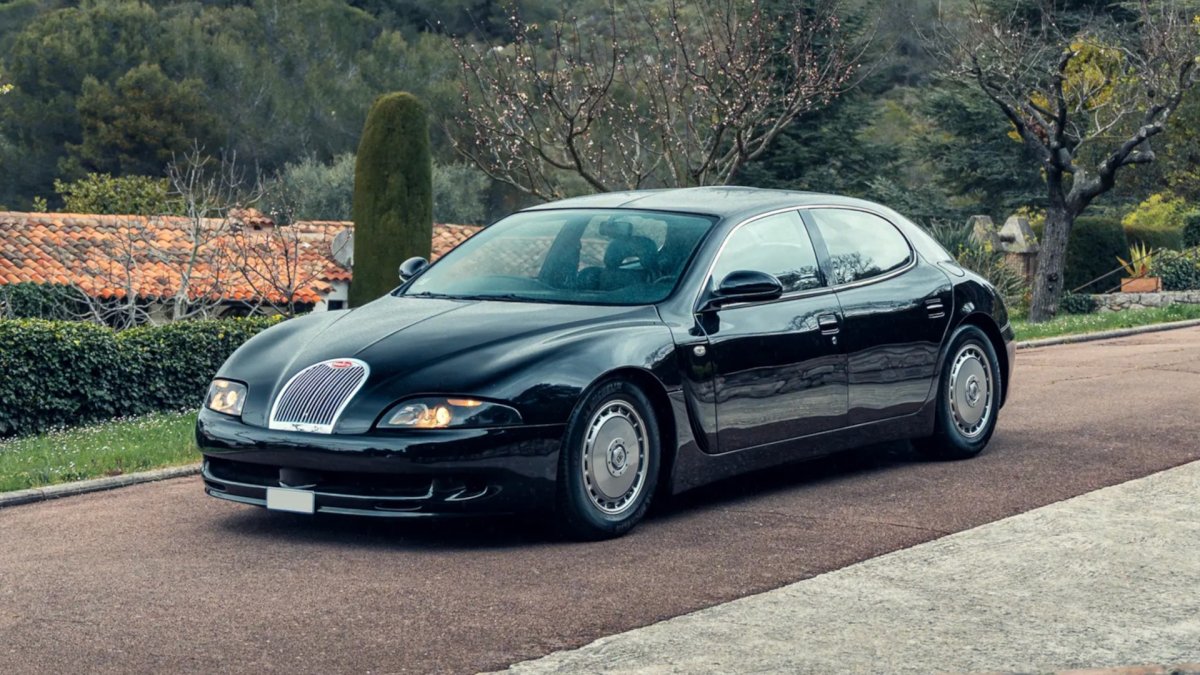
One of the rarest modern Bugattis is heading to auction, and it is not a hypercar. RM Sotheby’s will offer one of just three completed Bugatti EB112 sedans at its 2026 Monaco auction on April 25, reopening a fascinating chapter from the company’s 1990s revival under Italian businessman Romano Artioli.
As The Drive recounts, the EB112 was conceived as a follow-up to the EB110, the ambitious supercar that briefly reestablished Bugatti as a serious performance marque before financial collapse stopped the project short. The sedan never entered production. Instead, only three running examples were ultimately completed, making the EB112 less a failed model than a surviving fragment of an alternate Bugatti history.
Designed as a four-door Bugatti without giving up performance
The EB112 was unveiled at the 1993 Geneva Motor Show and built on a carbon-fiber monocoque derived from the EB110. That connection mattered. Rather than functioning as a detached luxury project, the car carried over core engineering DNA from the company’s halo machine and adapted it to a radically different format: a four-seat sedan with unmistakably high-performance intent.
Its powertrain underscored that ambition. Instead of the EB110’s quad-turbocharged 3.5-liter V12, the EB112 used a naturally aspirated 6.0-liter V12 mounted ahead of the cabin but behind the front axle. According to The Drive, the engine produced 460 horsepower and 435 pound-feet of torque. It was paired with a six-speed manual transmission and all-wheel drive with a 38% front and 62% rear torque split, another carryover in spirit from the EB110.
For a luxury sedan of its era, the performance figures were striking. Bugatti said the car could hit 62 miles per hour in 4.3 seconds and continue to a top speed of 186 mph. Those numbers help explain why the EB112 still feels unusual today. It was not merely an executive car wearing an exotic badge. It was an attempt to build a genuinely fast, technically sophisticated sedan at a time when the high-performance luxury four-door was still a narrower niche than it would become in later decades.
Giugiaro styling and a stronger link to Bugatti heritage
The car’s design also differentiated it sharply from the EB110. The EB112 was shaped by Giorgetto Giugiaro and carried more visible references to Bugatti’s prewar identity. The Drive notes that its pronounced spine and split rear window echoed the Type 57 Atlantic, while its wheels drew inspiration from the Type 41. The classic Bugatti horseshoe grille also returned at a larger, more historically faithful scale than the smaller version used on the EB110.
That styling direction is important because it suggests the EB112 was trying to do more than expand the lineup. It was attempting to define a fuller Bugatti identity, one that could bridge supercar engineering with grand, historically resonant luxury. In retrospect, that idea foreshadowed a strategy many prestige brands would later embrace: using heritage design cues to stretch into new body styles without surrendering performance credibility.
How the car survived Bugatti’s collapse
The EB112’s rarity is inseparable from the collapse that interrupted it. Bugatti completed one drivable prototype, the Geneva show car, and two styling models before shutting down in 1995. A small cache of chassis and parts remained. Monegasque businessman Gildo Pallanca Pastor later acquired the company’s assets and had two complete EB112s assembled from those components.
The example now heading to auction is the second of those two completed cars, which is why it is listed as a 1999 model even though Bugatti itself had already shut down by then. The Drive reports that Pastor occasionally drove it around Monaco before selling it. That unusual provenance only adds to the car’s appeal. It is not simply rare because few were built; it is rare because its existence spans the gap between a failed original manufacturer and the salvage of its unfinished ambitions.

Why the EB112 matters now
RM Sotheby’s expects the car to sell for 1.5 million to 2 million euros, or roughly $1.7 million to $2.3 million at current exchange rates. That estimate reflects more than scarcity. It reflects the growing value collectors place on unrealized branches of automotive history, especially when those branches combine major names, credible engineering, and a story of interruption.
The EB112 stands out because it captures a moment when Bugatti was experimenting with what it could become, not just proving that it could still build an exotic car. The sedan’s engineering, styling, and tiny production run make it a snapshot of a company reaching beyond the supercar template that had brought it back into public view.
In today’s market, where ultra-luxury brands routinely sell high-performance SUVs and four-door grand tourers, the EB112 looks less like an eccentric detour and more like an early draft of a strategy the industry would later normalize. That does not make it less strange. It makes it more historically revealing.
For collectors, the Monaco sale offers a chance to buy one of the rarest expressions of that idea. For the rest of the industry, it is a reminder that some of the most interesting vehicles are not the ones that changed the market, but the ones that arrived too early, disappeared too soon, and still show where the market was eventually going.
This article is based on reporting by The Drive. Read the original article.
Originally published on thedrive.com