The Cost Confession the Industry Didn't Want to Make
Ferrari CEO Benedetto Vigna has put precise numbers to what automotive enthusiasts and user experience researchers have suspected for years: the proliferation of touchscreen interfaces in modern vehicles is driven by cost savings, not customer preference. In an interview with the UK's Autocar, Vigna confirmed that touch controls are roughly 50 percent cheaper to produce than physical buttons and switches — a financial reality that has quietly shaped a decade of automotive interior design regardless of what drivers actually want.
"Touch is something made by, for, the supplier advantage," Vigna said. "Making a touch button is cheaper, 50% cheaper." The candor is unusual from a CEO of a luxury brand, particularly one that has itself leaned into touchscreen-heavy design in recent models.
Why This Matters Beyond Ferrari
The admission has implications well beyond Maranello. For years, automakers have presented the shift from physical controls to touchscreen interfaces as a forward-thinking design choice — a reflection of the digital native consumer who prefers familiar smartphone-like interfaces to the mechanical complexity of traditional dashboards. Consumer research and user experience studies have consistently told a different story.
Multiple independent studies have found that touchscreen interfaces require significantly longer interaction times for common controls like volume adjustment, climate settings, and navigation input compared to physical knobs and buttons. The distraction penalty of glancing away from the road to find an on-screen control — which lacks the tactile feedback that allows buttons to be operated by feel — has been documented in driving simulation research and linked to real-world accident patterns.
The European New Car Assessment Programme began penalizing touchscreen-dependent controls in its safety ratings in 2022, specifically because of the distraction risks. Several automakers have since reversed course, reintroducing physical volume knobs and key climate controls after consumer complaints and safety scrutiny.

Ferrari's Approach Going Forward
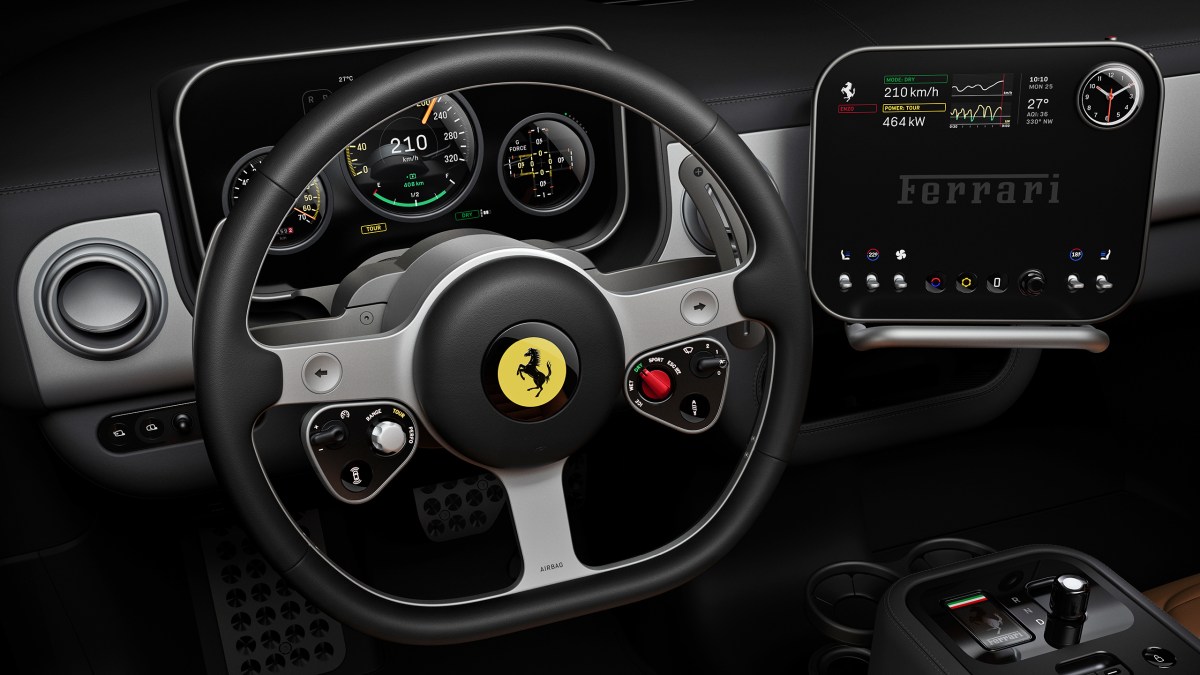
Vigna's comments came in the context of discussing Ferrari's new all-electric Luce, unveiled in February 2026, which features an interior designed with significant input from Jony Ive — Apple's legendary former design chief. Despite hiring arguably the world's most famous touchscreen interface designer, Ferrari has explicitly committed to a phygital design philosophy that combines physical controls with digital augmentation rather than pivoting to an all-digital cockpit.
"We need to do something unique," Vigna said, acknowledging that consistent touchscreen experiences work well for consumer electronics but don't resonate with Ferrari's customers, who expect tactile engagement with their vehicles. The company has already begun reintroducing more interactive cockpits with a mix of physical and digital controls.
The Broader Industry Reckoning
Ferrari's public acknowledgment joins a growing chorus. Hyundai's design chief previously predicted that analog interiors would return within one to two model generations. Volvo recently reintroduced physical climate controls to models that had stripped them following customer feedback. The pattern reflects a tension at the heart of automotive product development: the engineering and supply chain advantages of touchscreen interfaces are real at scale, but so are the user experience and safety costs. As regulators increase scrutiny, the cost calculus driving the touchscreen revolution may be shifting — and Ferrari's CEO has at least made the math visible.
This article is based on reporting by The Drive. Read the original article.
Originally published on thedrive.com