Automotive data has become a deliverable, not a byproduct
For years, the automotive industry treated information as a residue of doing business. Design files, production records, quality logs and procurement histories accumulated quietly in whatever system happened to generate them, and companies pulled them out only when a customer or auditor asked. That era is ending. OEMs and suppliers now face a steady escalation in what they are expected to document: carbon reporting, traceability, circularity and regulatory compliance have all moved from the periphery of corporate reporting into the center of commercial relationships.
The information those demands rely on already exists somewhere across the supply chain. The difficulty is getting it from one organization to another in a form the receiving party can trust, verify and use. Too often, that exchange happens through fragmented systems — a patchwork of portals, spreadsheets, message threads and one-off integrations that each party maintains separately and nobody governs collectively.
Four pressures converging on suppliers
The requirements arriving on suppliers' desks are not unrelated. Each depends on the same underlying capability: the ability to move accurate, verifiable data across company boundaries, geographies and tiers of the supply chain. Consider what each one asks for.
- Carbon reporting. Automakers must account for emissions not just from their own operations but from the materials and components they buy. That pushes suppliers to provide emissions data at a level of granularity that internal accounting systems were rarely designed to produce.
- Traceability. Knowing where a component came from — and being able to prove it — is increasingly a condition of doing business, whether the driver is material provenance, restricted substances, battery content or quality escalation.
- Circularity. As the industry pushes toward recycled content, reuse and end-of-life recovery, suppliers need to document what goes into a part and what can come back out of it.
- Regulatory compliance. Rules governing vehicle content, emissions and disclosure continue to expand, and each new obligation tends to arrive with its own data format and its own deadline.
Handled individually, each of these becomes a discrete project: a separate portal to log into, a separate template to populate, a separate set of credentials to manage and a separate integration to maintain. Multiply that by every OEM a Tier 1 supplier serves and every sub-supplier beneath it, and the administrative burden starts to rival the engineering work.
![Nissan reveals its newest EV, an affordable electric city cruiser with 259 km of range [Images]](https://electrek.co/wp-content/uploads/sites/3/2026/09/Nissan-affordable-Pixo-EV.jpeg?quality=82&strip=all&resize=1200,628)
What Catena-X proposes instead
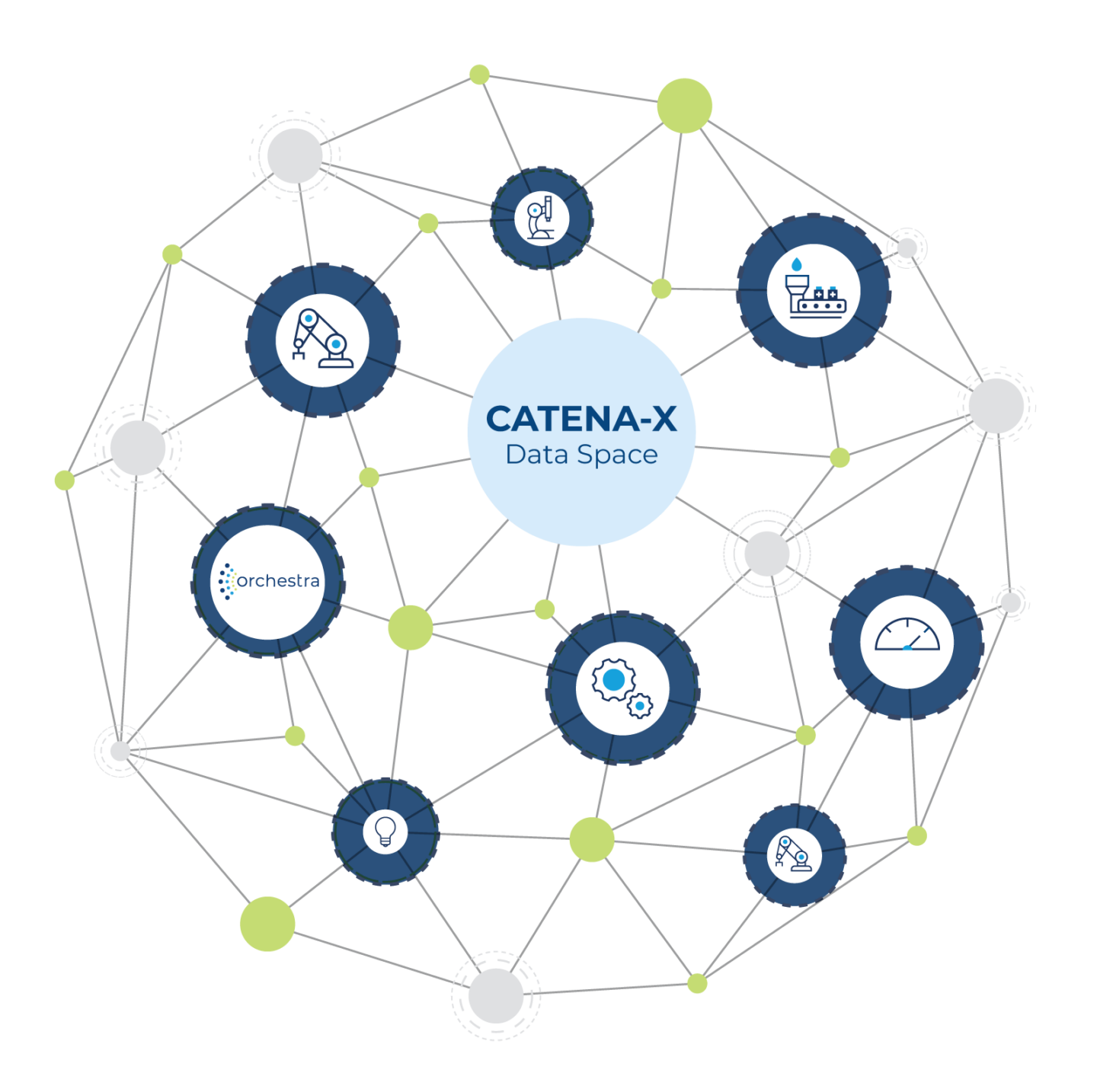
Catena-X is best understood as an automotive data network: a shared framework through which OEMs and suppliers exchange the information their commercial and regulatory relationships require. The premise is that the industry is better served by common rules, standards and interfaces than by a proliferation of proprietary channels — one that every participant adopts rather than one that every participant rebuilds.
That distinction matters commercially. In a fragmented model, the burden of integration scales with the number of relationships a company maintains. A supplier serving five OEMs maintains five connections; a supplier serving twenty maintains twenty. In a network model, participants connect once to a shared set of expectations and reuse that connection across partners. The economics shift from something that grows with every new customer to something closer to constant.
For suppliers, the practical consequence is that participation becomes a baseline expectation rather than a differentiator. OEMs that adopt the network will route requirements through it, which means the question for most suppliers is not whether to engage but how quickly they can.
Why the fragmented status quo is expensive
The cost of the current patchwork is easy to underestimate because it is distributed. It shows up as engineering hours spent building point-to-point integrations, as procurement staff manually reconciling supplier submissions, as quality teams chasing documentation that arrives in incompatible formats, and as audit preparation that consumes weeks of internal effort. None of these appear as a line item called "data exchange," yet collectively they represent a significant tax on every transaction that crosses a company boundary.
There is also a risk dimension. Fragmented exchange creates gaps — moments where data is retyped, translated or summarized by hand. Each gap is an opportunity for error, and each error carries the potential for a compliance finding, a delivery delay or a disputed claim. A shared network does not eliminate that risk entirely, but it removes some of the places where it accumulates.

What global suppliers should be doing now
Because the available source material is limited to the network's framing of the problem, the most responsible guidance is directional rather than prescriptive. Still, several practical steps follow directly from the pressures described.
- Map your data obligations. Identify every customer request for carbon, traceability, circularity and compliance data, and note the format and frequency each one requires. Patterns will emerge quickly.
- Audit your internal sources. Determine whether the data being requested actually exists in a structured, auditable form — or whether it is reconstructed manually each time.
- Track the network's development. Understand what participation would require of your organization, and who internally would own that responsibility.
- Plan for reuse. Prioritize approaches that let one investment in data quality serve multiple customers rather than just one.
The bottom line
Catena-X exists because the automotive industry's data problem has grown too large to solve one relationship at a time. Carbon reporting, traceability, circularity and compliance are no longer optional extras appended to a supplier agreement; they are conditions of participation in the global supply chain. The companies that treat data exchange as infrastructure — rather than as a series of forms to be filled out — will be the ones that absorb those requirements without letting them consume the business.
This article is based on reporting by Automotive News. Read the original article.

Originally published on autonews.com