Acura turns to its origin story for its 40th birthday
Anniversary cars are often designed to do two things at once: celebrate a brand’s history and quietly comment on its present. Acura’s new Integra 40 Racer does both. Built to mark the brand’s 40th birthday in the United States, the car is an explicit tribute to Acura’s first race-car era and a reminder of the identity that helped distinguish it from Japanese luxury rivals.
According to The Drive, Acura launched in the United States on March 27, 1986, with the Legend and the Integra. To commemorate that date, Honda Racing Corporation created the Integra 40 Racer, a homage to the Comptech number 48 car that won consecutive IMSA International Sedan Series manufacturers’ and drivers’ championships from 1987 through 1990.
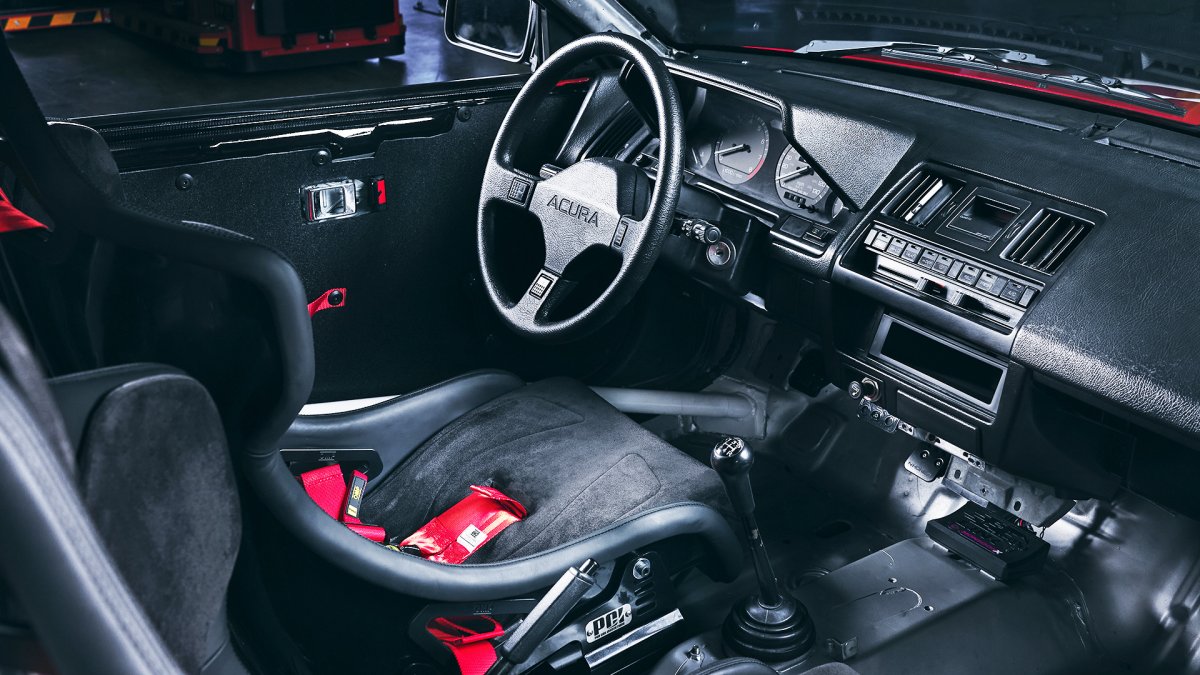
This is not just a heritage paint job. The details matter because the whole point is period character. The Rio Red Metallic hatchback uses the era-correct D16A1 1.6-liter four-cylinder engine, upgraded with a Monsoon ECU and coil-on-plug conversion, and exhaling through a stainless-steel 4-2-1 long-tube header and Borla exhaust system. It is paired with a five-speed manual transmission and a Torsen limited-slip differential.
A race tribute built around analog feel
The rest of the package follows the same logic. Suspension comes from Tein coilovers and an adjustable panhard bar. Steering and brakes are both manual. The wheels are 14-inch, wrapped in Yokohama Advan A050 semi-slick tires. Inside, the car gets a roll cage and racing seats with six-point harnesses.
That specification list matters because it rejects the contemporary tendency to over-filter performance through software and complexity. In place of modern abstraction, Acura is emphasizing mechanical clarity. Manual steering, manual brakes, and a manual gearbox do more than recreate a look. They recreate a relationship between driver and machine that many enthusiasts still associate with Acura’s best years.
That is why the Integra remains such a useful symbol for the brand. The original formula was compact, sporty, and competition-adjacent almost from the start. The Integra did not just give Acura a product. It gave Acura a personality.
Why the Integra still carries weight
The Drive makes the historical point plainly: Acura beat Infiniti and Lexus to market, but chose a two-pronged strategy. While rivals focused more exclusively on traditional luxury, Acura paired the upscale Legend with the small, sporty Integra. Over time, cars such as the Integra Type R and the NSX sharpened that identity further, giving Acura a performance image that felt less formal than its Japanese luxury peers.
The 40 Racer therefore works because it returns to a source that still feels authentic. It is not trying to invent heritage on demand. It is reaching back to a real motorsport story and a nameplate that continues to mean something to enthusiasts.
The car will make its public debut at the Acura-sponsored Long Beach Grand Prix weekend of April 19, which is exactly the sort of venue that reinforces that message. It places the anniversary not in a museum setting, but in a living motorsport environment.
A celebration with a present-tense edge
The problem, and perhaps the reason the tribute feels slightly bittersweet, is that Acura’s current position is less settled than its heritage might suggest. The Drive notes that today’s Integra remains one of the few bright spots in a diminished market for fun-yet-practical cars, and that Acura is still involved at the top level of IMSA racing. But it also says the brand is in a holding pattern.
Honda has canceled its next-generation EVs, including an Acura crossover that would have revived the RSX name. Acura was already lowering EV expectations before that. The article also says the brand is pausing RDX production with a replacement years away, giving up potential sales in the process.
That context changes the tone of the anniversary. The Integra 40 Racer is celebratory, but it also highlights where Acura’s clearest emotional capital still resides: in its performance history, its analog reputation, and the memory of compact sporty cars that felt distinct.
What the birthday car really says
There is nothing wrong with looking backward on a major anniversary. In Acura’s case, it may even be necessary. The brand’s best argument has rarely been sheer luxury scale. It has been a more specific proposition: technical confidence, motorsport credibility, and a willingness to make cars that feel enthusiast-minded without becoming inaccessible.
The Integra 40 Racer expresses that proposition more clearly than a press release ever could. It is small, mechanical, specific, and tied to a genuine competitive legacy. It reminds buyers and fans what Acura looks like when the brand is most itself.
That is useful nostalgia. It is also a challenge to the company’s future planners. If Acura’s sharpest anniversary statement is a lovingly built tribute to 1980s and 1990s identity, then the next chapter will need to show how that identity survives the industry’s current transition. For now, the 40 Racer is a polished reminder that the brand already knows what made it compelling. The harder part is proving it still does.
This article is based on reporting by The Drive. Read the original article.
Originally published on thedrive.com