A deep-space biology test is starting with animals just 1 millimeter long
Long-duration exploration beyond low Earth orbit poses a familiar but unresolved problem: the human body changes in dangerous ways when it leaves Earth’s protective environment. Muscle and bone loss, fluid shifts that can affect vision and exposure to radiation all threaten the feasibility of sustained missions to the Moon and beyond. A new experiment headed to the International Space Station is trying to illuminate those risks by studying a much smaller organism that still shares important biological features with us: the nematode worm C. elegans.
Universe Today reports that a group of these microscopic worms launched to the ISS on April 11 aboard NASA’s Northrop Grumman CRS-24 resupply mission as part of the Fluorescent Deep Space Petri-Pods project, or FDSPP. The effort is led by the University of Exeter, engineered by the University of Leicester, integrated by Voyager Space Technologies and funded by the UK Space Agency. It is a compact experiment with a large ambition: to show how living systems respond when exposed to the combined stress of microgravity and intense cosmic radiation.
The reason scientists keep returning to C. elegans is practical. Even though the worms are tiny, they share a surprising amount of biology with humans and are already widely used in medical research on Earth. That makes them a useful stand-in for early-stage questions about how organisms adapt, or fail to adapt, outside Earth’s protective shell.
The hardware is small, but the environment will be severe
The experiment’s core hardware is a specially designed miniaturized life-support system called a Petri Pod. Each unit measures 10 by 10 by 30 centimeters, weighs about 3 kilograms and contains 12 experimental chambers. Those chambers maintain pressure, temperature and a trapped volume of breathable air for the worms, while an agar carrier provides food.
The engineering challenge is notable because the project is not simply flying biology into orbit and bringing it home. After an initial period aboard the ISS, the Petri Pods are scheduled to be moved by robotic arm to the station’s exterior hull, where they will remain for 15 weeks. Outside the station, the worms will face a much harsher environment, combining microgravity with sustained radiation exposure that is far more relevant to deep-space conditions than an experiment kept entirely inside the pressurized interior.
That external placement is what gives the project much of its value. The ISS is often used as a stepping stone for understanding how life behaves in orbit, but not every orbital environment is the same. A payload placed outside the station experiences a more direct form of environmental stress, and this experiment is designed to capture biological responses under exactly those conditions.
Researchers will monitor glowing biological signals
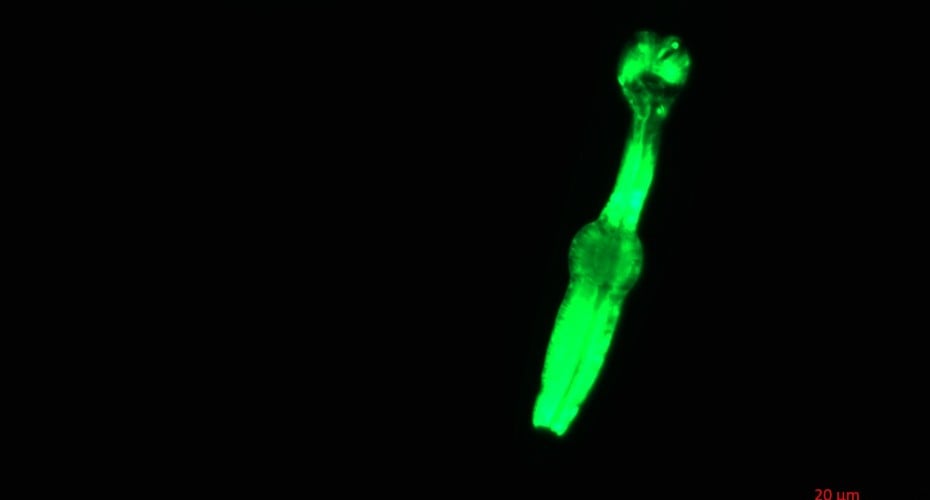
FDSPP is not just exposing worms to extreme conditions and waiting until the end to see what happened. The Petri Pods include four chambers equipped with miniaturized cameras that will capture white-light still images and time-lapse photography. More importantly, the experiment will track the worms’ biological responses using fluorescent signals.
That fluorescence is central to the design because it can reveal how biological systems are reacting over time. Rather than relying only on post-flight analysis, researchers can monitor changes remotely while the experiment is underway. The result is closer to a compact, autonomous space biology lab than a passive sample container.
Universe Today quotes Professor Mark Sims of the University of Leicester, the project manager, describing the device as both interesting and challenging to design and build. That description fits the mission well. The system must preserve life, gather data and survive a hostile environment, all within a very constrained package. Space biology often depends on that kind of engineering compression: shrinking the functions of a laboratory into something that can be launched, operated remotely and trusted to deliver usable data after months in orbit.
Why worms matter for future astronauts
At first glance, sending worms to space can sound like a novelty. In practice, it reflects a standard research logic. Human exploration requires biological understanding, and that understanding usually begins with simpler organisms that can reveal broad patterns of stress response, adaptation and damage. Because C. elegans shares important biological pathways with humans, it provides a workable model for investigating how living tissue responds outside Earth’s normal protections.
The experiment is also well matched to the future missions it is implicitly trying to support. Living long-term on the Moon, as Universe Today notes, means coping with a damaging environment rather than simply visiting space briefly. The farther humans move from Earth, the more urgent it becomes to understand how bodies change in reduced gravity and under chronic radiation exposure. If researchers can identify the biological mechanisms involved, they may be better positioned to develop countermeasures for astronauts.
The FDSPP mission does not promise those countermeasures on its own. What it offers is a clearer view into the problem. That is valuable because deep-space habitation is still constrained as much by biology as by rockets and habitats. A mission architecture may look credible on paper, but if the human body cannot tolerate the environment for long enough, the architecture remains incomplete.
A modest mission with outsized relevance
Space exploration stories often focus on launch vehicles, landers and crew timelines. The worm mission aboard CRS-24 highlights a quieter reality: progress toward long-duration exploration also depends on disciplined, highly specific biology experiments. The Petri Pods are small, the organisms inside them are smaller still, and yet the questions they are being asked to help answer are among the biggest in human spaceflight.
How do living systems handle long exposure to deep-space-like conditions? What breaks first? What adapts? What warning signals appear early enough to matter? Those are the kinds of questions the FDSPP team is trying to approach by putting C. elegans on the outside of the ISS and watching their fluorescent responses unfold.
If future lunar explorers end up benefiting from better countermeasures against radiation or microgravity-related damage, some of that progress may trace back to these tiny passengers. The worms are not the destination. They are a tool for understanding what it will take for humans to survive when Earth is no longer close enough to shield them.
This article is based on reporting by Universe Today. Read the original article.
Originally published on universetoday.com