Observations of 2002 XV93 challenge assumptions about small icy worlds
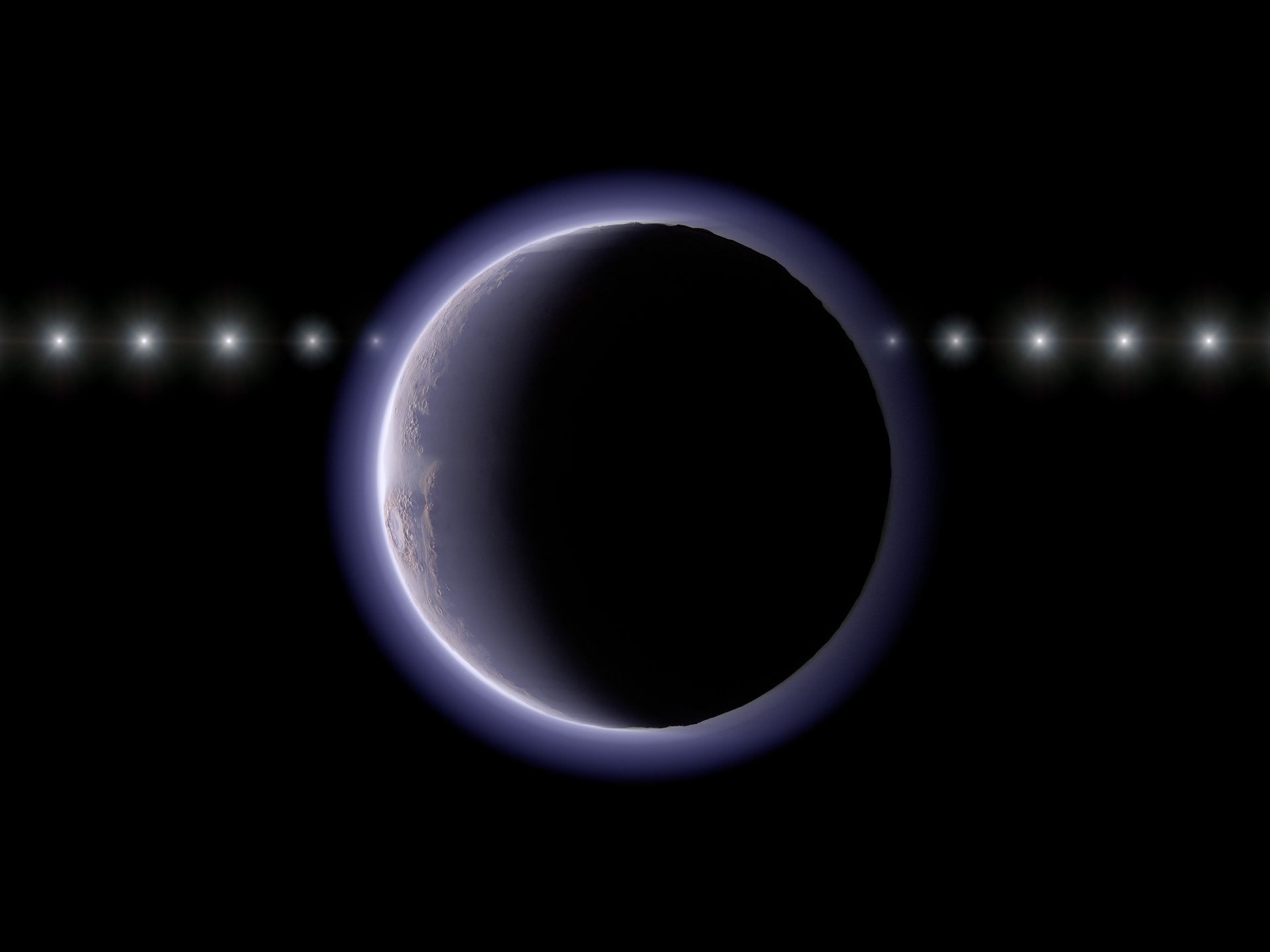
Astronomers have reported evidence that a small object beyond Neptune may possess a thin atmosphere, an unexpected result that could complicate long-standing ideas about which worlds in the outer solar system are capable of holding gas. The object, known as 2002 XV93, is less than a quarter of Pluto’s size, yet a Japanese research team says observations made during a stellar occultation are consistent with a faint atmospheric layer surrounding it.
The finding comes from observations of 2002 XV93 passing in front of a background star in January 2024. As the object moved across the star, researchers found that the starlight gradually dimmed before the star fully disappeared behind the body. That pattern suggested the light was passing through a layer of gas rather than being cut off sharply by a bare solid edge. The work was led by Ko Arimatsu of the National Astronomical Observatory of Japan and has been described in Nature Astronomy.
What makes the result notable is not only the possible presence of an atmosphere, but the apparent mismatch between that atmosphere and the object’s size. Based on estimates cited in the source material, 2002 XV93 should not have enough gravity to retain such a gaseous envelope for long, perhaps not even for more than about 1,000 years. In planetary terms, that is effectively transient. Yet the observation suggests gas is there now, or at least was present during the occultation event.
A puzzle from the edge of the solar system
2002 XV93 resides in the Kuiper Belt and follows an elliptical orbit beyond Neptune. Like Pluto, it is in orbital resonance with Neptune, a configuration that helps keep its path relatively stable over long timescales. But orbital stability does not solve the atmospheric problem. Small icy bodies are generally expected to lose volatile gases unless they are massive enough, cold enough, or actively replenishing those gases from internal or external processes.
That is why the follow-up observations matter. According to the source text, NASA’s James Webb Space Telescope did not find evidence of frozen gases on the object’s surface. That absence pushed the researchers toward more dynamic explanations. One possibility is that gas is being released by cryovolcanism, with ice volcanoes venting volatile material from below the surface. Another is that a cometary impact recently liberated gas that will dissipate over time.
Neither explanation has been confirmed. The source says the spectral signature of the filtered light would be consistent with nitrogen, methane, or carbon monoxide, all compounds associated with Pluto’s atmosphere. But the composition has not yet been independently verified, and more observations will be required to determine whether the atmosphere is stable, episodic, or perhaps the product of a singular recent event.
Why the claim matters
The broader significance lies in classification. Planetary science has tended to associate global atmospheres in the outer solar system with larger bodies that possess enough gravity and volatile inventory to maintain them. If 2002 XV93 truly has a stable atmosphere, especially one maintained through ongoing venting, then the size threshold for atmospheric worlds may need revision. That is exactly the implication highlighted by the researchers in the source material.
A shift like that would have consequences beyond a single object. The Kuiper Belt contains a large population of icy bodies that remain poorly characterized. If some of them can temporarily or persistently support thin atmospheres through cryovolcanism or impact-driven release, then the outer solar system may be more chemically and geologically active than many simplified models suggest. Such bodies would no longer be treated purely as frozen remnants, but as systems with evolving surface-atmosphere interactions.
The discovery would also reinforce the value of stellar occultation measurements, which can reveal details too subtle for direct imaging alone. In this case, the gradual dimming of starlight provided the crucial clue. That is a reminder that some of the most important advances in planetary science still come from careful geometry and timing, not just from flagship imaging campaigns.
Verification is the next step
At present, this is an intriguing and potentially important claim, not a closed case. The source includes outside commentary from Alan Stern, principal investigator of NASA’s New Horizons mission, who called the development amazing while stressing the need for independent verification. That is the correct posture for a result with broad implications and limited direct evidence so far.
There is also a productive tension between the two current hypotheses. If cryovolcanism is responsible, 2002 XV93 may possess a degree of internal activity not usually assigned to an object of its size. If impact release is the cause, the atmosphere could be fleeting, and astronomers may have captured an unusually timely event. Both possibilities are scientifically valuable, but they point to very different underlying physics.
For now, 2002 XV93 joins the growing list of outer solar system objects that resist simple categorization. Pluto once forced a reconsideration of what a distant icy world could be. This smaller body may now be hinting that even worlds far below Pluto’s scale can still surprise observers with atmospheric behavior. Whether that surprise becomes a new class of object or a rare exception will depend on what the next round of observations reveals.
- A stellar occultation suggests Kuiper Belt object 2002 XV93 may have a thin atmosphere.
- The object appears too small to retain gas for long under standard expectations, creating a major puzzle.
- Researchers have proposed cryovolcanism or a cometary impact as possible sources, but independent verification is still needed.
This article is based on reporting by Universe Today. Read the original article.
Originally published on universetoday.com