Black holes may have a stranger afterlife than expected
Black holes are often treated as the ultimate one-way objects: matter crosses the event horizon and never returns. That picture comes from general relativity, which describes black holes as classically permanent features of spacetime. But quantum physics has long complicated that story. Hawking radiation implies that black holes can slowly lose mass and eventually evaporate.
A recent theoretical study discussed by Universe Today pushes that quantum story further. The work examines the minimum lifetime of a black hole using assumptions that remain semiclassical far from the event horizon while allowing for more complicated quantum behavior near it. The result is a new lower bound on black hole lifetime and a suggestion that, late in their existence, black holes could enter a metastable stage in which they behave in ways that resemble white holes.
Why Hawking’s original picture is incomplete
Stephen Hawking’s original calculation showed that black holes radiate and therefore do not live forever. Very roughly, quantum effects let particles escape, causing the black hole to lose mass. Smaller black holes radiate faster, so the evaporation process accelerates over time.
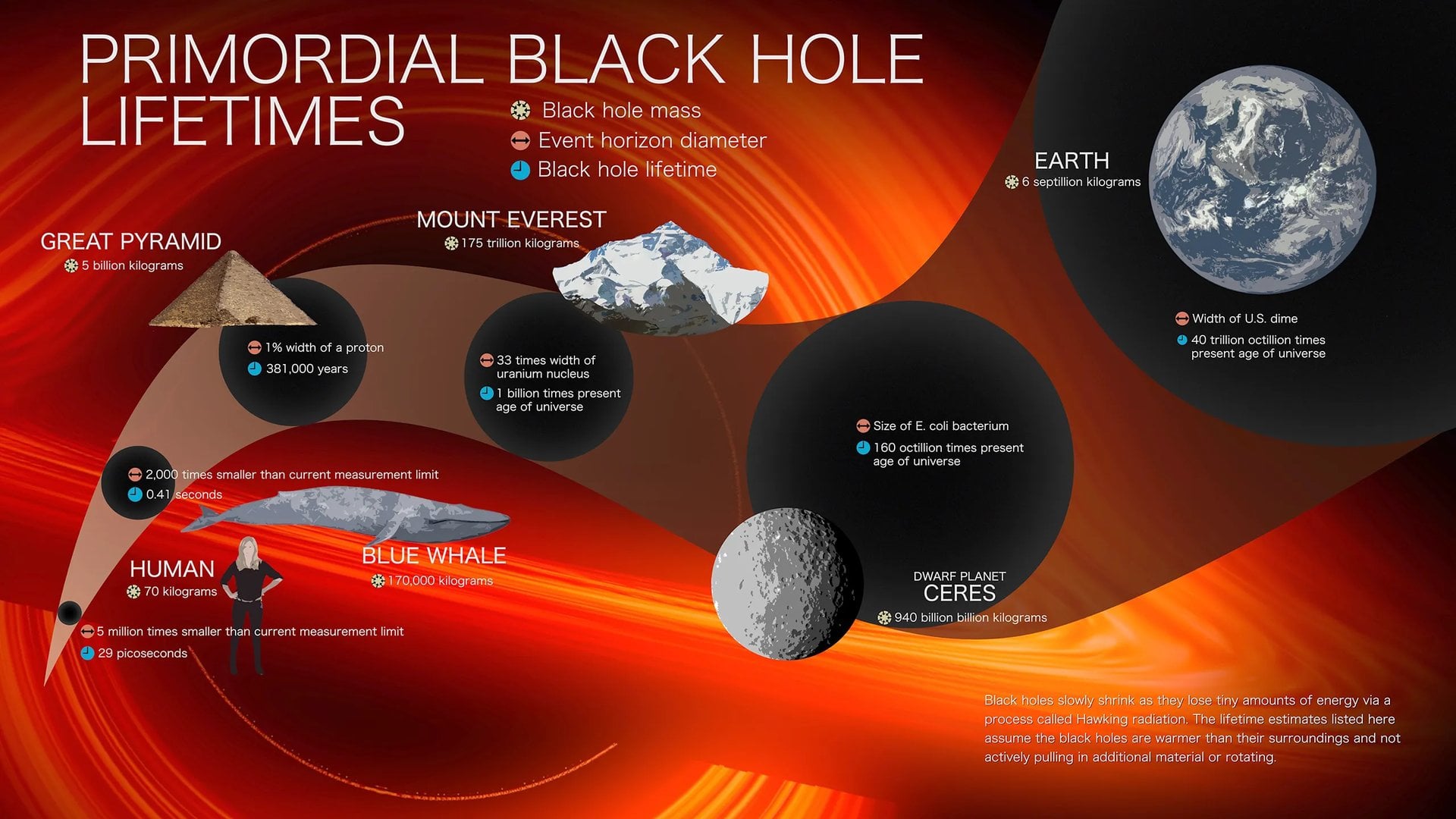
But Hawking’s result is semiclassical. It assumes the quantum correction is small enough that classical spacetime still provides the dominant backdrop. That assumption becomes more questionable as the black hole mass gets very small. For ordinary astrophysical black holes, this is not much of a practical problem because their lifetimes are staggeringly long. For primordial black holes, however, the issue becomes more significant, because their masses could be much smaller and their lifetimes matter to broader questions in cosmology.

What the new work claims
The study described in the source starts from two assumptions: that spacetime remains asymptotically semiclassical far from the black hole, and that the effects of entanglement entropy fade over time. With those conditions, the authors derive a minimum lifetime scaling of at least M4 divided by h-bar to the three-halves power for a black hole of initial mass M.
That result is presented as surprisingly simple. More importantly, it establishes that the end-stage behavior of an evaporating black hole may not be just a sudden disappearance. The study also argues that black holes could evolve into a metastable configuration that looks similar to a white hole.
White holes are the time-reversed conceptual counterparts of black holes: objects from which matter and energy could emerge rather than only fall in. They have long occupied a speculative corner of gravitational theory, but they are not part of mainstream observational astronomy. The interest here is not that astronomers have found white holes, but that quantum-gravity-inspired models may produce late-stage objects with white-hole-like properties.
Why primordial black holes matter in this debate
The discussion has particular relevance for primordial black holes, hypothetical objects that may have formed in the early universe and that have sometimes been proposed as possible contributors to dark matter. Because these black holes could start with much lower masses than stellar black holes, any revision to lifetime estimates could affect how researchers think about their abundance and cosmic role.
The study does not settle whether primordial black holes make up dark matter. It does, however, show why the lifetime question is not academic bookkeeping. If black holes survive longer than simpler evaporation estimates suggest, their imprint on cosmic evolution may also differ from older expectations.
What this changes, and what it does not
The work remains theoretical and, as presented in the source, is posted on the arXiv. That means it belongs in the category of provocative physics rather than established observational fact. Still, it sharpens a long-running question: what really happens when quantum effects become too important for classical black hole pictures to hold?
The study’s value is that it tries to answer that question without assuming full knowledge of quantum gravity, which physicists still do not possess. By working from broader constraints, it offers a lower bound on lifetime and a path toward white-hole-like end states.
If that picture survives further scrutiny, the final chapter of a black hole may look less like a clean fade-out and more like a transition into something stranger and longer-lived. That would not overturn Hawking radiation. It would deepen it, suggesting that evaporation may be only part of the story of how black holes end.
This article is based on reporting by Universe Today. Read the original article.
Originally published on universetoday.com