A Smaller Alphabet for a Bigger Question
One of the hardest problems in science is also one of the oldest: how nonliving chemistry on early Earth gave rise to biology. A new review paper highlighted by Universe Today approaches that question through a surprisingly practical route. Instead of trying to reconstruct all the complexity of modern proteins, researchers are testing whether much simpler versions could have folded, functioned, and endured under prebiotic conditions.
The paper, titled The borderlands of foldability: lessons from simplified proteins and published in Trends in Chemistry, focuses on what are called simplified proteins. The core premise is straightforward. Modern proteins are built from 20 distinct amino acids, but early Earth likely did not offer that full toolkit. If the first peptides and proteins had access to only a smaller subset, then the emergence of life may have depended on far less biochemical information than modern organisms require.
Why Modern Biology May Be Misleading
Proteins in living systems today are highly complex molecules whose shapes are central to their function. They fold into three-dimensional structures that enable everything from catalysis to structural support. Looking backward from that complexity can create a misleading picture of how difficult the first steps had to be.
The review argues that the earliest peptides were probably short and simple, made from amino acids either present naturally in the environment or generated by extremely primitive metabolism. Researchers cannot recover fossils of ancient proteins to confirm that directly, but the paper treats it as a reasonable starting point for experimental work.
That is where “alphabet reduction” comes in. Scientists rebuild proteins using restricted alphabets of roughly seven to 14 amino acids rather than the standard 20. The goal is not to create crude approximations of modern biology. It is to test whether a simpler chemical vocabulary could still produce ordered, functional structures.
Folding With Fewer Ingredients
The results described in the review are striking. Scientists have managed to build proteins that fold into stable 3D structures while excluding entire classes of more complex building blocks. In other words, much of the architectural logic needed for protein formation appears not to depend on the full modern set of amino acids.
That finding matters because it lowers the apparent barrier to life’s emergence. If a “prebiotic” alphabet of around ten amino acids is enough to get structured proteins off the ground, then early Earth would not have needed to solve the modern protein problem all at once. It only needed enough chemistry to produce molecules capable of organizing themselves into useful forms.
The review presents this as evidence that the core architectures required for biology may arise from surprisingly limited information. That does not explain the full transition from chemistry to life, but it narrows one of the gap’s most intimidating dimensions.
An Old Hypothesis Gains Experimental Support
The source text points to a well-known 1966 proposal from Richard Eck and Margaret Dayhoff, who suggested that ancient symmetric proteins could have formed through duplication and fusion of short, simple peptides. Modern work now appears to support that idea in practice.
Researchers have observed simple peptides “homo-oligomerize,” effectively snapping together into symmetric and functional proteins. The image is important because symmetry offers a plausible shortcut. Early systems may not have needed long, precisely encoded sequences from the beginning. Repeating small modules could have been enough to create structures with genuine capability.
That view gives origin-of-life research a more incremental model. Instead of imagining a sudden leap from random chemistry to highly refined proteins, scientists can explore how modest assemblies of short peptides might have accumulated function over time.
The Environment May Have Been Part of the Machinery
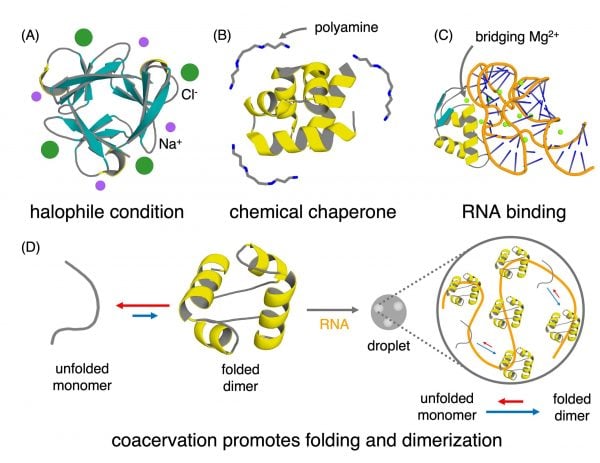
The review also emphasizes that early proteins would not have emerged in isolation. The surrounding environment may have actively helped them survive and fold. That is a critical shift in perspective. In modern biology, cells tightly control internal conditions. On early Earth, by contrast, minerals, salts, surfaces, and local chemical settings may have acted as scaffolding or stabilizers.
If that is correct, the first useful proteins may have been simpler not only because their amino acid alphabet was smaller, but also because the environment was doing part of the work. A peptide that seems marginal in a modern laboratory context might have behaved very differently in a supportive prebiotic niche.
This environmental angle broadens the significance of simplified protein studies. They are not just about what sequence information is necessary. They are also about what chemistry becomes possible when molecules and setting are treated as one system.
Why It Matters Beyond Earth
Research like this has clear astrobiological value. If life can begin with a smaller biochemical toolkit than once assumed, then the range of worlds worth investigating may expand. Scientists searching for biosignatures or habitable environments do not necessarily need to look for places that reproduce every detail of modern terrestrial biology.
Instead, they can ask whether other worlds offer conditions where simple peptides might form, assemble, and persist. The path to life may not require the full sophistication seen in contemporary cells. It may begin in the borderlands, where limited chemistry is still enough to generate order.
That is why simplified proteins are such a useful idea. They reduce one of science’s grandest questions into experiments that can be done now. By stripping biology down to a smaller alphabet, researchers are discovering that the distance between chemistry and life may have been shorter than it looks from the vantage point of the present.
- Researchers are testing proteins built from reduced amino acid sets of roughly seven to 14 building blocks.
- The review argues that around ten amino acids may have been enough to support early protein architectures.
- Experiments show simple peptides can assemble into symmetric, functional proteins.
- Early Earth environments may have helped primitive proteins fold and persist.
This article is based on reporting by Universe Today. Read the original article.
Originally published on universetoday.com