A New Federal Release Pushes UAP Transparency Back Into the Spotlight
The Pentagon has released a fresh batch of files related to unidentified anomalous phenomena, or UAP, opening a new phase in the U.S. government’s long-running effort to make more records on the subject public. The release includes images, reports, videos, and transcripts spanning decades, with some material tied to NASA’s Apollo moon missions and even a Gemini-era transcript from 1965.
The documents were posted through what the source describes as the Trump administration’s Presidential Unsealing and Reporting System for UAP Encounters, or PURSUE. The Department of Defense said additional files would follow on a rolling basis, suggesting that this is not a one-off disclosure but the beginning of a broader archival effort.
That matters because the politics of UAP disclosure have shifted from fringe fascination to a more formal question of government transparency. The newest release does not prove extraordinary explanations for reported sightings. What it does show is that Washington now sees continued disclosure itself as politically valuable and institutionally necessary.
What Is in the Release
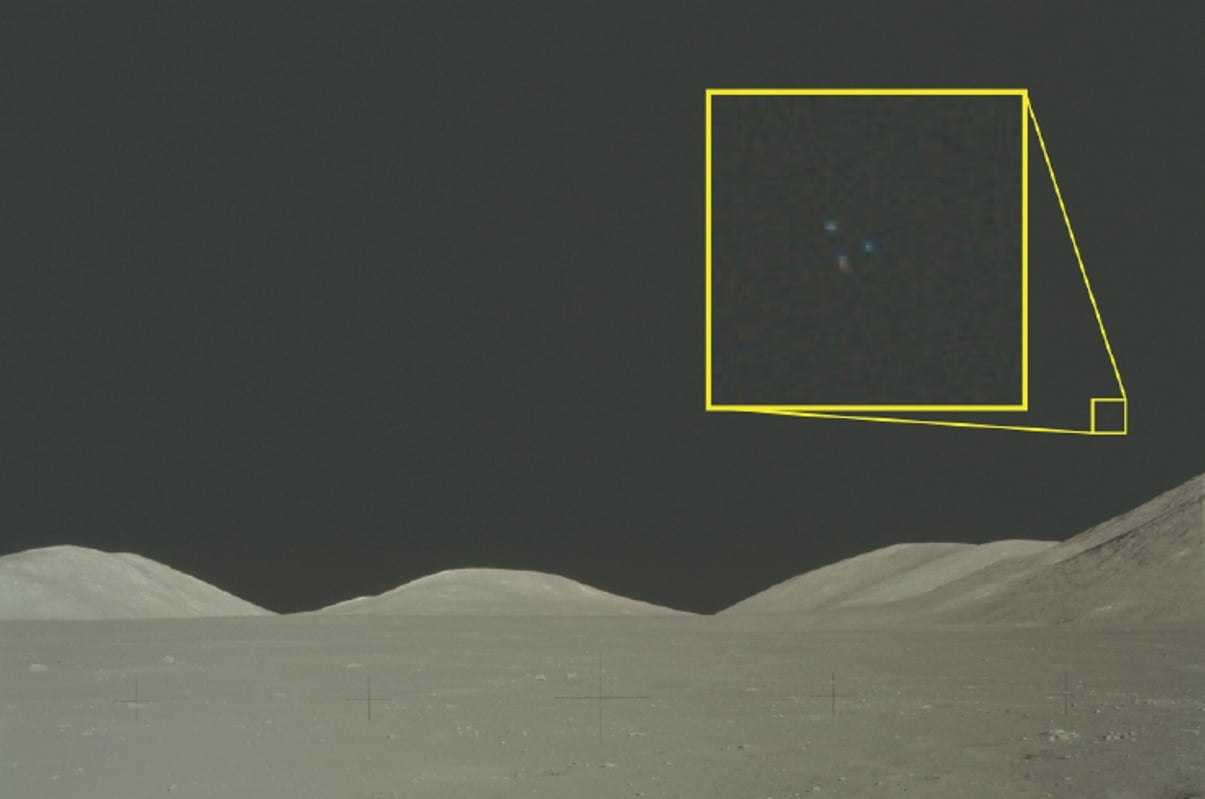
According to the supplied source text, the batch contains 161 files. Most are reports, photos, and videos tied to military missions, with cases stretching back to the 1940s. Among the most attention-grabbing items are pictures from Apollo 12 in 1969 and Apollo 17 in 1972, with enlarged sections highlighting bright spots or streaks visible in the sky.
The release also includes a transcript from the Gemini 7 mission in 1965 in which astronaut Frank Borman describes a “bogey” and a debris field made up of “hundreds of little particles.” Other materials reportedly include State Department cables as well as FBI photos and case files, broadening the collection beyond strictly military reporting.
One 2020 report cited in the source describes a military operator observing “a line of dots followed by a trailing dot.” On their own, those records do not settle what was seen. But they do illustrate the mix of historical artifacts and contemporary operational reports that the archive is beginning to assemble in one place.

Why the Apollo Connection Draws So Much Attention
The Apollo-era references are likely to dominate public discussion because they connect UAP interest to one of the most mythologized periods in American spaceflight. Any suggestion of unexplained observations during lunar missions is almost guaranteed to amplify public curiosity, regardless of whether the material ultimately points to visual artifacts, debris, camera effects, or something more difficult to classify.
Still, the significance here is not that the documents confirm sensational claims. The significance is that the Pentagon is willing to publish material linked to iconic missions that have long occupied a special place in popular imagination. That choice indicates a more expansive conception of disclosure, one that includes records likely to drive public engagement as well as those tied to routine military reporting.
It also blurs the line between national security transparency and cultural history. Once Apollo-related images enter a UAP archive, they stop being just obscure mission-era curiosities and become part of a larger public argument about what the government has documented, what it has withheld, and how it interprets unexplained observations across decades.
The Politics Around Disclosure Are Becoming Clearer
President Donald Trump praised the release publicly, framing it as a corrective to what he described as years of inadequate transparency. Defense Secretary Pete Hegseth likewise said his department was aligned with the White House in expanding public access to the federal government’s UAP archive.
But the source also notes that the current push builds on earlier work. Pentagon transparency efforts around UAP increased in 2020, and Congress required more systematic disclosure in 2022. That context is important. The present release may be politically branded by the current administration, but it is also part of a longer, bipartisan institutional shift in how reported anomalies are handled.
That continuity helps explain why lawmakers from outside the administration welcomed the release. Senator Kirsten Gillibrand, a Democrat from New York, said she had spent years pressing for declassification and public access to UAP records and was encouraged to see unsealing finally begin. Her reaction underscores that disclosure has become a durable policy issue, not just a messaging exercise for one political faction.
Transparency Does Not Equal Explanation
One of the central risks in any UAP document release is that publication can be mistaken for validation. A photo, transcript, or pilot report may show that an event was recorded without establishing what caused it. The source text hints at this tension through the reaction of Mick West, a retired engineer known for analyzing UAP reports, who characterized the release as a mix of old documents, newer pilot reports, and some new videos.
That framing is useful because it shifts attention away from spectacle and toward evidence quality. A growing archive can improve public access and give researchers more material to examine, but it does not automatically transform ambiguous observations into solved cases. In many instances, the result of disclosure may simply be a better documented uncertainty.
Even so, better documented uncertainty has value. It allows outside analysts, journalists, lawmakers, and the public to assess what has been observed and how those observations were recorded. In a field dominated for decades by rumor, secrecy, and selective leaks, that alone is a meaningful institutional change.
What This Release Really Signals
The biggest takeaway from the new UAP archive is not that the government has revealed definitive answers. It is that the government now appears committed to a more visible process of release. That process pulls military reports, Cold War-era records, and space-mission materials into a common public frame and invites scrutiny that would have been much harder a few years ago.
If future batches continue, the archive could become an increasingly important record of how the U.S. state has perceived, categorized, and debated unexplained sightings over time. Some files may turn out to be mundane. Others may remain unresolved. Either way, the historical and political importance of the archive is likely to grow as more material arrives.
- The Pentagon says additional UAP files will be released on a rolling basis.
- The current batch spans decades and includes military, FBI, State Department, and NASA-linked materials.
- Apollo- and Gemini-era records are likely to intensify public interest.
- The release reflects a broader transparency trend that predates the current administration.
For now, the newly opened archive offers something rare in the UAP debate: more primary material and fewer excuses for speculation detached from records. That does not end the mystery. It does change the terms on which the mystery is argued.
This article is based on reporting by Universe Today. Read the original article.

Originally published on universetoday.com