A familiar asteroid mystery just became more complicated
Jupiter’s Trojan asteroids have long been treated as valuable clues to the early solar system, but a new study suggests the smaller members of that population may not behave the way astronomers expected. Universe Today reports that researchers in Japan examined small Trojan asteroids and found that they do not display the same clear color split seen in larger objects. Instead of resolving a longstanding question, the result appears to have created a new one.
The older puzzle is straightforward in outline. Among larger Trojan asteroids, astronomers have identified two broad color groupings: “red” and “less red.” Those labels are not cosmetic. They are linked to different asteroid types and, by implication, to different surface compositions or histories. Red Trojans are typically associated with D-type asteroids, which are described in the source text as extremely dark and thought to be rich in complex organic molecules. Less red Trojans are more likely to be P-type or C-type, although the text notes that P-types may have more in common with D-types than C-types do, apart from their distinctly less red spectral slope.
Because Trojans are often treated as time capsules from the solar system’s formative era, this color distinction matters. If large asteroids separate cleanly into different spectral groups, that can hint at differences in origin, composition, or environmental processing. The expectation might be that smaller members of the same population would preserve some version of that pattern. The new work suggests otherwise.
What the researchers did
Studying small Trojan asteroids is technically difficult. Universe Today notes that one major challenge is rotation. Smaller asteroids tend to spin quickly, and astronomers need images taken in different wavelengths to build up an accurate spectral profile. If the asteroid rotates too much between exposures, the data can effectively sample different sides of the object and distort the final picture.
To address that problem, the researchers used the final run of the Suprime-Cam instrument on the 8.2-meter Subaru Telescope in Hawaii. According to the source text, Suprime-Cam offered one advantage especially relevant to this project: it could change filters faster than its successor, Hyper Suprime-Cam. That shorter filter-switching time reduced the amount of asteroid rotation between observations, improving the odds of obtaining cleaner color measurements from fast-spinning small bodies.
The team identified 120 small Trojan asteroids and narrowed that set to 44 unbiased samples ranging from roughly 3 kilometers to around 16 kilometers in diameter. That size range is important because it pushes the investigation into a part of the Trojan population that is harder to characterize than the larger objects that have historically defined the red-versus-less-red discussion.

The unexpected result
The central finding, as described by Universe Today, is that smaller Trojans do not show the same clear color-coding seen in larger ones. That is the opposite of what a simple extension of the larger-asteroid picture might lead observers to expect. Rather than cleanly dividing into the familiar red and less-red populations, the smaller objects appear to break that pattern.
That creates a fresh scientific problem. If the color split is real and robust among larger Trojans, why does it fade or disappear among smaller ones? The source text presents this not as a solved issue but as a genuine new question raised by the data. That is often how progress works in planetary science: a study designed to explain one anomaly ends up exposing another layer of complexity.
It is also a reminder that size may matter in ways that are not trivial. Smaller asteroids can have different collisional histories, different surface renewal processes, or different observational biases acting on them. The supplied source text does not specify which explanation is most likely, so it would be inappropriate to choose one. But the finding itself is enough to challenge the idea that the Trojan population can be understood through a single simple compositional split applied across all size scales.
Why Trojan asteroids matter so much
Trojan asteroids occupy unusual positions in space, sharing Jupiter’s orbit while clustering ahead of and behind the planet. Their dynamical stability and presumed antiquity make them attractive targets for researchers trying to reconstruct the conditions of the early solar system. If these bodies have preserved ancient material or ancient signatures of formation, then sorting out their spectral properties can help scientists test ideas about where they formed and how they evolved.
That is why color categories have drawn such interest. Spectral slopes are not merely descriptive labels; they are observational clues tied to surface composition and environmental history. A well-defined split among large Trojans invites theories about multiple source regions or divergent evolutionary paths. A weaker or absent split among smaller Trojans forces those theories to account for scale in a more precise way.
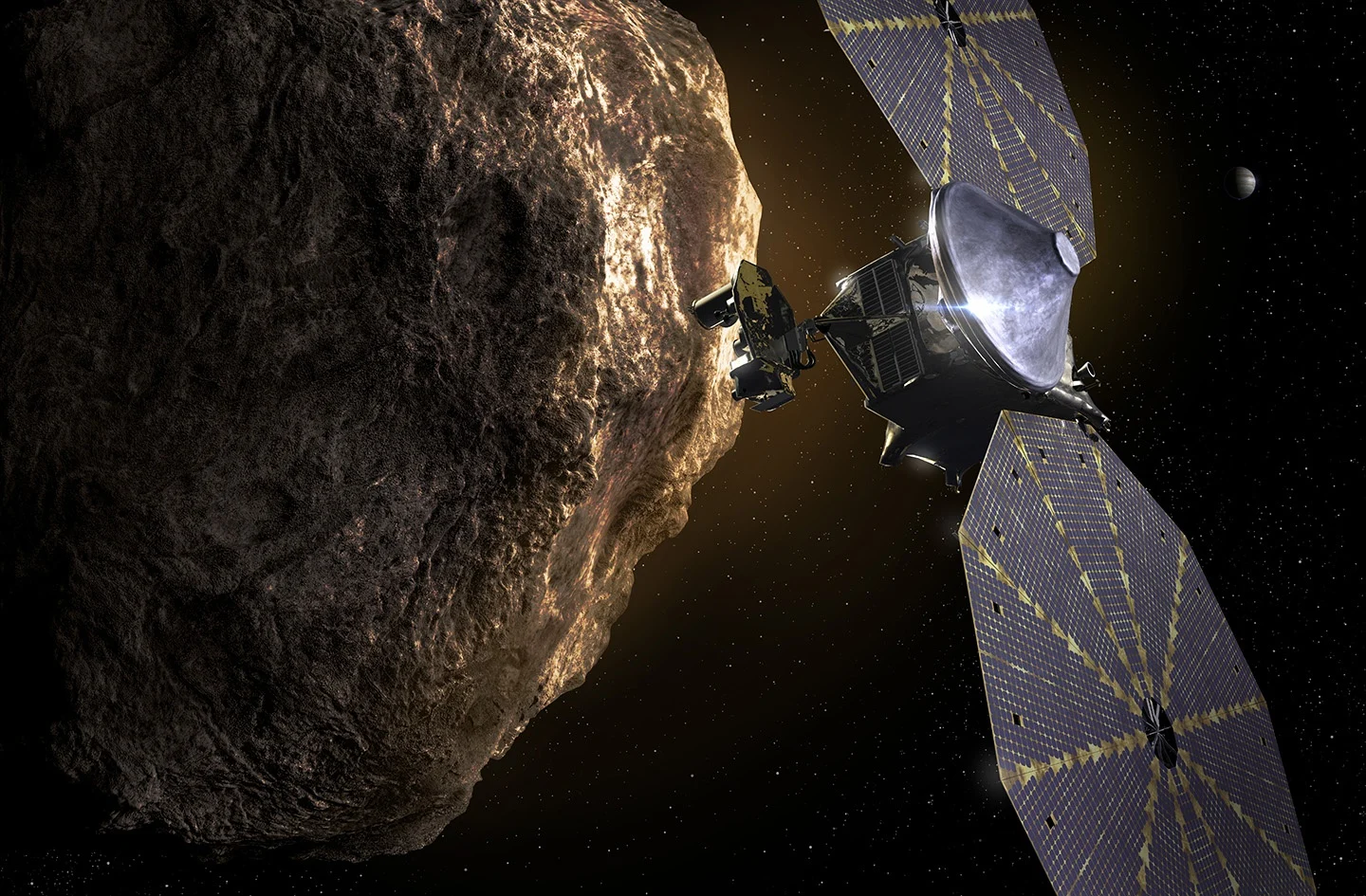
The timing is also notable because NASA’s Lucy mission has increased attention on Trojan asteroids as a class. Universe Today’s illustration reference to Lucy underscores the broader context: direct spacecraft exploration and improved ground-based observations are together turning these once-remote objects into a more active field of inquiry. A study that complicates the Trojan color story therefore lands at a moment when the scientific community is especially interested in what these asteroids can reveal.

A stronger puzzle, not a weaker one
There is a tendency to think of scientific progress as a steady reduction of uncertainty, but this study is a good example of how discovery can expand the problem space. The researchers set out to investigate a known mystery about Trojan colors. Instead of simply fitting small asteroids into the established red and less-red framework, they found evidence that the smaller bodies resist that neat categorization.
That result does not make the Trojan story less valuable. It makes it richer. If small and large members of the same broad population differ in their observed color behavior, then models of Trojan origins, surface chemistry, or collisional evolution may need refinement. The key point supported by the source material is that the old pattern is no longer sufficient on its own.
For now, the study’s main contribution is to sharpen the question. Large Trojans show a conspicuous color division. Smaller Trojans, at least in this sample, do not. Explaining that mismatch may turn out to be one of the more useful paths toward understanding what these asteroids are made of and what they can still tell us about the solar system’s beginning.
This article is based on reporting by Universe Today. Read the original article.
Originally published on universetoday.com