The Letters of Life, Found in Space
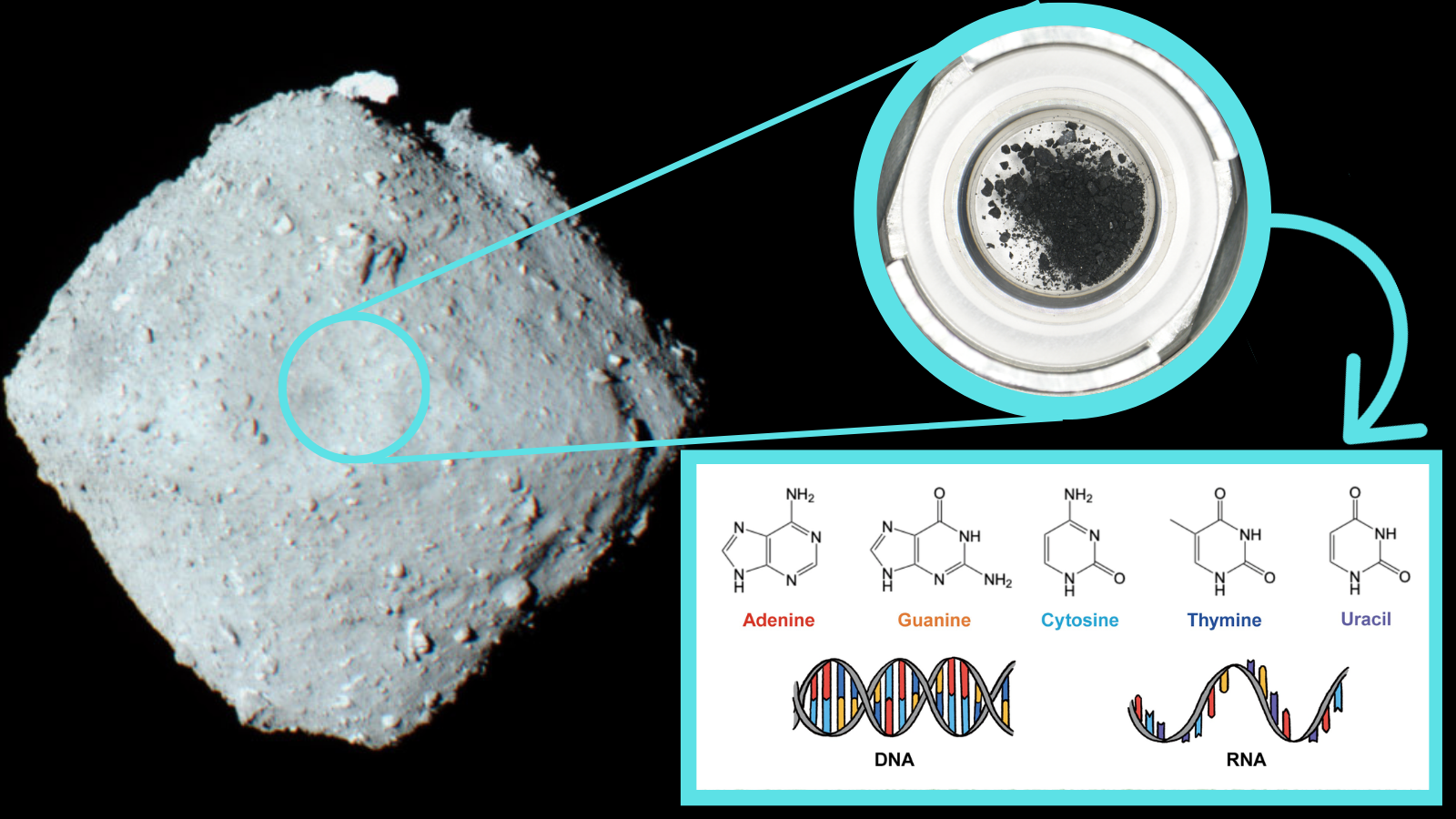
The five nucleobases — adenine, guanine, cytosine, thymine, and uracil — are the chemical letters that encode genetic information in DNA and RNA, the molecules at the foundation of all known life on Earth. Their presence in asteroid material has been confirmed individually before, but the detection of all five in a single, uncontaminated extraterrestrial sample from a known-origin asteroid is a milestone that significantly strengthens the scientific case for a cosmic contribution to the origins of life's chemistry.
Scientists analyzing material returned from the near-Earth asteroid Ryugu by Japan's Hayabusa2 spacecraft have made exactly that detection. The Ryugu sample — collected in 2019 and returned to Earth in late 2020 — has become one of the most scientifically productive extraterrestrial samples in history, yielding a stream of discoveries about the chemical composition of a primitive carbon-rich asteroid that formed in the early solar system.
Why Ryugu Matters
Not all asteroids are scientifically equal for questions about life's origins. Ryugu is classified as a C-type (carbonaceous) asteroid — the most chemically primitive class, composed of material that has experienced relatively little alteration since the solar system's formation 4.6 billion years ago. These objects are the closest analogs in our solar system to the interplanetary dust and planetesimals from which the early Earth was assembled.
The Hayabusa2 mission was specifically designed to return samples from Ryugu's subsurface as well as its surface, and to do so in a contamination-controlled fashion that allows scientists to attribute detected compounds definitively to the asteroid rather than to terrestrial contamination. This methodological rigor is what makes the nucleobase detection scientifically significant: previous meteorite analyses always faced the possibility of terrestrial contamination, since meteorites are exposed to Earth's biosphere from the moment they land.
All Five Nucleobases Confirmed
Previous analyses of the Ryugu sample had already detected several nucleobases. The confirmation of all five — adenine and guanine (purines), cytosine and thymine (pyrimidines found in DNA), and uracil (the RNA equivalent of thymine) — elevates this result from interesting to landmark.
The detection of all five together in a single pristine sample suggests that the chemical processes operating in primitive carbonaceous asteroids are capable of synthesizing the complete set of nucleobases through abiotic chemistry. The most likely synthesis pathway involves reactions between simple carbon compounds and ammonia in the presence of water ice and ultraviolet radiation — processes well-understood in laboratory settings and known to operate in the interstellar medium.
Implications for the Origin of Life
The finding contributes to — but does not resolve — one of the deepest questions in science: how did the molecular machinery of life originate on Earth? The panspermia hypothesis, in its most modest form, suggests that the chemical building blocks of life were delivered to the early Earth by carbonaceous asteroids and comets during the Late Heavy Bombardment approximately 3.8-4.1 billion years ago. The Ryugu results support this hypothesis by demonstrating that a primitive asteroid chemically capable of carrying all five nucleobases exists and that at least one such asteroid delivered material to Earth-crossing orbit.
What the results do not establish is that life itself, or even more complex prebiotic chemistry, can form in asteroids. The gap between having nucleobases and having self-replicating RNA or DNA molecules is enormous, involving catalysis, concentration, and a chemical environment that asteroids are unlikely to provide. The Ryugu sample demonstrates that space delivered the letters — the question of how those letters were assembled into the first words of biology remains open.
This article is based on reporting by Space.com. Read the original article.
Originally published on space.com