A Flower Blooming in Deep Space
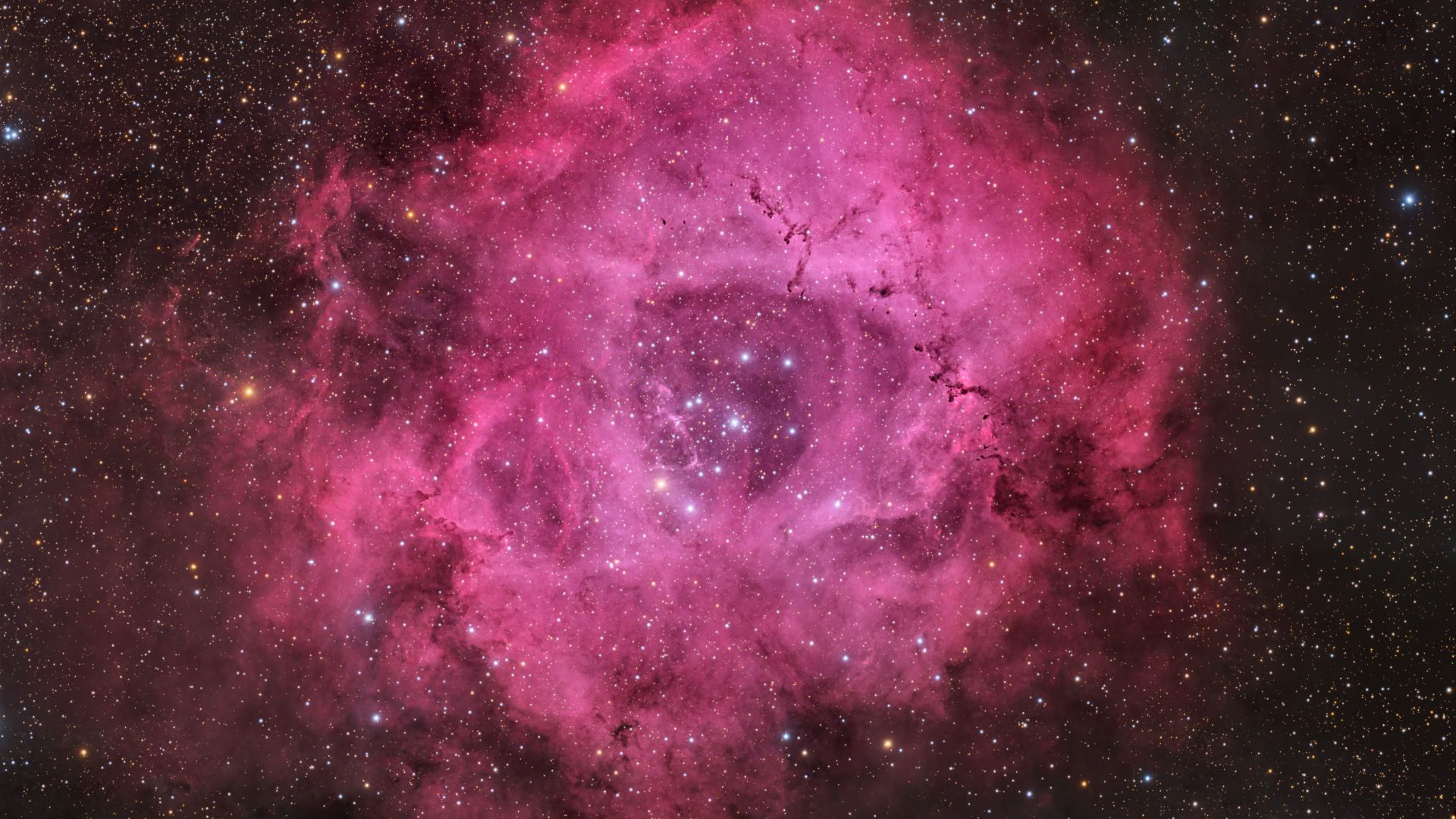
The universe has a way of producing beauty that rivals anything found on Earth. The Rosette Nebula, a massive emission nebula located approximately 5,000 light-years away in the constellation Monoceros, is one of the night sky's most spectacular sights. A new high-resolution photograph captures the nebula's intricate petal-like structures in vivid detail, revealing why this cosmic object has earned its floral name.
What Makes the Rosette Special
The Rosette Nebula, also cataloged as NGC 2237, spans roughly 130 light-years in diameter, making it large enough that if placed at the distance of the Orion Nebula, it would dominate the night sky. At its center sits the open star cluster NGC 2244, a group of young, hot stars whose intense ultraviolet radiation sculpts the surrounding hydrogen gas into the nebula's distinctive rose-like shape.
These central stars, some of which are 20 to 50 times more massive than our Sun, are responsible for the nebula's glow. Their radiation ionizes the surrounding hydrogen gas, causing it to emit the characteristic red and pink hues visible in long-exposure photographs. The interplay between stellar winds and dense gas clouds creates the layered, petal-like structures that give the nebula its romantic appearance.

A Stellar Nursery in Action
Beyond its visual appeal, the Rosette Nebula is an active stellar nursery. Within its dense molecular clouds, new stars are continuously forming as gravity pulls gas and dust together. Astronomers have identified numerous young stellar objects embedded within the nebula's pillars and globules, making it a valuable laboratory for studying star formation processes.
The nebula's mass is estimated at approximately 10,000 solar masses, providing ample raw material for continued star birth over millions of years. The interaction between the energetic central stars and the surrounding gas creates shock fronts that can actually trigger new episodes of star formation.
Capturing the Cosmic Rose
Photographing the Rosette Nebula requires patience, clear skies, and specialized equipment. The nebula is best observed during winter months in the Northern Hemisphere, when the constellation Monoceros rides high in the evening sky near the more familiar Orion. While the nebula is far too faint to see with the naked eye, it reveals its full glory through telescopes equipped with narrowband filters that isolate specific wavelengths of light emitted by its glowing gases, particularly the deep red of hydrogen-alpha emission.
Modern astrophotographers often combine exposures taken over several hours to bring out the nebula's subtle details, revealing dark globules and intricate filaments that hint at the complex physics shaping this stellar nursery. The resulting images stand as some of the most beautiful in all of astrophotography, a reminder that the cosmos can produce art on a scale that dwarfs anything human hands could create.
This article is based on reporting by Space.com. Read the original article.
Originally published on space.com