Roman enters its final prelaunch phase
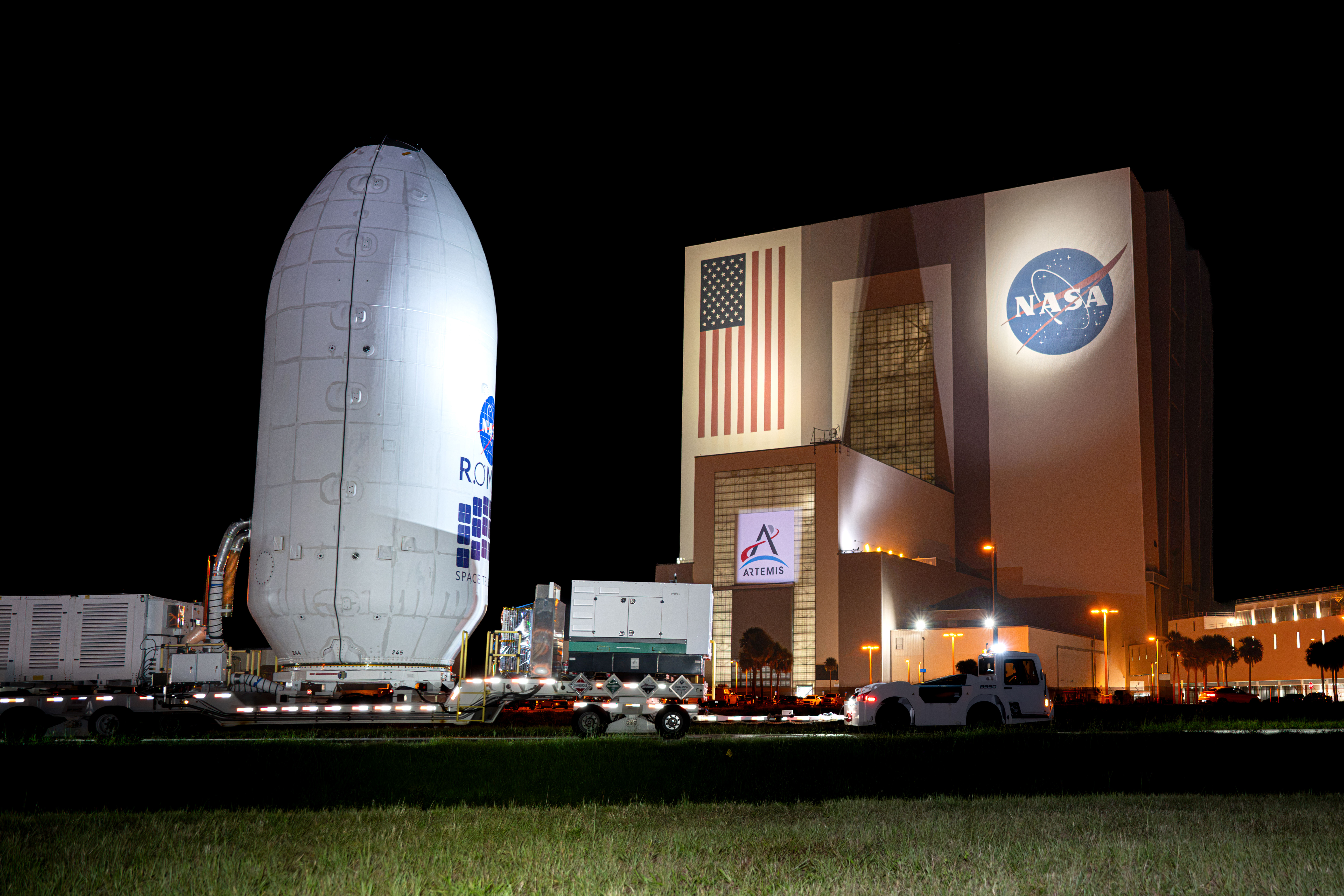
NASA’s Nancy Grace Roman Space Telescope has cleared one of the last major ground milestones before launch, traveling inside its payload fairing from the Payload Hazardous Servicing Facility to the SpaceX hangar at Launch Complex 39A at NASA’s Kennedy Space Center. The move places the observatory directly in line for mating with the Falcon Heavy rocket that is scheduled to send it into space.
NASA said the transfer took place on Tuesday, Aug. 25, 2026, and described the observatory as already encapsulated in its fairing when it made the trip. That detail matters because encapsulation is typically a sign that a spacecraft has advanced into the final sequence of launch processing. Once a payload is sealed inside the fairing and moved to the rocket integration area, attention shifts from instrument preparation to vehicle integration, checkout, and countdown readiness.
For Roman, the timing is especially significant. NASA said liftoff from Kennedy is targeted no earlier than Sunday, Aug. 30, 2026. With that date approaching, the telescope’s arrival at the SpaceX hangar signals that the mission is transitioning from years of development and testing into the last days of launch campaign execution.
A flagship observatory with cosmology in focus
Roman is designed to tackle some of the largest open questions in astrophysics. NASA said the observatory’s science instruments will help researchers study dark energy, the still-unexplained force driving the accelerating expansion of the universe. That makes Roman part of a broader effort to understand not just what the universe contains, but how its large-scale behavior has changed over cosmic time.
The telescope will also map how galaxies form, cluster, and evolve by tracing the influence of dark matter. Those two scientific goals are closely linked. The universe’s visible matter tells only part of the story; dark matter shapes the distribution of galaxies through gravity, while dark energy appears to affect how the universe expands on the largest scales. Roman’s job is to gather the observations needed to refine those models.
NASA’s description of the mission emphasizes survey science rather than a single narrow target. That suggests Roman’s value will come from the scale and quality of the datasets it produces. Missions built around wide-area mapping can become long-lived infrastructure for astronomy, generating baseline observations that support years of follow-on research by teams working on cosmology, galaxy evolution, and related questions.

Why the hangar move matters
The image NASA released is brief, but it captures a consequential operational step. Moving a telescope from spacecraft processing facilities to a launch vehicle integration site is not just ceremonial progress. It reflects confidence that the observatory is ready for one of the most sensitive parts of the launch pipeline: physical mating with the rocket that will carry it to orbit.
At Launch Complex 39A, the Roman payload will be paired with a Falcon Heavy, one of SpaceX’s heavy-lift launch vehicles. NASA’s note does not detail the full integration schedule, but the stated next milestone is clear: mating the encapsulated telescope to the rocket. Once that is complete, launch teams can focus on combined vehicle checks and the remaining countdown preparations.
In practical terms, this handoff is where mission ownership becomes more visibly shared across organizations. NASA remains responsible for the science mission and spacecraft, while SpaceX provides the launch system and ground integration support tied to Falcon Heavy operations. A clean transfer between those systems is essential because launch campaigns compress years of engineering into a short window where logistics, procedures, and timing all have to align.
Roman’s scientific promise extends beyond launch day
Launch milestones tend to dominate headlines because they are easy to visualize: a spacecraft moves, a rocket rolls out, a countdown begins. But Roman’s larger importance lies in what happens after deployment. NASA’s description frames the telescope as a tool for investigating dark energy and dark matter through large-scale observation of galaxies and cosmic structure.
That positions Roman as a mission aimed at measurement at scale. Instead of looking only at a handful of extraordinary targets, it is expected to gather data that help researchers compare patterns across large populations of galaxies. Those observations can improve understanding of how matter is distributed and how cosmic expansion has unfolded.
If Roman performs as planned, it could become a major source of data for astronomers trying to reconcile theory with observation in some of the field’s most difficult areas. Dark energy remains mysterious not because scientists lack ideas, but because it is hard to constrain with the precision needed to rule models in or out. The same is true for dark matter’s role in shaping structure across the universe. Roman’s survey capabilities are meant to strengthen that empirical foundation.
A countdown milestone for NASA and SpaceX
The short gap between the Aug. 25 move and the no-earlier-than Aug. 30 launch target underscores how close Roman now is to flight. Even so, “no earlier than” language remains important. It signals that the date is a target, not a guarantee, and that the campaign still depends on successful completion of the remaining integration and readiness work.
Still, the transfer to the SpaceX hangar marks the clearest sign yet that the observatory is entering its final ground phase. In launch terms, this is the moment when the mission stops looking like a future program and starts behaving like an active flight campaign.
For NASA, Roman represents a major astrophysics mission aimed at some of the deepest questions in cosmology. For SpaceX, it is another high-profile scientific payload assigned to Falcon Heavy. For the research community, the immediate headline is simple: the telescope is now where it needs to be for the last major step before launch.
With the spacecraft encapsulated, transferred, and awaiting rocket mating at Kennedy, Roman’s long road toward operational astronomy is nearly at its most dramatic point. The next time the mission draws global attention, it is likely to be on the pad.
This article is based on reporting by NASA. Read the original article.
Originally published on nasa.gov