A Relic of Creation at the Heart of Collapsed Stars
Neutron stars are among the most extreme objects in the known universe. Born in the violent collapse of massive stellar cores during supernova explosions, they pack a mass greater than the Sun into a sphere roughly the size of a city, producing densities so extreme that the very nature of matter inside them is uncertain. Now, a growing body of theoretical and observational evidence suggests that the cores of neutron stars may contain a state of matter not seen freely since the universe was a microsecond old: quark-gluon plasma, the primordial stuff of the Big Bang.
Quark-gluon plasma is the phase of matter that existed when the universe was younger than a millionth of a second and temperatures exceeded trillions of degrees. Under those conditions, quarks — the fundamental constituents of protons and neutrons — are not confined inside composite particles but exist freely in a hot, dense soup along with gluons, the particles that mediate the strong nuclear force. As the universe cooled, quarks became permanently confined inside protons, neutrons, and other hadrons, and quark-gluon plasma ceased to exist as a free phase in natural conditions.
Except, potentially, inside neutron stars. Calculations suggest that neutron star cores may reach densities high enough to dissolve the boundaries between individual nucleons, recreating conditions where quarks roam freely — a cold, dense form of quark matter distinct from the hot plasma of the early universe but governed by the same fundamental physics. Confirming this would represent one of the most significant discoveries in astrophysics and nuclear physics of the modern era.
The Evidence So Far
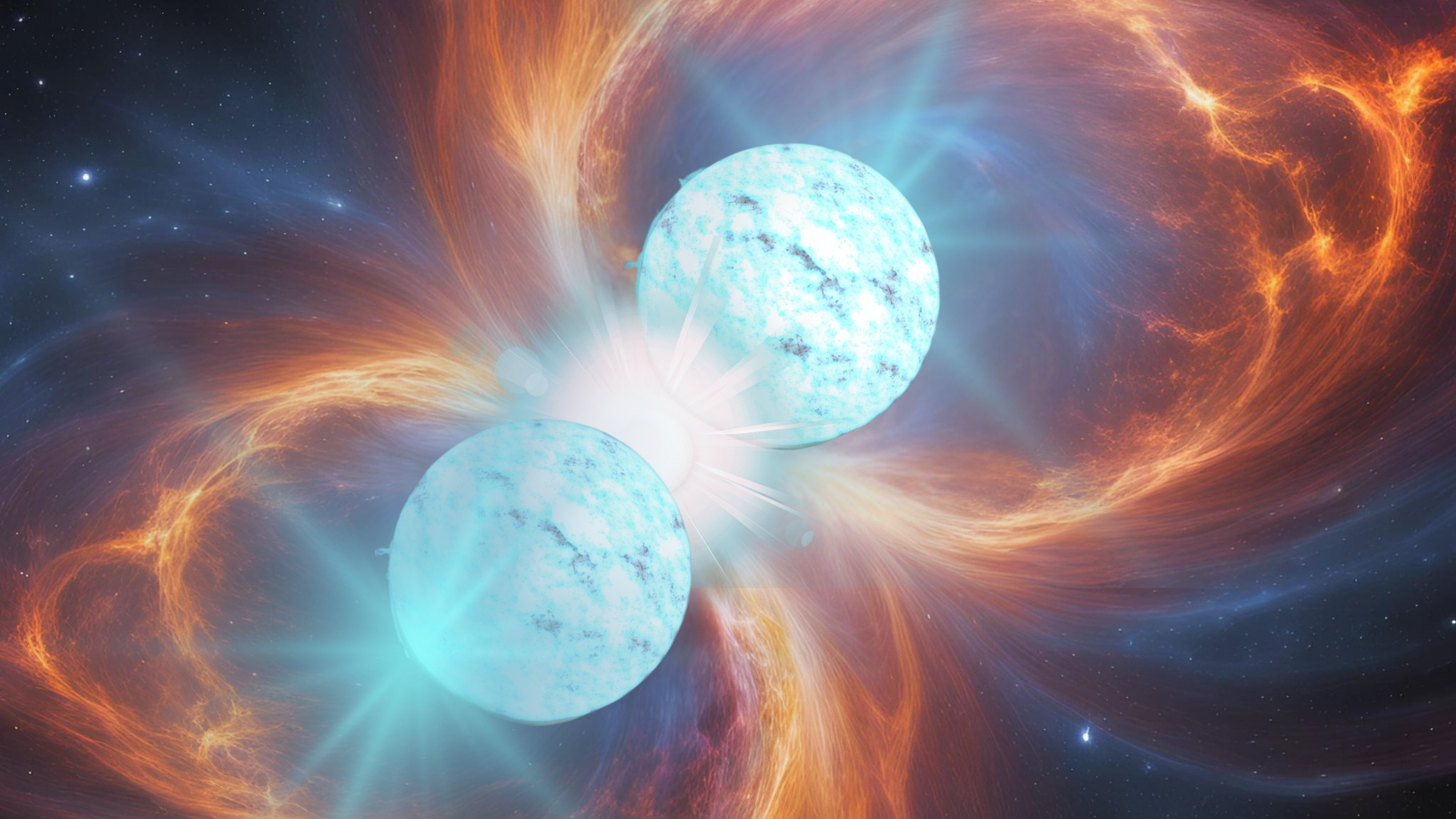
Evidence for quark matter inside neutron stars comes from multiple indirect directions, none individually conclusive. The most powerful constraints come from gravitational wave observations of neutron star mergers by LIGO and Virgo. When two neutron stars spiral together and merge, the gravitational waves they emit carry information about the stars' internal structure — specifically how deformable they are in each other's gravitational field, a property called tidal deformability. The measured tidal deformabilities from the landmark GW170817 event constrained the neutron star equation of state in ways that some theoretical models suggest are most naturally explained by the presence of quark matter in the stellar cores.
X-ray observations of neutron star masses and radii provide complementary constraints. The NICER instrument on the International Space Station has measured the sizes of several neutron stars with sufficient precision to constrain their internal structure. Combined mass and radius measurements can rule out some theoretical equations of state and favor others, narrowing the range of plausible internal compositions. Current NICER data does not conclusively identify quark matter, but it is consistent with its presence in the densest known neutron stars.
The challenge is that the interior of a neutron star is inaccessible to direct observation, and theoretical calculations of matter behavior at neutron star densities are extraordinarily difficult. Quantum chromodynamics — the theory governing quark and gluon interactions — can be solved computationally using lattice QCD methods at the densities found in atomic nuclei and the extreme densities of early-universe quark-gluon plasma, but intermediate densities corresponding to neutron star cores remain in a regime where current theoretical methods are unreliable. The uncertainty is not a failure of physics but a genuine frontier of calculation.
How Scientists Think They Can Prove It
The path to confirming quark matter in neutron stars runs through improvements in gravitational wave detector sensitivity, more precise neutron star radius measurements, and theoretical advances in understanding dense nuclear matter. The next generation of gravitational wave detectors — Einstein Telescope in Europe and Cosmic Explorer in the United States — will observe neutron star mergers with dramatically improved sensitivity, potentially measuring the post-merger gravitational wave signal that current detectors cannot yet detect and that carries information about what happens to quark matter during the violent collision and merger process.
The post-merger signal is particularly informative because it depends on the behavior of matter at densities substantially exceeding those of the pre-merger stars. If quark matter is present and undergoes a phase transition during merger — changing from ordinary nuclear matter to deconfined quark matter as density peaks — the gravitational wave frequency content would carry distinctive signatures of that transition. Theoretical predictions of what these signatures look like are an active research area, and future detectors may be sensitive enough to observe them.
Laboratory experiments also contribute to the picture. Heavy-ion collisions at facilities like CERN's Large Hadron Collider and Brookhaven's Relativistic Heavy Ion Collider create quark-gluon plasma in miniature for fractions of a second, providing experimental data on quark matter properties at high temperatures that can constrain extrapolations to the high-density, lower-temperature regime relevant to neutron star interiors. The theoretical bridge between these regimes is imperfect but improving as nuclear theory advances.
What This Would Mean for Physics
Confirming quark matter inside neutron stars would be a landmark result for nuclear physics and astrophysics simultaneously. It would establish that a phase of matter predicted by quantum chromodynamics and created momentarily in laboratory particle accelerators exists as a stable component of macroscopic astronomical objects — validating the theory across an extraordinary range of conditions and connecting the microscopic physics of quarks to the astrophysics of compact objects.
The discovery would also sharpen understanding of the neutron star equation of state — the relationship between pressure and density inside these objects — which is one of the central open problems in nuclear astrophysics. A better equation of state improves models of supernova collapse, neutron star formation, gravitational wave emission from mergers, and the r-process nucleosynthesis in neutron star mergers that is responsible for producing most of the gold, platinum, and other heavy elements in the universe.
For physicists interested in the strong nuclear force at extreme densities, neutron stars are natural laboratories that no terrestrial experiment can replicate. Each new observational constraint on their internal structure is a window into physics that cannot be directly created and studied on Earth, making the project of characterizing neutron star interiors one of the most productive intersections of astrophysics and fundamental physics currently being pursued.
This article is based on reporting by Space.com. Read the original article.

Originally published on space.com