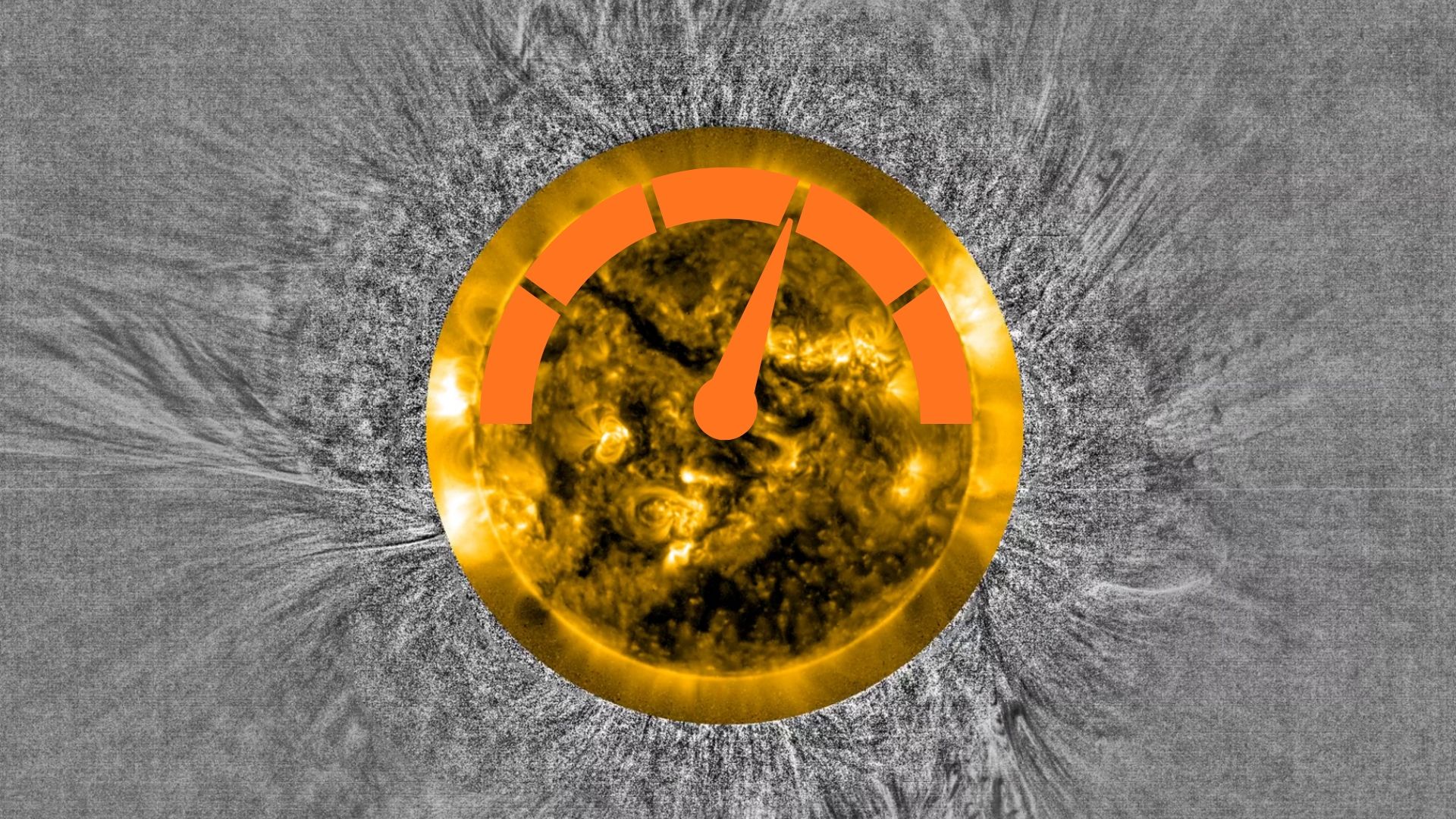
A difficult-to-observe region of the sun is yielding a surprise
The European Space Agency’s Proba-3 mission has produced observations suggesting that slow solar wind in the sun’s inner corona moves far faster than expected. According to the supplied Space.com report, researchers studying images from the eclipse-simulating spacecraft found gusts moving three to four times faster than earlier assumptions. The finding matters because the inner corona is one of the hardest places in solar physics to observe directly, despite being central to understanding how the sun sheds material into space.
Solar wind is a constant outflow of charged particles from the sun. Scientists have long distinguished between fast solar wind, which can reach about 480 miles per second and is associated with coronal holes, and slower wind emerging closer to the sun’s surface. The slow solar wind studied here had previously been known to blow at around 60 miles per second, according to the source text. Proba-3’s data indicate that this picture may have underestimated how quickly that material can move in the inner corona.
The result is significant not because it overturns everything known about solar wind, but because it provides new information from a region that has been unusually difficult to measure. If the slow wind accelerates earlier and more forcefully than expected, models of how energy and plasma move through the corona may need revision.
Why Proba-3 is able to see what is usually hidden
The Proba-3 mission is notable in its own right. The report describes it as a duo of satellites flying in formation to simulate a solar eclipse. That arrangement lets the mission block the intense brightness of the sun’s disk and observe the faint corona more clearly. Ordinarily, the glare of the sun makes this region extremely challenging to study except during rare natural eclipses or through specialized instruments.
That is why the new data stand out. The inner corona is precisely where key questions about solar wind formation and acceleration remain unresolved. Being able to observe that zone more effectively gives researchers access to a part of the sun’s atmosphere that has often sat between theoretical models and limited observational evidence.
The report quotes Andrei Zhukov of the Royal Observatory of Belgium saying that in the inner corona, scientists saw slow solar wind gusts moving three to four times faster than expected. Even framed cautiously, that is the kind of statement that draws attention because it points to a mismatch between prior assumptions and newly available measurements.

Faster early motion could alter how scientists think about solar outflows
The slow solar wind has always been the more complicated member of the solar wind family. Fast wind from coronal holes has a clearer association with open magnetic field lines and high-speed outflow. The slower component is more variable and harder to pin down, which has made its origin and acceleration mechanisms more contested. If Proba-3 is showing that this supposedly slow wind can already be moving much faster close to the sun, then the distinction between “slow” and “slow to start” becomes more important.
That could affect how researchers interpret the role of magnetic structures, heating, and plasma dynamics in the corona. The supplied text does not go into the full mechanism, and it would be wrong to overstate what one result proves. But the basic implication is clear enough: the inner-corona stage of solar wind development may be more dynamic than expected.
That matters practically as well as scientifically. Solar wind is a driver of space weather, and space weather affects satellite systems, communications, navigation, and power infrastructure. Better understanding how solar wind forms and accelerates ultimately improves how scientists model the sun-Earth environment, even if this specific result is an early piece of a larger puzzle.
A mission built around precision formation is now paying off scientifically
There is also a broader lesson in the result. Proba-3 was designed to create observing conditions that are otherwise difficult to achieve. The apparent payoff is not just sharper images, but genuinely new physical insight. Missions that solve observational problems can reshape theory simply by letting researchers see a neglected region with enough clarity to challenge assumptions.
The Space.com report frames the new data as a revelation from an eclipse spacecraft, and that is an apt description. The mission is exploiting a clever engineering setup to answer an old astrophysical question from a new angle. Those are often the circumstances in which meaningful discoveries emerge.
For now, the major takeaway is disciplined rather than sensational. Scientists working with Proba-3 data have found evidence that slow solar wind in the inner corona can move much faster than previously thought. That does not settle every debate about solar wind origin or space weather dynamics. It does, however, show that one of the least accessible regions around the sun still has the power to surprise researchers once it becomes visible enough to study properly.
This article is based on reporting by Space.com. Read the original article.

Originally published on space.com