Roman is breaking from the usual big-telescope script
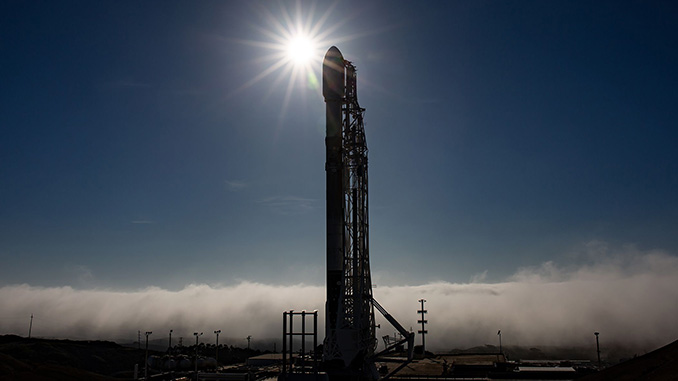
Large space telescopes are usually introduced through delay notices, budget overruns, and shifting launch timelines. NASA’s Nancy Grace Roman Space Telescope is, at least for now, telling a different story. According to the supplied source material, Roman is ahead of schedule and under budget, with launch due in September and operations to begin after checkout at the Sun-Earth L2 point.
That is notable on its own. Advanced observatories tend to accumulate technical and managerial friction as complexity rises. Roman’s reported schedule position therefore marks a rare piece of positive execution news in a field where the example of the James Webb Space Telescope still looms large. But the more interesting part of the story is what Roman is being prepared to do once it arrives in space.
The telescope is built around large-area surveys, and one of its core campaigns will be the 15-month Galactic Bulge Time Domain Survey. That program targets one of the most crowded and information-rich regions in the Milky Way: the galactic bulge near the center of the galaxy. Roman will repeatedly monitor that field for changes in starlight brightness, using those fluctuations to uncover exoplanets, rogue planets, and other compact or otherwise hard-to-see objects.
Why the galactic bulge matters
The bulge is a dense stellar environment packed with stars and planetary systems. It is also thought to contain free-floating worlds and isolated stellar-mass black holes. A survey that revisits this region over time is valuable because some of the most revealing objects do not announce themselves through steady light. They show up through changes, especially brief or subtle shifts in brightness that indicate gravitational microlensing or other transient effects.
Roman’s strength lies in combining wide-field capability with the kind of repeated, systematic observation needed to catch those events at scale. Other telescopes have studied the galactic bulge before, but the supplied material argues that none brings the same observational power Roman will apply to the problem. That means the mission is expected not just to add more detections, but to change the volume and quality of the underlying census.
One of the major expectations described in the source text is that Roman’s bulge survey could locate more than a thousand exoplanets orbiting far from their host stars. That matters because planets at wider orbital distances are harder to detect with some of the methods that have dominated exoplanet discovery so far. A better sample of those worlds would improve models of planetary system architecture and migration.
Hubble is acting as Roman’s advance scout
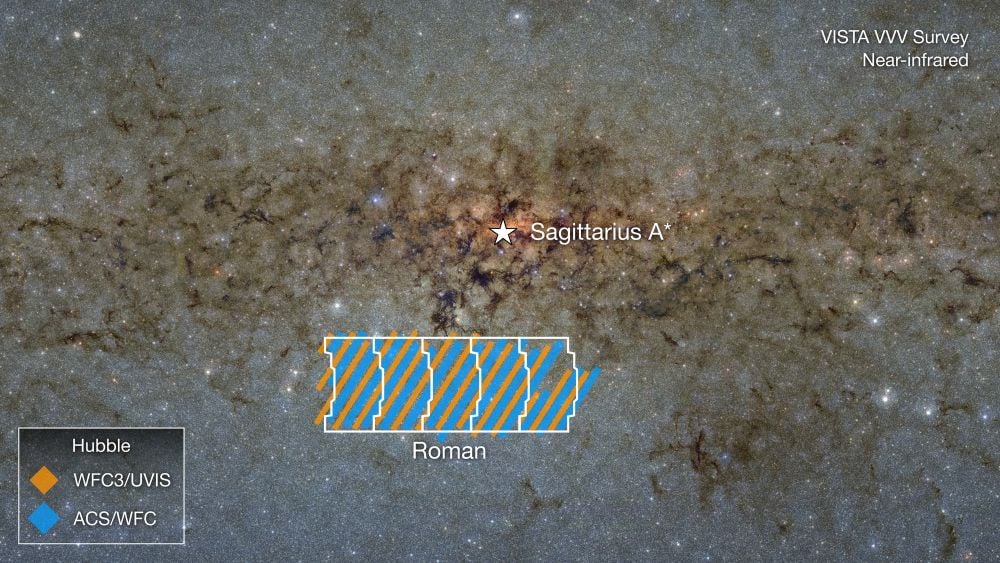
Even before Roman launches, another telescope has started laying the groundwork. Astronomers used the Hubble Space Telescope to survey overlapping parts of the same bulge region Roman will later examine. The purpose is not redundancy. Hubble’s earlier observations are intended to give astronomers a baseline for understanding and interpreting what Roman sees once its own survey begins.
The source material says the first results from that Hubble work appear in a paper in The Astrophysical Journal Letters titled “An HST Wide-field Survey of the Galactic Bulge: Overview, Strategy, and First Results.” The survey covers a 1.1 square degree area toward the Milky Way’s bulge. High-resolution Hubble imaging of that field can help astronomers disentangle crowded stellar environments, characterize the background population, and better calibrate the analysis Roman will eventually perform on a much larger scale.
This handoff between observatories illustrates a broader pattern in modern astronomy. Flagship missions are rarely isolated events. They are embedded in a chain of precursor observations, archival comparisons, and follow-up campaigns. Roman may be the next major survey engine, but its scientific productivity will be amplified by the groundwork Hubble is already providing.
A mission built for discovery at scale
Roman’s bulge campaign is only one part of its scientific agenda, but it captures the mission’s style. Rather than focusing on a small number of individual targets, Roman is designed to scan wide regions deeply and repeatedly, allowing statistically powerful searches for rare or difficult phenomena. That approach is particularly useful for objects that reveal themselves only intermittently or through indirect signatures.
In the context provided by the source text, that includes exoplanets, rogue planets, and isolated black holes. These are exactly the kinds of populations where a larger and cleaner sample can shift theory. Rogue planets, for example, challenge simple ideas about planet formation and long-term system stability. Isolated stellar-mass black holes are difficult to study because they emit little or no light directly. Repeated monitoring in a dense field gives astronomers a better chance to catch the subtle gravitational effects that betray their presence.
The mission’s reported progress on cost and schedule may also matter scientifically. When a telescope launches earlier than expected, the advantage is not only administrative. It can move key datasets into the hands of the community sooner, accelerating follow-on proposals, theory development, and coordination with other observatories.
Why Roman’s preparation phase matters now
The supplied source presents Roman not as a distant promise but as a mission already entering a consequential transition. Hardware and schedule discipline are one side of the story. The other is scientific readiness. By using Hubble to pre-map part of Roman’s future hunting ground, astronomers are reducing uncertainty before the first Roman data even arrives.
That preparation could pay off quickly once the telescope is in service. Survey missions generate enormous information streams, and early interpretation often depends on how well researchers understand the field in advance. In a crowded region like the galactic bulge, that is especially true.
If Roman launches on the reported timeline and the Galactic Bulge Time Domain Survey performs as expected, NASA will gain a powerful new tool for filling in missing parts of the exoplanet census and for probing hard-to-detect populations across the inner Milky Way. The unusual part is that the mission may reach that moment without the familiar story of years of added delay.
For now, the strongest conclusion supported by the supplied material is straightforward: Roman is moving toward launch from a position of uncommon programmatic strength, and Hubble is already helping ensure that when the survey begins, astronomers will be ready to extract more meaning from the flood of data that follows.
This article is based on reporting by Universe Today. Read the original article.
Originally published on universetoday.com