A short-lived whiteout in Patagonia
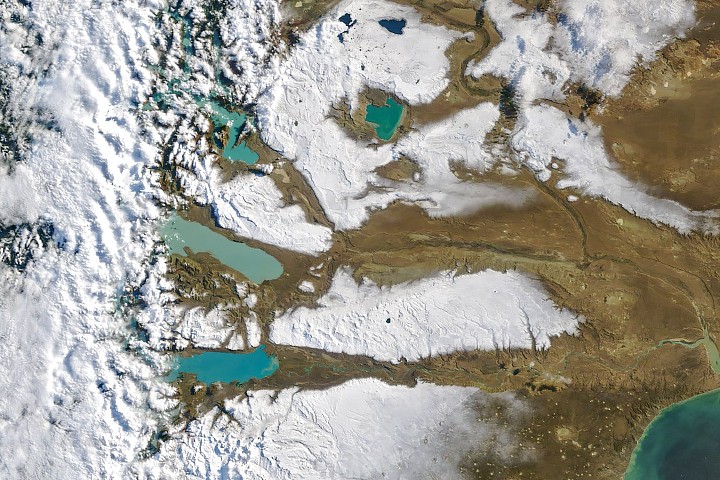
An early autumn storm swept across southern Argentina in early April, leaving a broad but temporary layer of snow across the high plains east of the Andes. NASA’s Earth Observatory highlighted the event with satellite imagery showing the Patagonian Desert transformed from its usual dry browns into a striking patchwork of white, blue, and gray.
The main image was captured on the morning of April 3, 2026, by the MODIS instrument aboard NASA’s Terra satellite. A second, more detailed view from Landsat 9 showed snow lining a valley near the outlet of Lago Argentino. Together, the images documented both the scale of the snowfall and how quickly it began to retreat.
Snow on the dry side of the mountains
The setting matters. Southern Argentina’s eastern plains sit in the rain shadow of the Andes, a region that often appears arid and subdued from orbit. The landscape is typically interrupted by glacier-fed lakes rather than widespread snow cover. That made the early April scene notable: large areas of the high plains were blanketed in white after a storm pushed winter-like conditions into a region better known for dryness.
According to NASA’s summary, atmospheric scientist René Garreaud of the Universidad de Chile said early fall had been wetter than normal in southern Patagonia. Satellite-based estimates showed above-average precipitation from late March through early April. Much of the region’s precipitation usually falls on the western, windward side of the Andes, but strong winds can carry snow eastward into Argentina. In this case, that transport was visible from space.

What the satellites showed
The MODIS image revealed extensive snow cover across the desert on April 3. The Landsat 9 view added local detail, especially around Lago Argentino, where a sharp snow line traced the outlet valley. NASA noted that snow clung to higher elevations while valleys draining the large glacial lakes remained comparatively bare.
The imagery also highlighted one of Patagonia’s signature visual features: vivid blue and turquoise lakes. NASA attributed those colors to suspended glacial sediment, sometimes called glacial flour, that has been pulverized by the region’s many glaciers. The fine particles remain in the water and scatter light, giving the lakes their milky appearance.
That contrast, white snow against sediment-rich blue water and otherwise brown terrain, made the satellite scene especially dramatic. It also underscored how remote sensing can capture multiple interacting processes at once, including precipitation, topography, runoff pathways, and sediment transport.
A fleeting event
The snowfall did not last. NASA said a satellite view from the afternoon of April 4 showed that most of the snow had already melted away, remaining only in the highest mountain areas. That rapid change is part of what makes such events important to observe from orbit. In mountain-adjacent drylands, snowfall can arrive abruptly, reshape the visible landscape for a day, and then disappear almost as fast.
The quick melt also illustrates the seasonal transition underway in the Southern Hemisphere. Although the storm arrived in early autumn, conditions were still mild enough across much of the lower terrain to prevent longer-lasting accumulation. The result was less a seasonal lock-in than a brief atmospheric episode written across the surface and erased within about a day.
Why it matters
At first glance, the images are visually compelling more than strategic. But they also show why Earth-observing satellites remain essential for tracking regional weather patterns and environmental variability in sparsely populated areas. Southern Patagonia is vast, and detailed ground observations are not always easy to obtain across the full area affected by storms. Satellite views provide a consistent record of where precipitation falls, how snow distributes across elevations, and how long it persists.
NASA’s account also points to a broader climate and weather story. Garreaud’s observation that the season had been wetter than normal suggests the snowfall was part of a larger pattern rather than a purely isolated anomaly. Even without drawing conclusions beyond the supplied observations, the images offer a snapshot of how unusual precipitation can briefly redraw the boundaries between mountain climate and desert climate.
For readers, the lesson is straightforward: terrain still governs weather, but weather does not always stay in its expected lane. In the Andes, where mountains split wet and dry regimes across short distances, a strong storm and favorable winds can push snow into places where it appears surprising, even ephemeral. On April 3, 2026, that interaction produced a rare and beautiful view over southern Argentina. By the next day, much of it was gone.
This article is based on reporting by science.nasa.gov. Read the original article.
Originally published on science.nasa.gov