A Familiar Glow on an Alien World
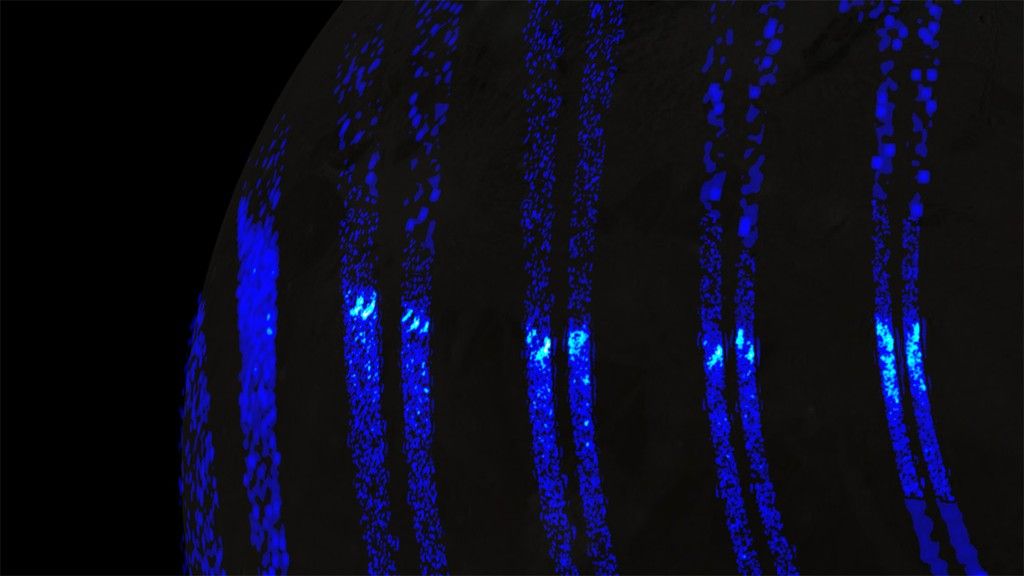
NASA's Juno spacecraft has revealed that auroras on Ganymede, Jupiter's largest moon, bear a striking structural resemblance to Earth's own northern lights. The discovery shows that Ganymede's auroral displays break apart into small, bright patches rather than forming smooth, continuous bands — a pattern that closely mirrors features observed in Earth's auroral zones above the Arctic and Antarctic.
The finding is significant because Ganymede is the only moon in the solar system known to possess its own internally generated magnetic field, making it a unique laboratory for studying magnetospheric physics beyond Earth. Understanding how auroras form and behave on Ganymede provides researchers with a comparative dataset that can deepen knowledge of magnetic field interactions throughout the solar system.
How Ganymede's Auroras Work
Auroras on Earth form when charged particles from the solar wind are funneled along magnetic field lines into the upper atmosphere, where they collide with gas molecules and cause them to emit light. The process on Ganymede follows a broadly similar mechanism, though with important differences arising from the moon's unique position within Jupiter's enormous magnetosphere.
Ganymede sits inside Jupiter's magnetic field, which is roughly 20,000 times stronger than Earth's. This means that the charged particles driving Ganymede's auroras come primarily from Jupiter's magnetosphere rather than directly from the solar wind. The interaction between Ganymede's own magnetic field and Jupiter's surrounding field creates a complex electromagnetic environment that channels particles toward the moon's polar regions.
What surprised researchers was the fine structure of the resulting auroral displays. Rather than forming diffuse glows or simple arcs, Ganymede's auroras fragment into discrete bright spots and patches. This splintering pattern is remarkably similar to what scientists observe in Earth's auroras, where discrete auroral arcs break into smaller structures due to localized variations in the magnetic field and particle precipitation patterns.
Juno's Observations
The data comes from Juno's close flyby of Ganymede, during which the spacecraft's ultraviolet spectrograph captured detailed images of the moon's auroral emissions. Juno has been orbiting Jupiter since 2016 and has made several close passes of the gas giant's largest moons, each providing opportunities to study these worlds in unprecedented detail.
The ultraviolet observations were complemented by measurements from Juno's magnetometer and particle detectors, which recorded the magnetic field configuration and charged particle environment near Ganymede during the flyby. Together, these datasets allowed researchers to connect the observed auroral structures to specific features of the moon's magnetic topology.
Previous observations of Ganymede's auroras, primarily from the Hubble Space Telescope, had shown the auroral zones shifting in response to changes in Jupiter's magnetic field. Juno's closer vantage point has now revealed the fine-scale structure within those zones for the first time.
Why It Matters
The discovery that Ganymede's auroras share structural features with Earth's suggests that certain physical processes governing auroral formation may be universal, operating wherever a magnetic field channels charged particles into an atmosphere or surface. This universality is important for understanding auroras on other bodies throughout the solar system and potentially on exoplanets orbiting distant stars.
If the same fundamental physics produces similar structures regardless of the specific magnetic field strength, particle source, or atmospheric composition, then researchers can use knowledge gained from studying Earth's well-characterized auroras to interpret observations of far more distant objects that are difficult to study directly.
The findings also contribute to the growing body of knowledge about Ganymede ahead of the European Space Agency's JUICE mission, which launched in 2023 and is expected to enter orbit around Jupiter in 2031 before eventually settling into orbit around Ganymede itself. JUICE will carry instruments designed to study Ganymede's magnetic field, surface, and subsurface ocean in far greater detail than Juno can achieve during brief flybys.

A Window Into Subsurface Oceans
Ganymede is also of intense scientific interest because it is believed to harbor a vast saltwater ocean beneath its icy surface. The moon's magnetic field, which makes its auroras possible, is thought to be generated by convective motions within a liquid iron core, similar to the dynamo process that produces Earth's magnetic field.
Understanding the magnetic field's structure and behavior through auroral observations provides indirect information about the interior processes that sustain it. This contributes to assessments of Ganymede's habitability potential, as the presence of a liquid ocean, internal heat, and a protective magnetic field are all considered favorable conditions for the possible emergence of life beyond Earth.
This article is based on reporting by Space.com. Read the original article.
Originally published on space.com