Artemis II sends back its first official lunar flyby views
NASA has released the first official images captured by the Artemis II crew during the mission’s lunar flyby, offering a striking set of views from humanity’s return to the Moon’s vicinity. The agency said the photographs were taken on April 6 during a seven-hour pass around the lunar far side and released on April 7, with some captions updated on April 8 to reflect ongoing scientific discussion about the images.
The photographs come from NASA astronauts Reid Wiseman, Victor Glover, Christina Koch, and Canadian Space Agency astronaut Jeremy Hansen, who used multiple cameras aboard Orion to document the Moon, Earth, and the space environment around them. NASA said the crew has taken thousands of photos so far, with more expected as the astronauts continue their trip home to Earth.
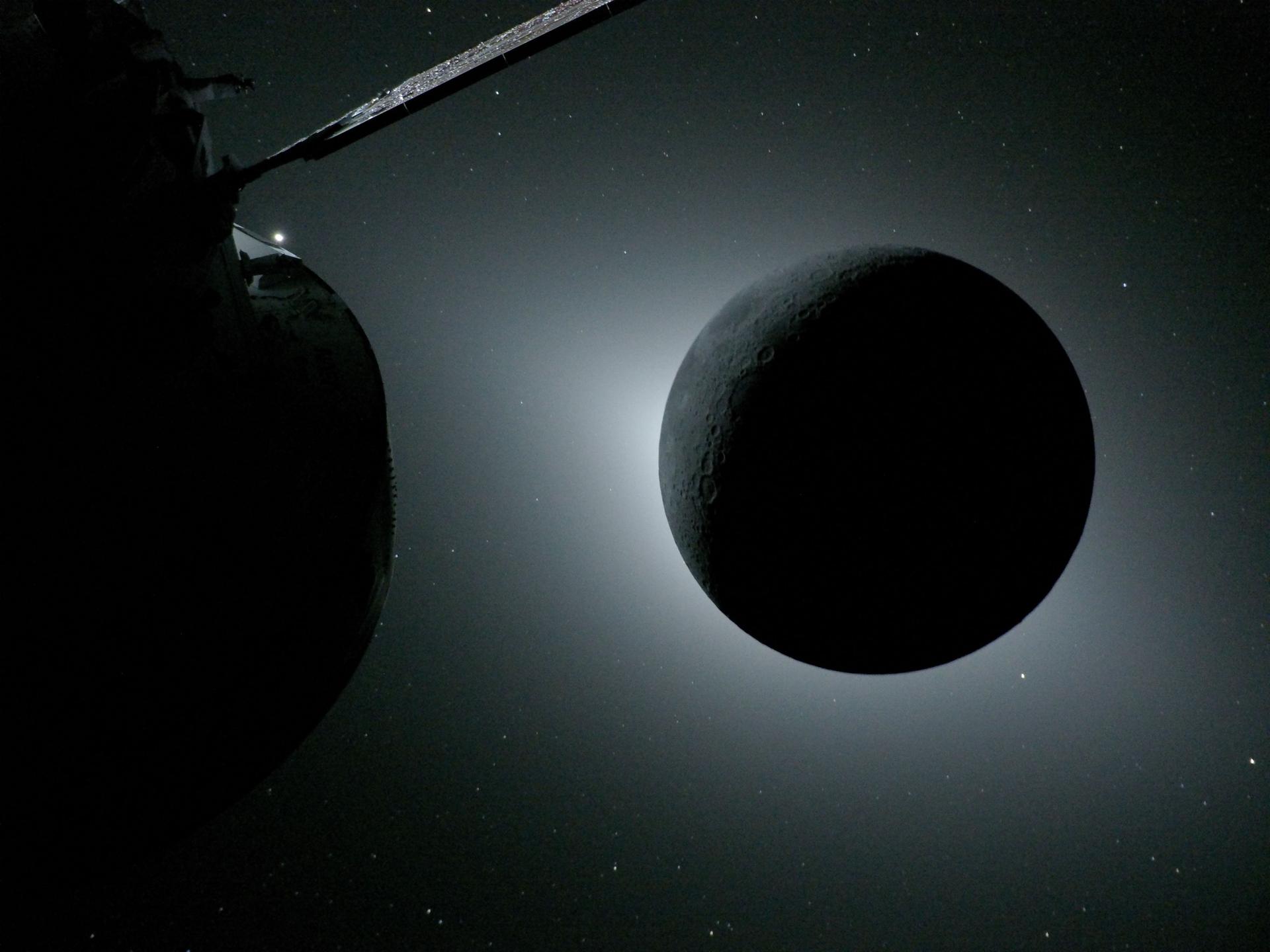
Among the most notable images is a view of the Moon backlit by the Sun during a solar eclipse seen only from the crew’s position. NASA said Orion’s unique vantage point allowed the astronauts to witness an eclipse unavailable to observers on Earth. In one published image, Earth reflects sunlight along the Moon’s edge, while bright points identified by NASA as Saturn and Mars are also visible.
A rare set of observations from a human lunar return
The release is important not just because the images are visually dramatic, but because of what they represent. Artemis II is a historic test flight, and these photographs are the first official flyby images of the Moon returned by the mission’s crew. NASA described them as showing some regions no human has seen before, including views produced during the passage around the lunar far side.
According to the agency, the astronauts documented impact craters, ancient lava flows, fractures on the surface, and differences in color, brightness, and texture across the terrain. NASA said those observations will help scientists study the Moon’s geologic evolution. The crew also captured an earthset and earthrise sequence and recorded views of the Sun’s corona during the eclipse.
One especially intriguing detail from NASA’s release is the crew’s report of six meteoroid impact flashes on the Moon’s darkened surface. The agency did not provide a deeper scientific analysis in the release, but the note indicates that the mission is producing more than commemorative imagery. The crew is also gathering observations that could contribute to lunar science and to understanding the near-Moon environment during future missions.
NASA’s wording is careful and observational rather than speculative. The agency presents the imagery as both a public milestone and part of a growing scientific record from Artemis II. That balance reflects the mission’s dual purpose: it is a highly visible demonstration of crewed deep-space capability and a practical test that feeds into later lunar operations.

The Moon, Earth, and the experience of distance
Some of the most compelling images in NASA’s release focus on perspective. As Orion moved behind the Moon and approached a planned loss of signal, the crew captured a crescent Earth setting on the lunar limb. NASA noted that in the image, the dark side of Earth was in nighttime while Australia and Oceania remained sunlit. The foreground included the Ohm crater, whose terraced edges and central peaks were described in the release as features formed by the lunar surface liquefying during impact and then rebounding.
Those details matter because crewed lunar photography does something robotic imaging does not always do as effectively: it ties geology to human presence and motion. The Moon is shown not as a distant disc but as terrain observed in real time by astronauts moving around it. Earth, meanwhile, appears small, partial, and dynamic. That reversal of the usual perspective has long been one of the defining features of deep-space exploration, and Artemis II is already generating a fresh visual archive for that experience.
NASA also emphasized the beauty of the imagery. Science Mission Directorate Associate Administrator Nicky Fox said the photographs were “exquisite” and “brimming with science,” describing them as images that will inspire future generations. Even allowing for the ceremonial tone that often accompanies major mission milestones, the release makes clear that NASA sees these pictures as part of the public identity of Artemis as much as part of its technical output.
Why these images matter for the Artemis program
Artemis II is a test flight, but its success has implications far beyond a single mission. The program is intended to return humans to lunar space and eventually support sustained activity around and on the Moon. In that context, every operational and scientific product from Artemis II carries weight. The photos are evidence that Orion and its crew are functioning in deep space, that mission timelines are producing planned observations, and that the mission is generating usable scientific material while in transit.
The image release also reinforces the continuity between symbolic exploration and technical preparation. NASA’s public messaging around Artemis often combines inspiration, science, and systems validation, and this release fits that pattern. The astronauts are not only demonstrating that humans can again travel to lunar distance; they are also helping characterize the environment and procedures future crews will rely on.
That is one reason NASA highlighted the large volume of imagery still to come. The current release is presented as an initial selection rather than the complete record. More photos in the coming days could add to scientific analysis and to public understanding of what the mission accomplished during its lunar flyby.
A milestone with operational context
The timing of the release is also important. NASA said the crew was more than halfway through the mission and headed back toward Earth when the first official images were published. That gives the announcement a midpoint quality: not a retrospective after splashdown, but a live milestone during the return leg.
In practical terms, that means the images are doing several jobs at once. They document the mission, sustain public engagement, and show that Artemis II is advancing through its planned phases. They also remind observers that the mission is not just orbiting near Earth or carrying out a short demonstration. It has already completed a lunar flyby and is now returning with data, photographs, and operational lessons.
The broader significance is simple. Artemis II has now delivered one of the defining products expected from a crewed lunar mission: direct, human-made views from the Moon’s far side and its surrounding space. NASA is framing those views as scientifically valuable and historically resonant. On both counts, the first release suggests Artemis II is beginning to build the visual and observational legacy it was designed to create.
This article is based on reporting by NASA. Read the original article.
Originally published on nasa.gov