A promising exomoon search ran into a familiar astrophysical problem
The James Webb Space Telescope is sensitive enough, in principle, to help astronomers detect a moon roughly analogous to Earth’s. But a new preprint describing observations of the nearby TOI-700 system shows how that promise can still be defeated by the star itself.
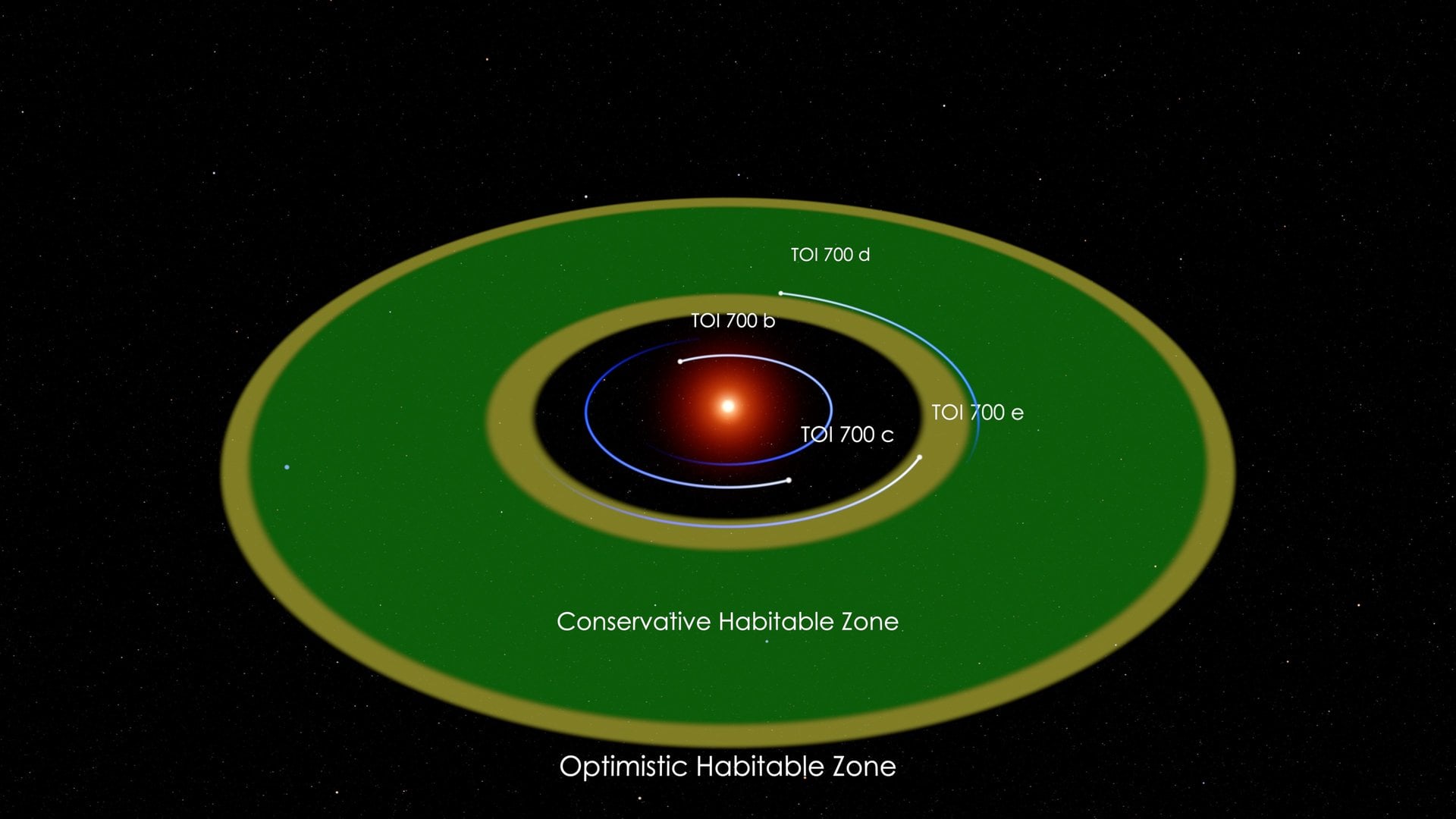
Researchers from MIT, Harvard, and the University of Chicago used JWST to track two Earth-sized planets in the habitable zone of TOI-700, an M-dwarf star about 100 light-years from Earth. The target planets, TOI-700 d and TOI-700 e, were considered especially strong candidates for hosting stable moons because of their characteristics and orbits. Instead of finding a definitive exomoon signal, however, the team found that noise from the star’s surface behavior effectively buried the kind of subtle transit signature they were hoping to see.
The result is not a detection, but it is still an important measurement of the practical limits of exomoon hunting with current tools. JWST improved key measurements of the planets themselves, yet the host star’s variability remained strong enough to obscure the smaller signal of a moon.
The target: two habitable-zone, Earth-sized planets
TOI-700 has already drawn attention because it hosts multiple known planets, including two Earth-sized worlds in the star’s habitable zone. In the new work, the researchers report improved measurements for both. They refined the planets’ orbital estimates by an order of magnitude and sharpened the radius measurements by a factor of two to three.
For TOI-700 d, the paper reports a radius of 1.145 times Earth’s. For TOI-700 e, the radius is 0.919 times Earth’s. Those are the kinds of planets that naturally invite speculation about long-term stability, climate, and whether a moon might influence planetary evolution in ways loosely comparable to Earth’s own history.
The motivation is not merely sentimental astronomy. Earth’s moon is thought to have had profound consequences for this planet, including stabilizing axial tilt and moderating climatic swings. A moon can alter tides, rotation, and potentially the broader environmental history of a world. Finding an Earth-moon analogue elsewhere would therefore be more than a curiosity. It would open another dimension in the search for potentially life-friendly systems.
JWST had the raw sensitivity, but the star got in the way
According to the preprint, JWST should be able to detect an Earth-like moon signal under the right conditions. The team estimated that identifying a Luna analogue in this system would require measuring a dip in starlight of about 20 parts per million. That is within the telescope’s capabilities.
The obstacle was not instrumental weakness. It was astrophysical contamination from the star. When the team analyzed the data, they identified a repeating red-noise pattern caused by stellar granulation, the bubbling and boiling of plasma at the star’s surface. In TOI-700, this signal oscillated roughly every 16 minutes and had an amplitude of about 46 parts per million.
That meant the stellar noise was more than large enough to wash out the exomoon-sized signal the team hoped to isolate. In effect, JWST could measure exquisitely faint changes in brightness, but the star itself was varying at the wrong scale and cadence for the moon search to cleanly succeed.
This is a useful reminder that the limiting factor in precision astronomy is often not the telescope alone. Even when the hardware performs as designed, the sky can still be messy.
What the researchers could still conclude
Although the observations did not deliver evidence of a moon around either planet, the study still narrowed the parameter space. The team concluded that, with this level of sensitivity under the observed noise conditions, their data were only capable of detecting moons larger than Ganymede on certain orbits. That leaves substantial room for smaller moons, including analogues closer to Earth’s moon in scale, to remain unseen.
In other words, the non-detection is not proof that TOI-700 d and e are moonless. It shows that any moons present did not produce a clean enough signal in this dataset to rise above the star’s intrinsic variability. That is an important distinction in a field where null results can still shape future observing strategy.
The work also improves the scientific value of the TOI-700 system itself. Better orbital and size measurements help refine models of the planets, their transits, and the kinds of follow-up observations that may be most informative. Even without an exomoon discovery, the campaign tightened understanding of one of the more interesting nearby multi-planet systems available for continued study.
Why this matters for the broader exomoon search
Exomoons remain elusive not because astronomers lack interest, but because the signals are extraordinarily subtle. Detecting a planet is already hard. Detecting a moon around that planet requires a more delicate reading of timing, brightness, and system geometry. The TOI-700 result shows that stars themselves can be the decisive source of uncertainty, even in systems that look favorable on paper.
That lesson will matter as astronomers prioritize future targets. Nearby stars, habitable-zone planets, and JWST-class sensitivity are all valuable. But stellar behavior may need to be weighted more heavily when deciding where an exomoon search is most likely to succeed.
The study therefore marks a technical advance as much as a disappointment. It demonstrates what JWST can do for planet characterization and what kinds of stellar noise can still frustrate the next level of discovery. For now, the search for an Earth-moon twin continues. TOI-700 remains compelling, but the star has made clear that any moon there will not be easy to reveal.
This article is based on reporting by Universe Today. Read the original article.
Originally published on universetoday.com