Hubble finds a new geometric weather pattern at Saturn’s south pole
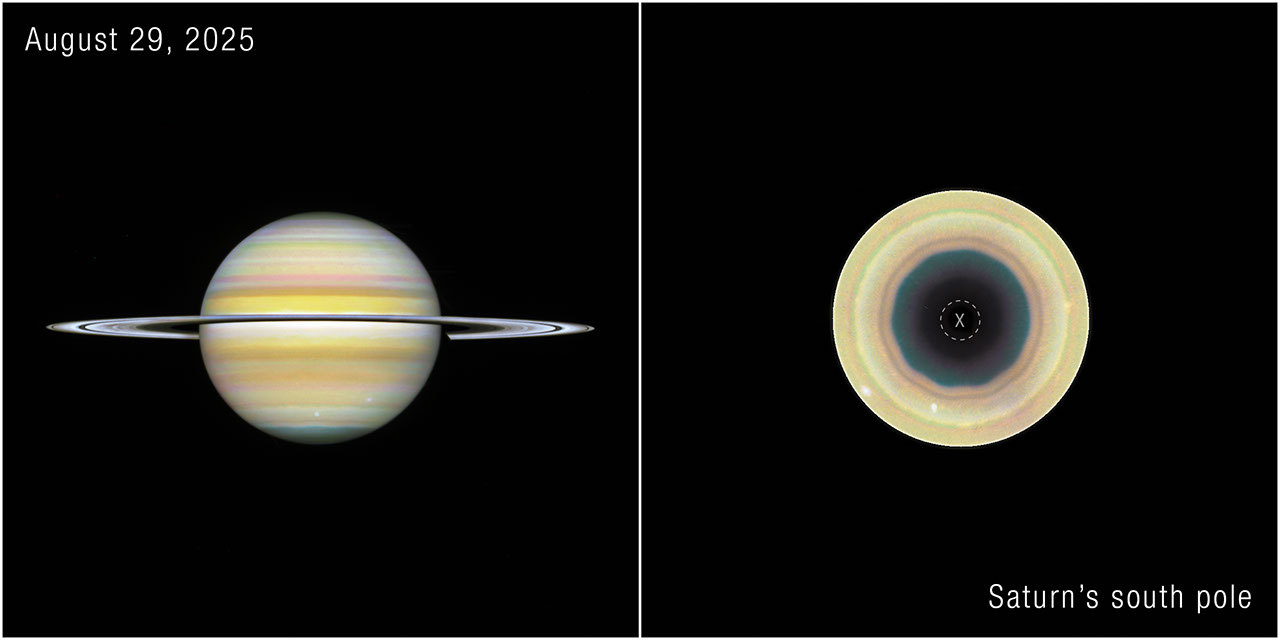
NASA’s Hubble Space Telescope has revealed an unusual new feature in Saturn’s atmosphere: a giant, evolving 10-sided wave circling the planet’s south pole. The structure is notable both for its scale and for its geometry. Researchers say it is the first time a large, regular-sided jet pattern has been identified in Saturn’s southern hemisphere, and the discovery adds a new piece to the long-running puzzle of how the gas giant organizes its polar weather.
The finding immediately invites comparison with Saturn’s famous north-polar hexagon, one of the most recognizable atmospheric features in the solar system. But the newly reported southern pattern is not simply a mirror image of that structure. According to NASA’s description of the observations, the decagon appears to be developing and strengthening, which means scientists may be watching a major planetary weather system emerge rather than merely documenting a stable one that has existed unchanged for decades.
A rare chance to watch a pattern form
That possibility is what makes the result especially valuable. Saturn’s northern hexagon has been observed for more than 40 years, turning it into a fixture of planetary science. The new southern feature appears different in one crucial respect: researchers traced hints of it back through Hubble images collected since 2023 and found signs that the structure grew more distinct over time before becoming a clearly defined 10-sided pattern.
Those observations come from Hubble’s Outer Planet Atmospheres Legacy, or OPAL, program, which has photographed the outer planets annually for more than a decade. Long-running observational campaigns like OPAL matter because giant-planet atmospheres change over years, not just hours or days. Without repeat imaging, subtle transitions can be missed or mistaken for one-off events. By stitching together several years of data, scientists were able to place the southern decagon in an evolutionary context instead of presenting it as an isolated snapshot.
NASA said the feature extends through multiple layers of Saturn’s atmosphere. That detail suggests the phenomenon is not confined to a thin visible cloud band but is tied to deeper atmospheric dynamics. On a planet dominated by powerful jet streams, storms and layered cloud decks, a structure that maintains a regular polygonal shape across altitude bands points to a robust organizing mechanism.
Why polygonal jet streams matter
A geometric pattern in a planetary atmosphere is more than a visual curiosity. It is evidence that the flow of gas around Saturn’s pole can settle into a highly ordered state under the right conditions. Scientists study these shapes because they can illuminate how rotation, temperature gradients, wind speed and wave motion interact in atmospheres that have no solid surface to interrupt circulation.
Saturn is particularly useful for that work because its poles host strong, persistent jet systems. The north-polar hexagon has long been treated as a benchmark case for understanding how a fast-moving jet can create a standing wave with straight edges. A southern decagon broadens that conversation. If Saturn can support more than one kind of polygonal polar structure, then the mechanisms behind the northern hexagon may be part of a larger family of atmospheric behaviors rather than a singular exception.
The distinction between the two poles is equally important. Scientists do not just want to know that Saturn can make polygons; they want to know why the shapes differ, why one appears deeply established while the other seems to be intensifying, and what that says about the symmetry or asymmetry of Saturn’s climate. Seasonal shifts, local wind conditions and vertical structure could all matter. The southern decagon offers a new test case for those ideas.
What Hubble adds to the picture
Hubble’s continuing role in outer-planet science is one of the deeper themes behind the announcement. Although the telescope is often associated with deep-space imagery, it also serves as a long-baseline observatory for changes closer to home. In Saturn’s case, that steady watch allows researchers to compare year-to-year atmospheric evolution with a consistency that is difficult to reproduce through occasional flybys or short campaign windows.
The agency’s summary also underscores the value of cross-institution work. The image credits include NASA, the European Space Agency, the Space Telescope Science Institute, and researchers from several institutions. That collaborative structure is typical of modern planetary science, where discovery depends not just on access to telescopes but on careful processing, repeated measurement and interpretation across multiple teams.
The results were published Wednesday in Science Advances, placing the finding in the peer-reviewed literature and signaling that the observation has moved beyond an eye-catching image into a formal scientific result. That matters because atmospheric interpretation on giant planets is technically demanding. Establishing that a shape is real, sustained and physically meaningful requires more than visual resemblance.
What scientists will be watching next
The obvious next question is whether the decagon will persist. Because NASA described the feature as evolving, future OPAL observations will be crucial for determining whether the wave sharpens further, shifts in symmetry, changes speed or weakens. Researchers will also want to determine how deeply the structure reaches and how it connects to surrounding cloud and wind patterns near the pole.
Several broader implications follow from that work:
- The southern decagon may help explain whether Saturn’s polar weather systems share a common formation mechanism.
- Its apparent growth could reveal how quickly giant-planet atmospheric structures can organize on seasonal timescales.
- Comparisons with the northern hexagon may improve fluid-dynamics models used for other planets, including exoplanets with thick atmospheres.
For now, the main result is straightforward but significant: Saturn’s south pole is not merely a less famous counterpart to the north. It is producing a large, orderly and still-changing atmospheric pattern of its own. On a world already known for rings and strange weather, Hubble has identified another reminder that even the most familiar planets can still surprise scientists when they are observed patiently, repeatedly and over time.
This article is based on reporting by science.nasa.gov. Read the original article.
Originally published on science.nasa.gov