A Cosmic Valentine From a Dying Star
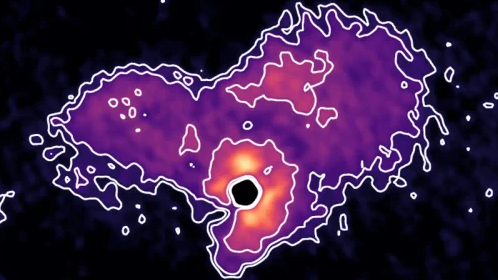
In a discovery that seems almost too poetic to be real, astronomers have observed a dying star producing an outburst in the unmistakable shape of a heart. The phenomenon, captured through advanced telescopic imaging, reveals the dramatic final stages of a star's life creating one of the most visually striking structures ever recorded in space.
The heart-shaped formation is not the work of cosmic Cupid but rather the result of complex physical processes as the star sheds its outer layers in its death throes.
How a Star Creates a Heart
The heart shape emerges from the way the dying star expels material into space. As stars in their final evolutionary stages run low on fuel, they become unstable and eject vast quantities of gas and dust. The specific geometry of this outburst, likely influenced by a companion star or the star's own magnetic field and rotation, has channeled the expelled material into two opposing lobes that together form the heart-like silhouette.
Such bipolar outflows are common in planetary nebulae and the late stages of stellar evolution, but the precise heart shape observed here is exceptionally rare. The symmetry suggests a highly ordered ejection mechanism, possibly driven by gravitational interactions in a binary star system.

What This Tells Us About Stellar Death
Beyond its visual appeal, the heart-shaped outburst provides valuable scientific data about the mechanics of stellar mass loss. Understanding how dying stars shed their outer envelopes is crucial for modeling the chemical enrichment of the interstellar medium, since these ejected materials seed surrounding space with heavy elements that eventually form new stars and planets.
The observation adds to a growing catalog of asymmetric planetary nebulae that challenge the older, simpler models of spherical mass loss. Modern observations increasingly show that stellar death is a complex, sculpted process shaped by rotation, magnetism, and binary interactions.
A Rare and Fleeting Spectacle
Structures like this heart-shaped outburst are cosmically short-lived, lasting perhaps only a few thousand years before dispersing entirely into the interstellar medium. On astronomical timescales, that is barely an instant, making the observation a fortunate capture of a transient phenomenon. Detecting such a structure requires both precise timing and advanced instrumentation capable of resolving fine details in distant stellar environments.
The observation serves as a reminder that even in death, stars can produce moments of unexpected beauty, turning the destructive process of stellar evolution into something that appears almost celebratory. As telescopes grow more powerful and surveys cover larger swaths of the sky, astronomers expect to find more of these sculptured outflows, each one providing new clues about the mechanics of how stars end their lives and seed the cosmos with the raw materials for future generations of stars and planets.
This article is based on reporting by Space.com. Read the original article.

Originally published on space.com