New Glenn moves toward a reuse milestone
Blue Origin has completed a static fire of its New Glenn rocket using the company’s first previously flown booster, marking a significant step in its effort to turn a successful landing into repeatable heavy-lift reuse. The engine test took place on the morning of April 16, 2026, in Florida and, if post-test data review goes well, could clear the way for a launch of AST SpaceMobile’s BlueBird-7 satellite as soon as Sunday, April 19, 2026.
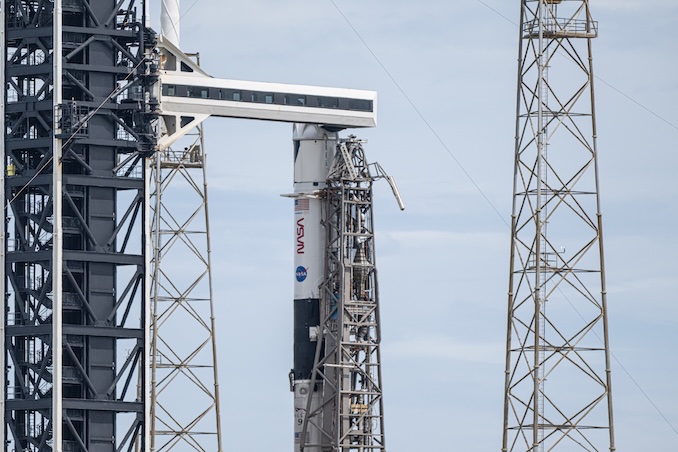
According to the supplied source text from Spaceflight Now, the seven BE-4 engines fired for about 20 seconds at 7:45 a.m. EDT. Just before ignition, the pad’s water deluge system activated to reduce acoustic stress during the test. For Blue Origin, the moment was more than a standard prelaunch checklist item. It was a public demonstration that the company is now pushing beyond booster recovery toward the harder task of putting flown hardware back on the pad.
The first reflown booster, with a twist
The upcoming mission, designated NG-3 by Blue Origin, uses a booster called Never Tell Me the Odds. The booster previously flew and landed during the NG-2 mission in late 2025, making this the first time the company has prepared a previously flown New Glenn first stage for another launch attempt.
But the reuse story is not as simple as flying the exact same propulsion stack a second time. Blue Origin chief executive Dave Limp said the company chose to replace all seven engines on this refurbished booster and also test some upgrades, including a thermal protection system on one engine nozzle. He added that the engines used on NG-2 are planned for future flights.
That detail reveals where Blue Origin is in its reuse maturity curve. Recovering a large booster is already a major technical achievement, but routine airline-style turnaround requires confidence not just in the airframe and landing profile, but in propulsion reuse, refurbishment pace and inspection workflows. Swapping engines suggests the company is still deliberately managing risk as it learns what reflown heavy-lift hardware should look like in operational practice.
A small club with big ambitions
The source text notes that Blue Origin is only the second company to successfully land an orbital-class booster using vertical descent, after SpaceX. That places the company in a very limited group, but it also highlights the distance still left to close. SpaceX has already reflown boosters hundreds of times, turning reusability from a demonstration into a production system. Blue Origin, by contrast, is now entering the phase where it must prove that recovery can support cadence, not just headlines.
New Glenn is central to that effort. The rocket is designed as a heavy-lift vehicle, and Blue Origin has said its boosters are intended to support up to 25 flights each. The source text makes clear, however, that it is still uncertain whether that target assumes the same engines flying throughout the booster’s life or a more modular approach in which engines and structures may have different reuse limits.
That is a consequential unknown. In launch economics, reuse is not merely about whether hardware survives. It is about how much labor, replacement and inspection is required between flights. If a booster can land but demands extensive refurbishment or major component replacement, the benefits narrow. The NG-3 campaign is therefore important not just as a mission milestone, but as an early signal about Blue Origin’s operational philosophy.
What the static fire actually showed
Static fires are designed to validate the integrated performance of engines, vehicle systems and ground equipment while the rocket remains secured to the pad. In this case, the roughly 20-second burn demonstrated that the seven-engine first stage could be brought to life in a coordinated test ahead of launch. Engineers will now review the resulting data to determine whether the rocket is ready for flight.
For a previously flown booster, that analysis carries extra weight. Any reuse program depends on building confidence that refurbishment, replacement decisions and upgraded components perform as intended when the full system is loaded and fired. The test therefore acts as both a safety check and a learning exercise.
The mission payload adds another layer of interest. The planned launch would carry AST SpaceMobile’s BlueBird-7 satellite, tying New Glenn’s technical progress to a commercial customer mission rather than an isolated internal demo. That is important because launch providers ultimately have to prove reliability in service, not just in development campaigns.
The next phase for Blue Origin
The broader picture is that Blue Origin is beginning to assemble the pieces of a reusable orbital fleet. The source text also notes that Limp recently revealed another booster in development, suggesting the company is expanding beyond a one-off recovery narrative and toward a growing inventory of flight hardware.
Even so, the weekend launch opportunity is best seen as an incremental but meaningful checkpoint. A successful static fire does not settle the long-term questions around cadence, engine reuse or cost structure. What it does show is that Blue Origin is transitioning from first achievements to second-order challenges: refurbishment choices, upgraded hardware, repeat launch preparation and the institutional discipline required to make reuse routine.
If NG-3 launches on April 19, 2026, it will not merely place another payload into orbit. It will also test whether New Glenn’s recovery success in late 2025 can begin to evolve into an actual reusable launch system. For Blue Origin, that distinction matters. In the modern launch market, recovery is impressive, but repetition is what changes the industry.
This article is based on reporting by Spaceflight Now. Read the original article.
Originally published on spaceflightnow.com