NASA turns a successful recovery into mission data
NASA’s Artemis II crew has completed a major milestone in the agency’s lunar campaign, splashing down in the Pacific Ocean off the coast of California before returning to Houston for a postflight news conference. The supplied source text identifies the crew as Reid Wiseman, Victor Glover, Christina Koch, and Canadian Space Agency astronaut Jeremy Hansen, and notes that the mission is the first crewed flight in the Artemis program.
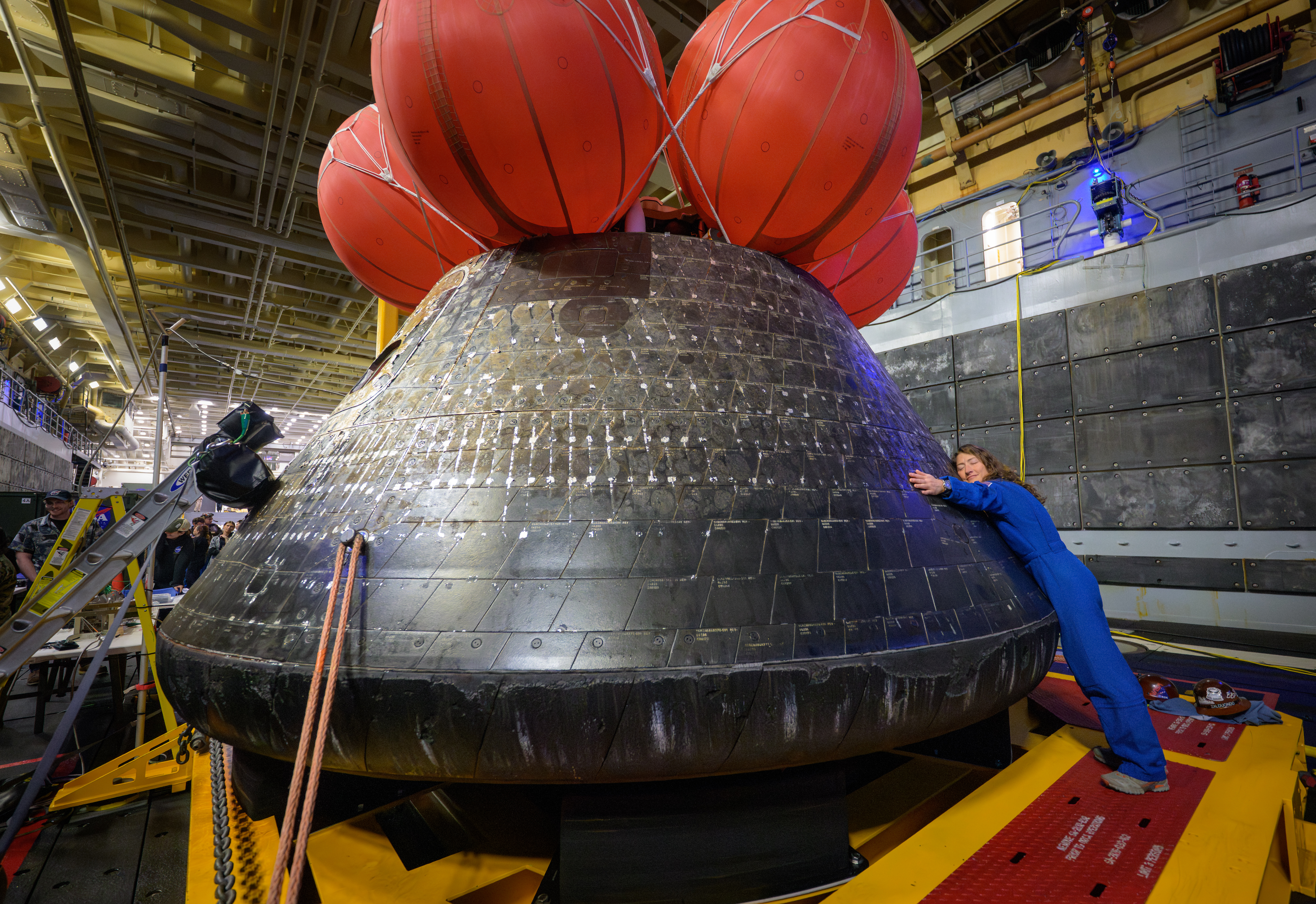
The immediate images from the recovery were striking, including a published NASA photo showing Koch embracing the Orion spacecraft aboard the USS John P. Murtha. But the larger importance of the event lies in what comes next. Artemis II was explicitly described in the source text as a test flight, and NASA says lessons from it will inform the agency’s return to the lunar surface and later missions to Mars.
Why the splashdown mattered
Crewed missions are judged not only by launch and in-flight operations, but also by how safely and efficiently astronauts and hardware are recovered. According to the supplied text, a combined NASA and U.S. military team met the crew in open water, assisted them out of Orion, and transported them by helicopter to the recovery ship for initial medical checks.
That sequence is more than ceremonial. Recovery operations are part of the mission architecture. They test communications, timing, coordination, crew handling, shipboard procedures, and the practical realities of bringing astronauts home after a high-profile spaceflight. Every step generates data that can be used to refine training, procedures, and timelines for future missions.
The first crewed Artemis flight carries broader weight
Artemis II occupies a distinct place in NASA’s current strategy because it is the first time the agency has put a crew into the Artemis system. Earlier work could validate hardware and concepts, but a crewed mission forces every part of the program to operate under tighter scrutiny. Human spaceflight raises the standard for systems integration, recovery readiness, and mission assurance.
The inclusion of Hansen also reinforces the international dimension of Artemis. The program is not being positioned solely as a U.S. lunar return, but as a multinational architecture that can support broader exploration goals over time. That matters politically as well as operationally, because long-duration exploration programs depend on durable alliances as much as on launch hardware.
What NASA is likely to carry forward
The source text does not enumerate the specific lessons learned, but it does make clear that Artemis II is feeding directly into future missions. In practical terms, that means the flight is likely to shape how NASA evaluates spacecraft performance, crew experience, mission operations, and recovery execution before the next steps in the Artemis cadence.
That is the central significance of the mission’s conclusion. Splashdown is not the end of the work. It is the start of the close review that determines which systems performed as expected, which procedures need revision, and what confidence NASA can carry into its next lunar efforts.
With Artemis II complete, NASA now has more than symbolic progress. It has crewed-flight evidence. For a program built around returning humans to deep-space operations and eventually extending that experience toward Mars, that evidence is the real payload.
This article is based on reporting by NASA. Read the original article.
Originally published on nasa.gov