A sharp new look at a familiar galaxy
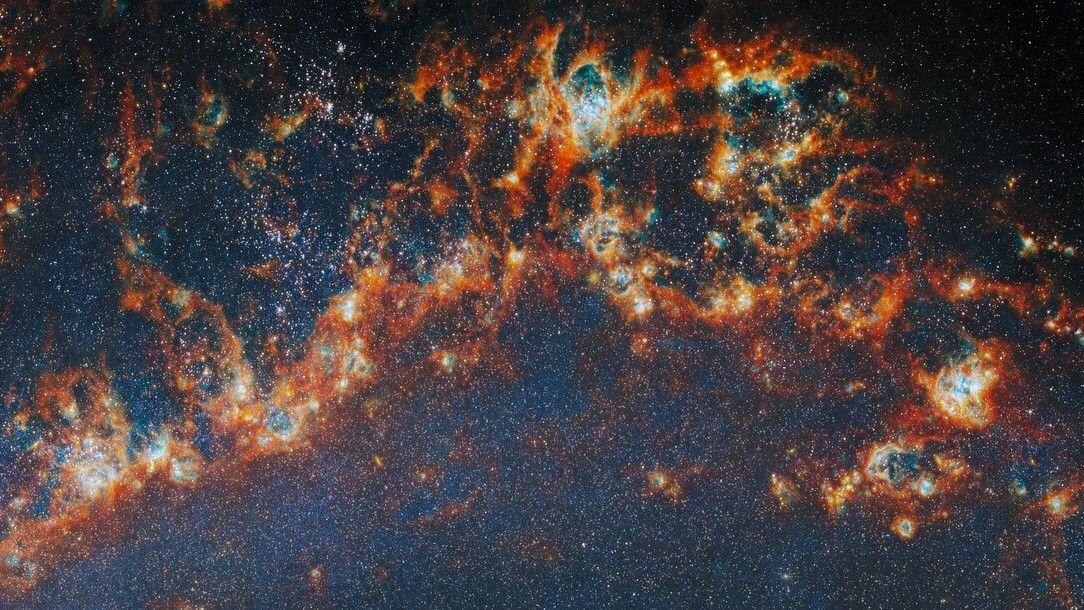
A combined image from the James Webb Space Telescope and the Hubble Space Telescope is giving astronomers a closer view of how star formation reshapes a galaxy from the inside. The target is one spiral arm of the Whirlpool Galaxy, also known as Messier 51, about 31 million light-years away in the constellation Canes Venatici.
The image was shared May 6 and is part of a broader study published the same day in Nature Astronomy. According to the supplied reporting, the observations show that larger groups of stars leave their birth clouds much faster than smaller groups do. That finding bears directly on one of astronomy’s longstanding questions: what happens in the period immediately after stars form inside dense clouds of gas and dust.
What the telescopes reveal together
The power of this result comes from combining the strengths of two observatories. Hubble provides detailed visible-light views, while Webb can see infrared light and detect stars that would otherwise remain hidden behind dust. In a galaxy where star formation is wrapped inside thick clouds, that matters enormously.
The resulting image shows red-orange threads of gas and dust stretched through the spiral arm, along with blue bubbles glowing from within. Bright white star clusters appear where gaps open in the gas. In physical terms, the image captures a transition: stars are born inside obscuring material, then their radiation, winds, and eventual supernova activity begin to push that material away.
That process is known as stellar feedback, and it is one of the key regulators of galactic evolution. Not all of a galaxy’s gas ends up turning into stars. Once young stars begin injecting energy into their surroundings, they can halt further collapse in nearby regions, disperse their birth clouds, and alter the pace and pattern of future star formation.

Why this matters beyond one pretty image
The Whirlpool Galaxy has long been a favorite target for astronomy because its spiral structure is prominent and relatively nearby by extragalactic standards. But the importance of this new image is analytical, not just aesthetic. By looking across multiple wavelengths and comparing different clusters, astronomers can begin to estimate how quickly young stellar populations emerge from their natal clouds and how that differs by cluster size.
The supplied report says larger groups of stars leave those birth clouds more quickly than smaller ones. That implies the local environment around massive stellar groupings is cleared more efficiently, likely because the combined effects of strong stellar winds, ultraviolet radiation, and later supernovae are more intense. In other words, more stars acting together reshape their surroundings faster.
That matters because the same feedback cycle influenced the early universe. Understanding how star clusters clear gas today helps astronomers interpret how galaxies evolved when the cosmos was younger, denser, and more actively forming stars.
A visible record of feedback in action
The image makes the theory easier to picture. Where gas and dust still dominate, star formation remains partly hidden. Where bubbles and gaps appear, feedback has already carved channels through the material. The white clusters mark places where stars are no longer fully enclosed. Webb’s infrared sensitivity is especially useful here because it can expose stars still embedded in dusty regions and connect those hidden populations to the larger pattern.
That link between embedded stars, visible clusters, and cleared cavities gives astronomers a more continuous view of the star-formation timeline. Instead of observing isolated phases, they can trace a sequence from cloud collapse to emergence and environmental disruption.
What this research adds
The study does not solve every mystery of star birth, but it sharpens a crucial part of the picture: the earliest relationship between newborn stars and the material that made them. Once that relationship is better measured, models of how galaxies sustain or suppress star formation become more reliable.
In that sense, the new Whirlpool Galaxy image stands as more than a showcase for two powerful space telescopes. It is a research tool that turns a familiar spiral arm into a laboratory for feedback physics. By showing how star clusters escape and clear their surroundings at different rates, the observations bring astronomers closer to understanding how galaxies regulate themselves over cosmic time.
This article is based on reporting by Live Science. Read the original article.
Originally published on livescience.com