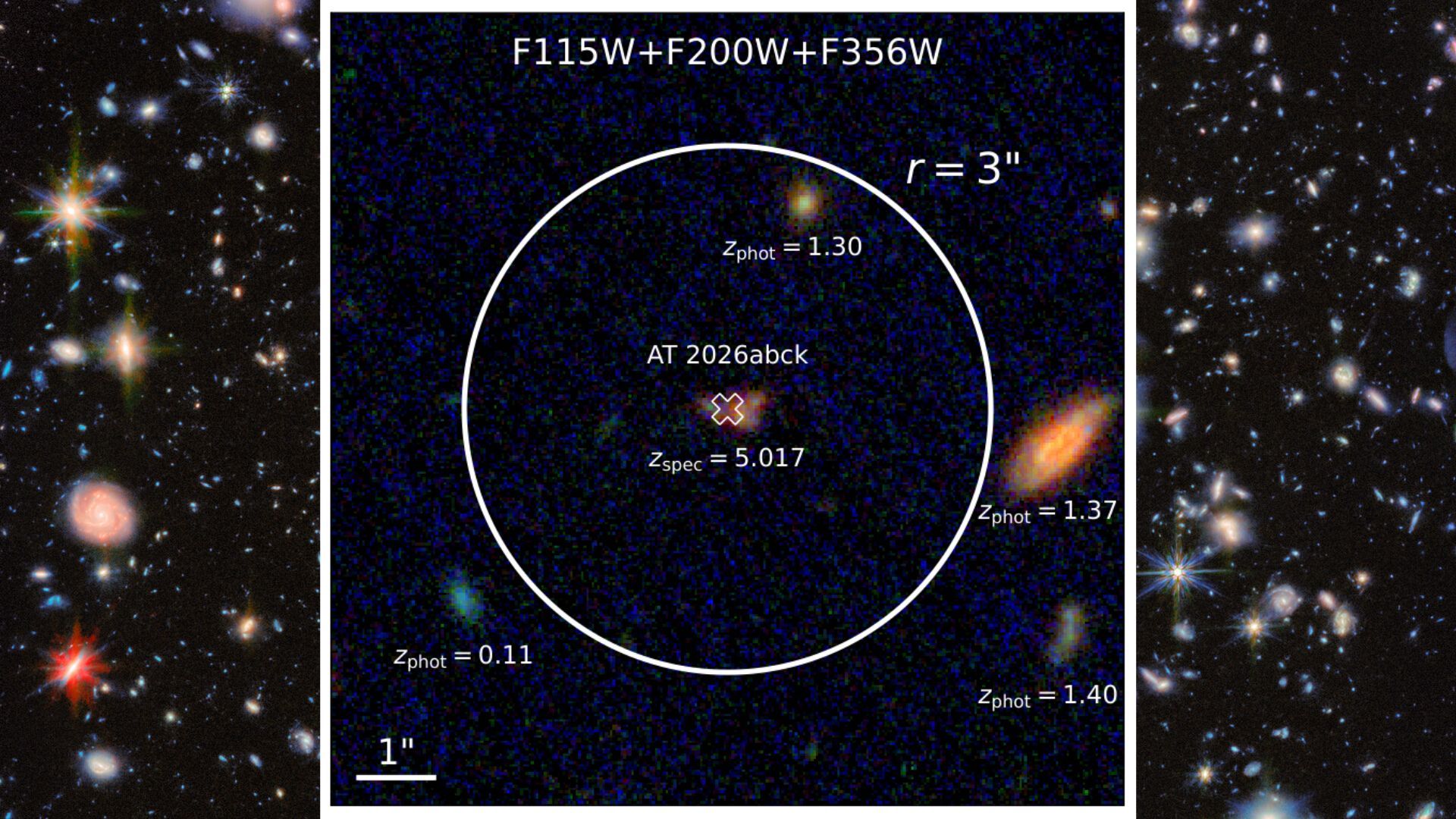
A possible record-setting stellar explosion
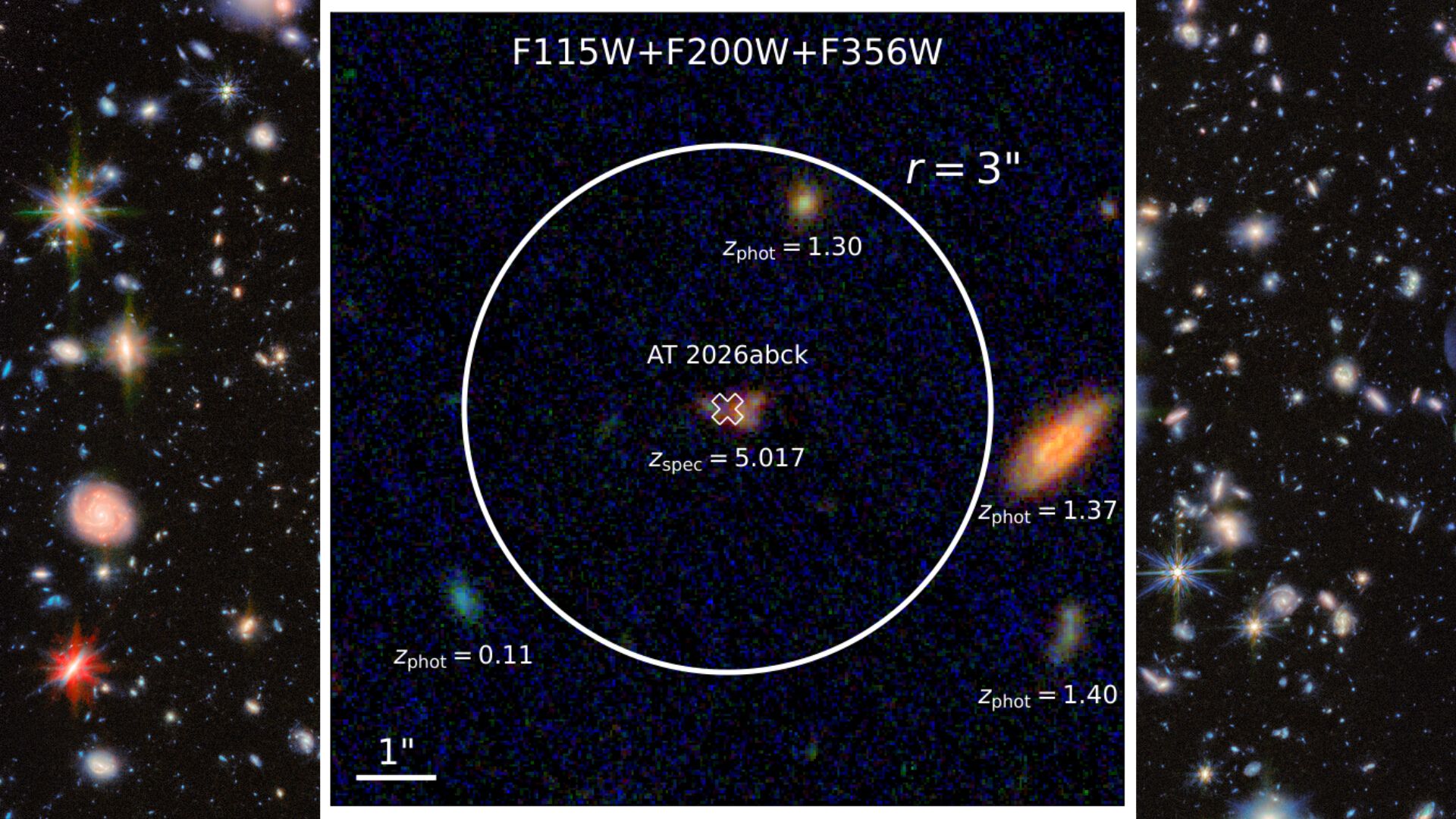
Astronomers using the James Webb Space Telescope may have observed one of the most distant supernovas yet found—and may be seeing it only days after its eruption. The object, designated AT 2026abck, is dated to roughly 1.15 billion years after the Big Bang, when the universe was less than one-tenth of its present age.
The discovery is described in a paper uploaded to the arXiv preprint server on September 29. It has not yet been peer reviewed, an important qualification for a result that could help astronomers study how massive stars ended their lives in the young universe.
The light from the explosion began its journey about 12.5 billion years ago. During that time, the expansion of the universe has greatly increased the distance between the source and Earth; the researchers say that distance has effectively expanded by around sixfold. Webb’s infrared sensitivity is central to this kind of work because light from remote early-universe objects is shifted to longer wavelengths as space expands.
An exceptionally bright transient
According to study co-author Xiaohui Fan, an observational cosmologist at the University of Arizona, the supernova reached a peak brightness of about 8 billion times that of the Sun—nearly comparable to the luminosity of the Milky Way. Across the course of the explosion, it radiated roughly the energy the Sun will emit over about 2 billion years.
The reported observations also offer a snapshot of the event’s physical conditions. The newly found supernova was said to shine at more than 30,000 degrees Fahrenheit, or about 16,000 degrees Celsius. Its shell of ejected material had expanded to an estimated radius of approximately 46 astronomical units, a scale comparable to the greatest distance of Pluto from the Sun.
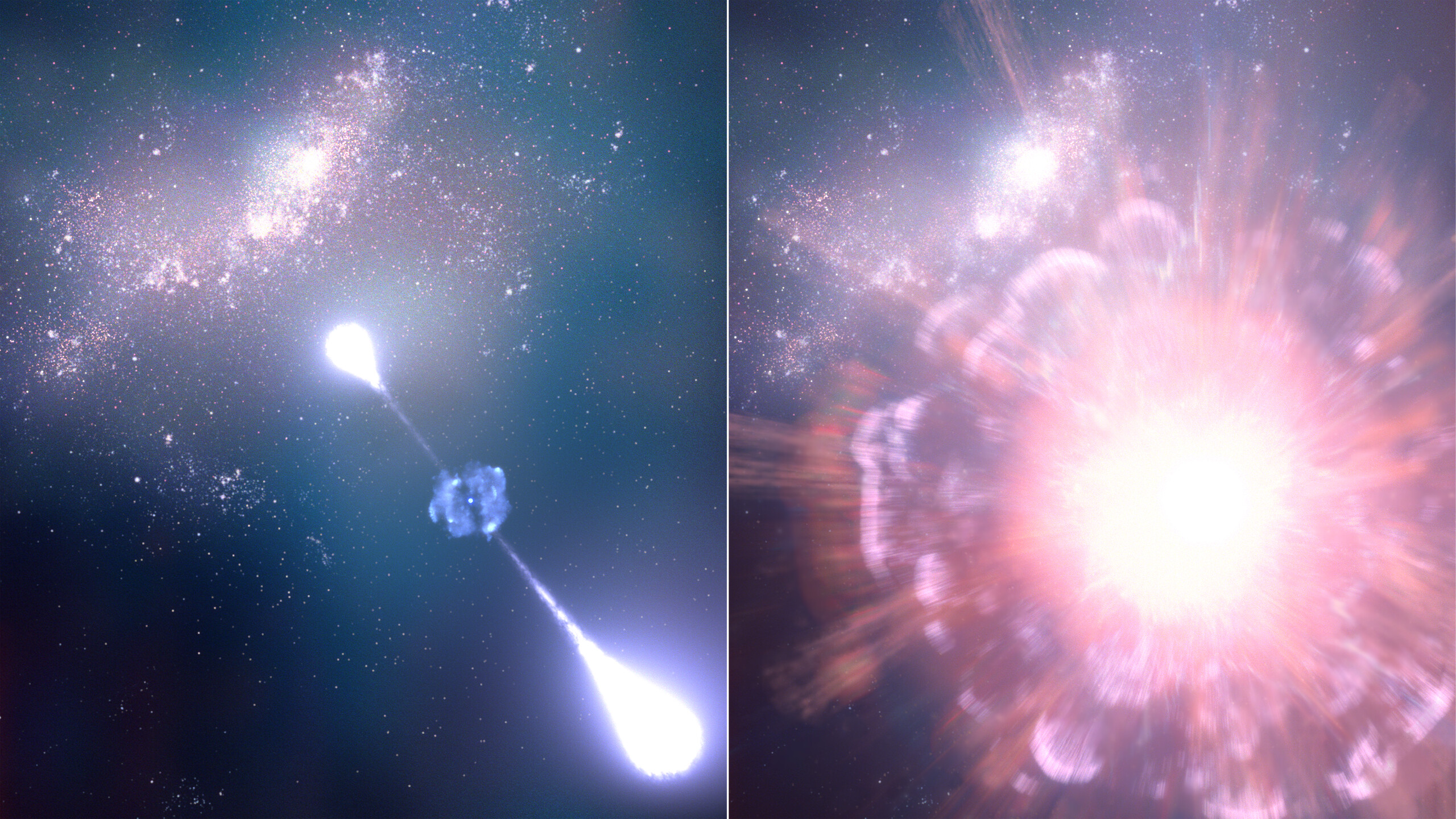
Those numbers convey both the violence and the speed of a supernova. In a matter of days, matter expelled from a dying massive star can form an enormous, intensely hot envelope around the explosion. Capturing that early phase is difficult even for nearby events; doing so for a source from the universe’s first few billion years is particularly valuable.

Why early observations matter
A supernova changes rapidly after it begins. Its brightness, temperature and spectrum evolve as the blast wave moves through material around the star and the ejecta expand and cool. Observations obtained close to the eruption can preserve clues that become harder to recover later, including information about the star’s outer layers and its immediate surroundings.
For AT 2026abck, the team believes it is seeing the explosion just days after ignition. If further analysis confirms that interpretation, the observation would give researchers a rare view of a massive stellar death at a period when the universe was producing enormous numbers of new stars.
The young cosmos was a different environment from today’s local universe. Stars were forming rapidly, and the chemical makeup of galaxies was still being shaped by repeated generations of stellar birth and destruction. Supernovas are central to that transformation because they disperse material forged in stars into surrounding space, where it can later become part of new stars, planets and other structures.
Webb’s role in finding the distant universe
The James Webb Space Telescope has expanded astronomers’ ability to observe faint, distant and redshifted sources. In this case, its observations made it possible to identify an extraordinarily luminous transient at an epoch more than 12 billion years in the past.
Distance alone does not make a supernova scientifically decisive. Researchers must still establish its type, reconstruct its evolution and rule out alternative explanations. The fact that the study remains a preprint means its methods and conclusions have not undergone formal peer review. The eventual scientific picture could change as other researchers examine the data and as the team continues to analyze the event.
Still, the report illustrates a broader shift in observational astronomy. Telescopes capable of repeatedly surveying deep fields can now do more than catalog ancient galaxies. They can catch changing objects within them, allowing astronomers to study individual stellar events across much of cosmic history.

A result awaiting confirmation
The strongest conclusion at this stage is carefully phrased: AT 2026abck may be among the most distant supernovas ever observed, and the data may capture it in its first days. Those are compelling possibilities, but they are not yet final ones.
Peer review and additional study will be needed to test the object’s distance, classification and inferred timing. If the finding holds, it would add a bright new data point to efforts to understand massive stars and stellar explosions when the universe was still young.
For now, the event is a reminder of the unusual temporal reach of modern astronomy. Webb is not watching an explosion as it happens in the present. It is receiving ancient light from a star that died billions of years ago—light that is only now arriving with enough detail for researchers to reconstruct its brief, violent final act.
This article is based on reporting by Live Science. Read the original article.
Originally published on livescience.com