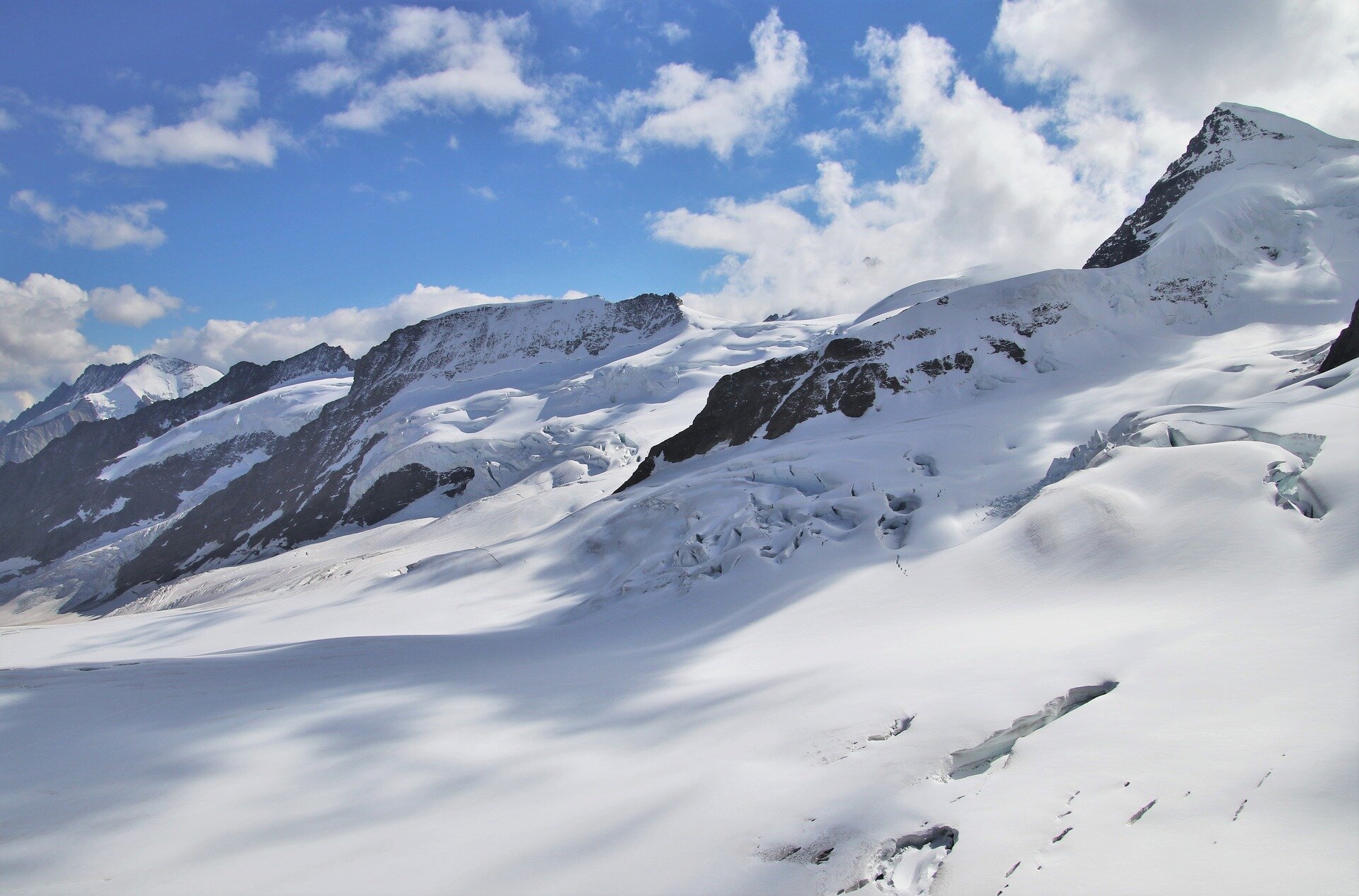
Daily extremes change the picture of glacier melt
Global glacier projections often work from monthly climate averages. That approach is useful for representing broad trends, but it can smooth away the weather events that determine how a glacier changes from one day to the next. A new study led by researchers at ETH Zurich and Vrije Universiteit Brussel argues that this missing detail matters: when daily weather variability is included, simulations produce greater glacier ice loss by the end of the century than conventional monthly calculations.
The research, published in Nature Communications, updates the Global Glacier Evolution Model, known as GloGEM, so that it operates at daily resolution. The team applied the approach to more than 12,500 glaciers, representing 94% of global glacier ice volume. The daily model also better reproduced observed glacier mass loss than the traditional monthly method, according to the researchers.
The central finding is not simply that warmer conditions melt ice. It is that the timing, duration and sequence of weather conditions can alter a glacier's surface in ways that monthly averages cannot fully capture. A brief heat wave, a spell of rain near the freezing point, or a sequence of warm days after a snowfall can have consequences that extend beyond the event itself.
Why a few hot days can matter so much
Glaciers are highly sensitive to whether their surface is covered by fresh snow or exposed ice. Snow reflects more sunlight, while darker glacier ice absorbs more solar energy. During an unusually warm period, snow can disappear quickly and reveal that darker ice. Once exposed, the surface can absorb more energy and melt faster.
A monthly average may show moderately warm conditions, even when the month included several exceptionally hot days capable of stripping away protective snow cover. The average therefore misses the rapid switch between a reflective snow surface and a more heat-absorbing ice surface. The new model is designed to resolve those transitions day by day.
Precipitation adds another source of uncertainty. In mountain environments, whether precipitation arrives as rain or snow can depend on small temperature differences around the freezing point. Snow can add mass to a glacier and maintain a reflective surface. Rain, by contrast, does not provide the same accumulation and can affect runoff conditions. Daily modelling is better able to represent these shifts as temperatures fluctuate.
A model built around weather as glaciers experience it
Lead author Lander Van Tricht said glaciers respond to the weather they experience each day rather than to monthly averages. That observation explains why the researchers focused on high-frequency changes such as heat waves, heavy precipitation and sudden temperature swings.
In practical terms, the revised GloGEM model tracks rapid changes between snow-covered and exposed ice surfaces and the associated change in melt. The study says this gives a more realistic representation of the processes behind glacier mass loss. It also means that short-lived extremes, which might look minor in a monthly record, can have a disproportionately large effect on a glacier's seasonal balance.
The work comes after exceptional heat waves and extreme melt seasons have been observed in several glacierized regions. The study does not treat those events as isolated anomalies with little bearing on long-term modelling. Instead, it shows why their physical effects should be represented directly in projections.
What the result means for sea-level planning
Mountain glaciers are a significant contributor to sea-level rise as they lose mass. If models underestimate their melt by smoothing out daily extremes, planners may also be working from projections that understate one part of future sea-level change.
The study does not eliminate uncertainty from glacier forecasting. Future emissions, regional climate patterns, snowfall and the evolution of extreme weather all remain important. But it identifies a specific modelling limitation and offers a way to address it: use daily climate information when modelling a system that can change rapidly over only a few days.
That distinction is particularly important as climate risks are increasingly assessed through extremes rather than averages alone. Infrastructure, water management and coastal planning all depend on understanding not only gradual warming, but also the consequences of short periods of unusual heat or precipitation.

A sharper tool for a changing climate
The new daily-resolution approach reinforces a broader lesson for climate science. Averages remain essential for identifying long-term trends, yet they can conceal the mechanisms through which those trends produce damage. For glaciers, a handful of intense days can determine whether snow persists or ice is exposed, changing the amount of energy the surface absorbs for the rest of a melt period.
By incorporating that day-to-day reality across a global glacier dataset, the researchers have produced projections that better match observed losses and indicate faster future ice decline. The result gives scientists and decision-makers a more detailed basis for assessing glacier change and its contribution to rising seas.
This article is based on reporting by Phys.org. Read the original article.
Originally published on phys.org