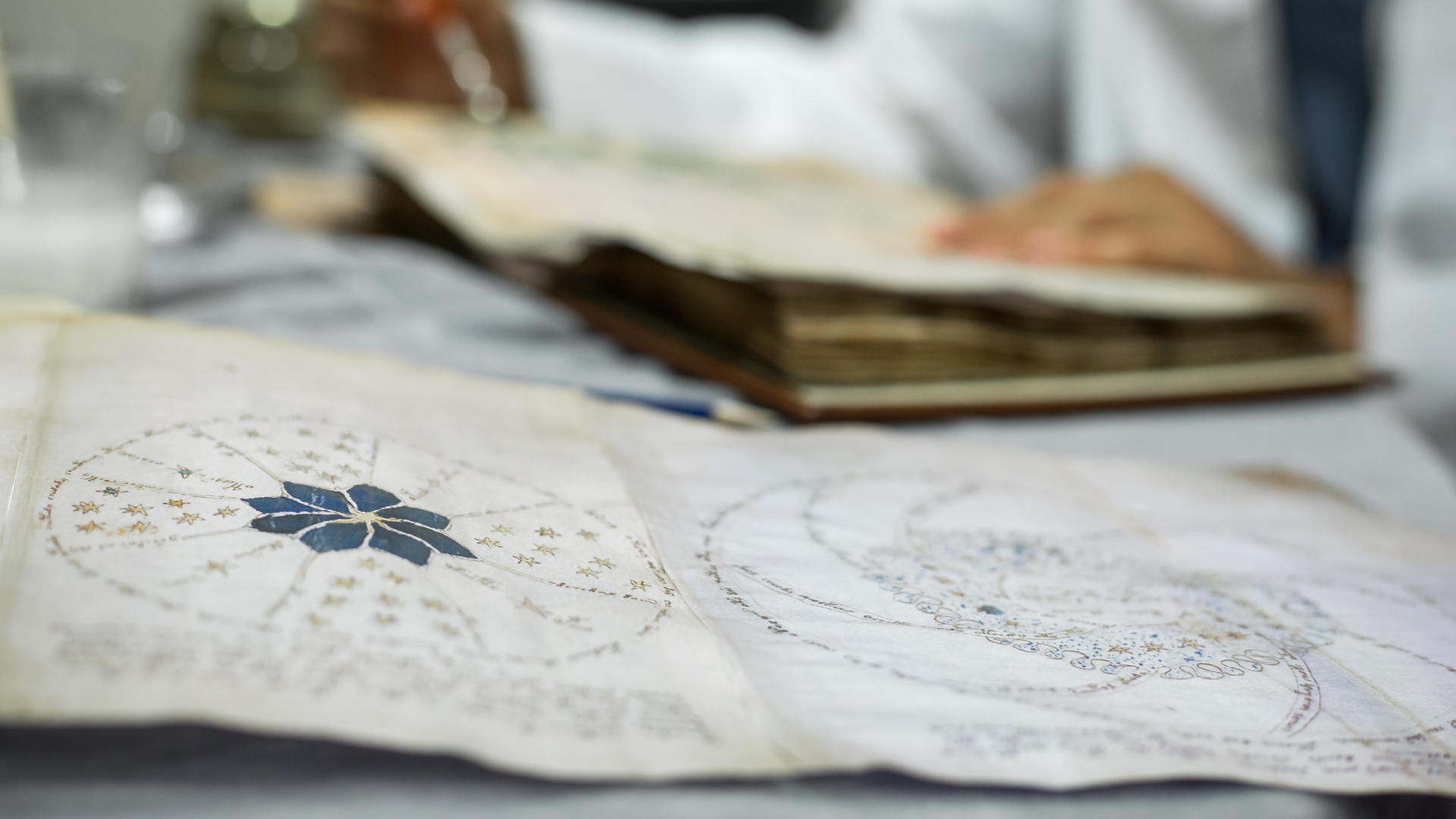
A new analysis of the Voynich manuscript argues that one of history’s most stubborn textual mysteries may also be a physical one: the manuscript may have been bound in the wrong order soon after it was made.
The proposal, published in the journal Digital Medievalist, does not claim to decipher the manuscript’s unknown script. Instead, it addresses a basic but consequential question about the medieval codex’s construction. If leaves and gatherings were rearranged while being bound, readers and researchers may have been trying to interpret a document whose text and illustrations no longer follow the sequence intended by its makers.
A century-old puzzle with a structural problem
The Voynich manuscript is a parchment codex carbon-dated to the early 15th century. Its 240 pages contain roughly 38,000 words written in an otherwise unique script commonly called Voynichese. The text is accompanied by images of plants, people and astrological symbols. Despite more than a century of attempts by code-breakers, linguists and medieval scholars, no consensus has emerged on what the writing says, whether it is a cipher, or even what kind of work it was meant to be.
The manuscript, also known as the Beinecke Cipher manuscript, was purchased by bookseller Wilhelm Voynich in 1912 and has been held by Yale University’s rare book library since 1969. Its strange writing has naturally drawn attention, but the new work redirects attention to the object itself: its handwriting, its folded parchment leaves and the relationships between images spread across pages.
Lisa Fagin Davis, executive director of the Medieval Academy of America and a co-author of the study, noticed patterns that did not make sense while examining how many scribes copied the document. According to the report, the handwriting appears to alternate in ways that would be difficult to explain in a coherent sequence. There are also illustrations that appear to run off one page and resume on another page separated by several intervening leaves.

Why the order matters
Medieval manuscripts were assembled from folded sheets of parchment, known as bifolia, that were grouped into gatherings and then sewn and bound. A mistake in that process can do more than put a few pages out of sequence. It can separate a drawing from its continuation, shift a section away from the text that relates to it, and turn a logical progression into an apparent jumble.
That possibility is especially important for the Voynich manuscript because researchers have long tried to infer meaning from the arrangement of its illustrations and writing. A page showing a botanical image, a diagram or a figure may be interpreted differently when it is read beside different neighboring pages. If the present order is not original, conclusions drawn from adjacency and section order become less secure.
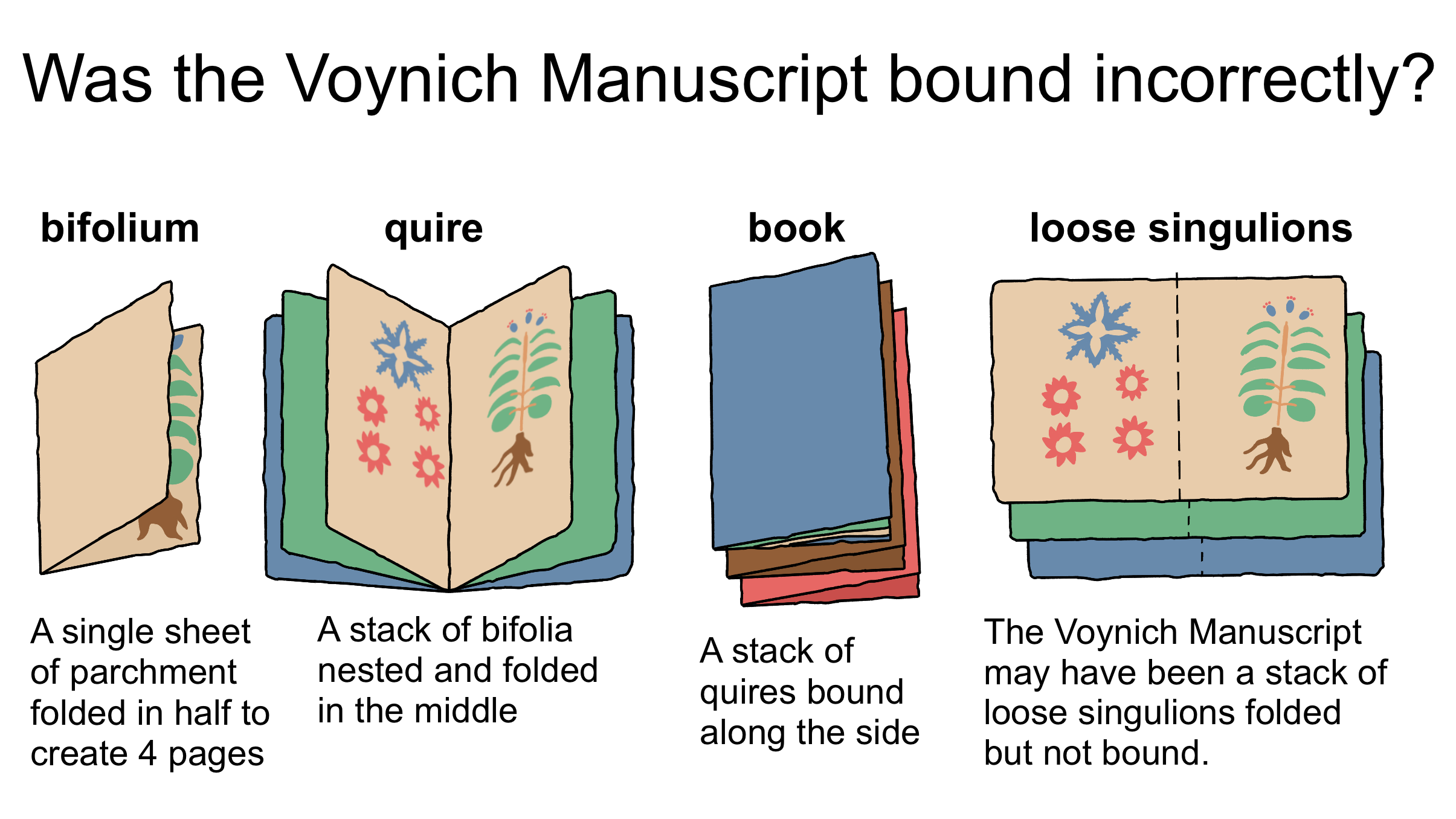
Davis and co-author Colin Layfield, an information systems researcher at the University of Malta, suggest that a later binder may have mishandled a manuscript they could not read. That explanation would fit a practical problem: a person rebinding an unfamiliar work could not rely on readable headings, page numbers or normal textual continuity to confirm the correct order.
A lead, not a solution
The finding does not establish the language of Voynichese or prove that the text conceals a conventional message. It also does not mean every unusual feature in the manuscript results from rebinding. The document remains undeciphered, and its images and script still require explanation.
But the study offers a narrower, testable line of inquiry. Scholars can examine the physical structure of the surviving leaves, compare handwriting patterns, and model alternative sequences to see whether illustrations, text and scribal activity align more consistently. That work could help distinguish features created by the original makers from disruptions introduced during assembly or rebinding.
For a manuscript that has often been treated chiefly as a cryptographic puzzle, the argument is a reminder that material history can shape interpretation. Before deciding what an enigmatic text says, researchers may first need to establish how its pages were meant to be read.

What comes next
A corrected or better-supported reconstruction would not automatically make the manuscript legible. It could, however, give future linguistic and computational analysis a more reliable starting point. If sequences of illustrations and words were disrupted, restoring plausible relationships between them may reveal patterns that are invisible in the current order.
The new study therefore moves the question from a single dramatic breakthrough to a careful reconstruction of a medieval artifact. Its central claim is modest but potentially significant: part of the Voynich manuscript’s mystery may lie not only in its unread script, but in the order in which later readers received it.
This article is based on reporting by Live Science. Read the original article.
Originally published on livescience.com