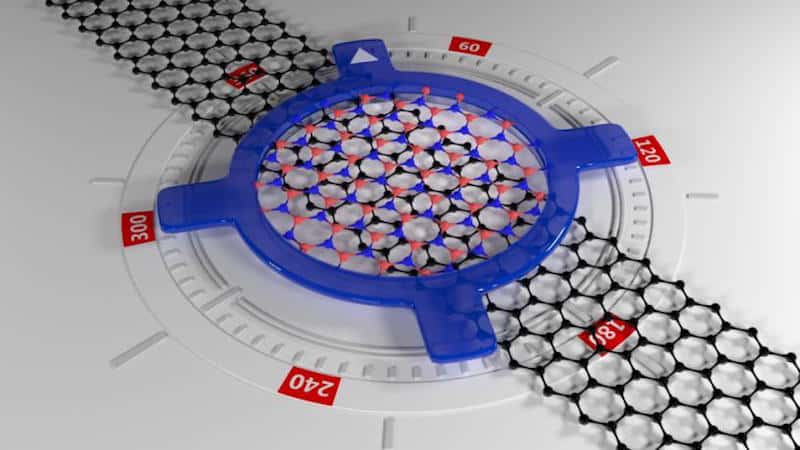
Twistronics has become one of the most productive ideas in modern materials research. The premise is simple to state and surprisingly powerful in practice: stack two atomically thin crystals, rotate one relative to the other, and the combined structure can behave in ways neither layer manages on its own. Depending on the angle, a twisted stack may conduct, insulate, magnetize, or superconduct. A report published in Science, Volume 393, Issue 6818 (September 2026), tackles one of the field's practical bottlenecks by assembling a database of two-dimensional materials that are theoretically twistable.
The wording matters. "Theoretically twistable" signals a computational, screening-first approach rather than a sample-by-sample experimental one. It also suggests a research area that has matured enough to need inventories and shared reference points, not just isolated breakthroughs.
Why a Materials Database Fits the Moment
For the first several years of twistronics, progress centered on a handful of model systems. The best known is twisted bilayer graphene, where rotating two graphene sheets to a specific "magic" angle produced strongly correlated electronic states, including superconductivity. That finding turned twist angle into a real design parameter rather than an alignment detail.
But the combinatorial space is unforgiving. A large and growing family of layered materials can be thinned to single- or few-layer form, and each additional candidate multiplies the number of possible pairings, stacking orders, and rotation angles. Choosing what to build next by intuition alone wastes time and resources. A curated database of theoretically twistable 2D materials narrows that space before anyone touches a glovebox.

What "Theoretically Twistable" Implies
The qualifier is a classification, not a hedge. Any screening effort of this kind has to weigh whether a layered crystal survives exfoliation or growth as a stable monolayer, whether it can be physically rotated without tearing or wrinkling, how strongly the layers bind, and whether the resulting mismatch between crystal lattices generates a usable moiré pattern. The consideration set typically includes:
- Structural stability of the isolated layer under ambient and device-relevant conditions.
- Mechanical robustness — the ability to survive the transfer and stacking steps twistronics requires.
- Interlayer coupling strong enough to matter, weak enough to allow clean interfaces.
- Lattice compatibility, since mismatched constants change the moiré period and the angles at which interesting physics appears.
- Electronic character, which determines whether a twisted version might be metallic, semiconducting, insulating, or magnetic.
A database that scores materials against criteria like these is less a catalogue of finished devices than a map of where the interesting physics is likely to be found.
Moiré physics in brief
When two periodic lattices are overlaid with a slight rotational offset, the interference between them creates a larger, longer-wavelength pattern called a moiré superlattice. That superlattice acts as a gentle periodic potential for electrons, reshaping their band structure. At certain angles the bands can become extremely flat, which slows electrons dramatically and strengthens the interactions between them. Flat bands are the reason twisted systems display correlated phenomena that the parent materials do not. The twist angle, rather than chemistry alone, becomes the tuning knob — which is exactly why knowing in advance which materials can be twisted usefully is so valuable.
From Screen to Laboratory
A theoretical database cannot manufacture a device. It can, however, change how experimental groups prioritize. Instead of surveying candidates one at a time, teams can begin with lists ranked by predicted stability and moiré behavior, then commit fabrication effort to the most promising entries. That shift is familiar from other corners of materials science, where high-throughput computation preceded and then guided synthesis campaigns. The same logic applies here: screen first, then grow, transfer, and measure.
Limitations Worth Keeping in View
Computational predictions are only as good as their assumptions. Real twisted stacks contend with strain, bubbles and wrinkles at interfaces, contamination from the transfer process, and disorder that no idealized model captures. Interfaces in particular are difficult to model, and interfacial chemistry can dominate behavior in ways that bulk calculations miss. A material that passes a theoretical screen may still prove impossible to fabricate cleanly, and one that fails may turn out to be interesting for reasons the screen did not anticipate. Databases are best treated as maps: useful for navigation, never a substitute for the terrain.
What to Watch Next
- Whether experimental groups report devices built from candidates the database flagged, closing the loop between prediction and measurement.
- How the resource evolves — new entries, refined criteria, and possibly broader access for the research community.
- Whether the approach spreads beyond twistronics into adjacent areas of stacked 2D devices, where similar combinatorial problems apply.
The Takeaway
Twistronics grew up fast, moving from a striking experimental result to a broad research program in a few years. The next phase depends less on a single dramatic finding than on systematic exploration — knowing which of the countless possible layer combinations is worth the effort. A database of theoretically twistable 2D materials is an infrastructure contribution in that spirit: unglamorous, unambiguously useful, and likely to shape which twisted systems reach a laboratory bench next. The full report appears in Science, Volume 393, Issue 6818, September 2026.
This article is based on reporting by Science (AAAS). Read the original article.
Originally published on science.org