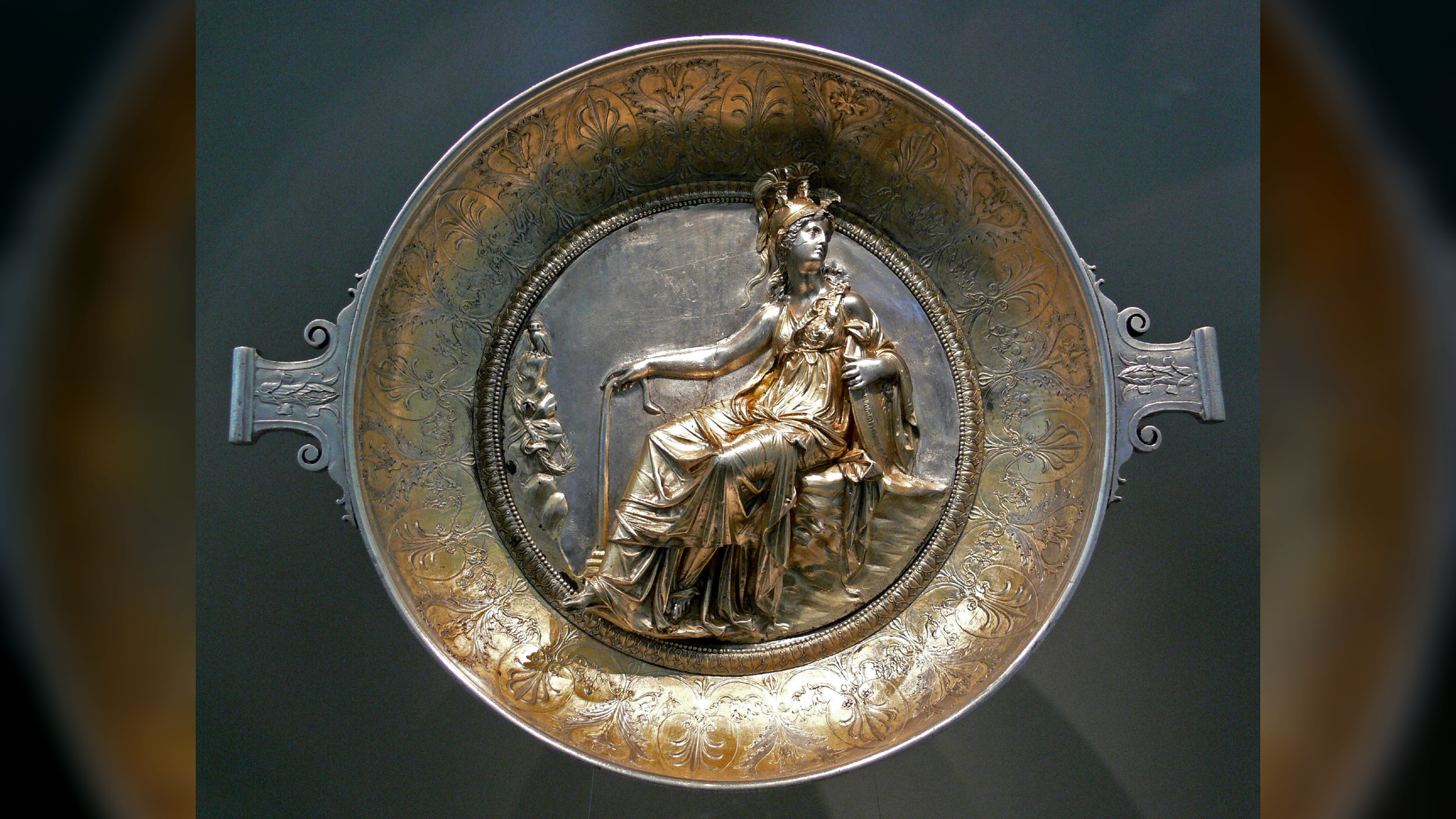
An ornate object from a famous Roman hoard
Archaeological discoveries do not always arrive through fresh excavation. Sometimes the most revealing stories come from objects found long ago and reexamined in light of what they say about power, identity, and movement across ancient frontiers. That is the case with the Athena bowl, a silver vessel with gold accents that forms part of the Hildesheim treasure discovered in central Germany in 1868.
The bowl, highlighted by Live Science, was found in a hoard of dozens of Roman silver artifacts uncovered by soldiers from an Imperial Prussian Army regiment while building a shooting range near Hildesheim. The larger cache has long attracted attention because of its craftsmanship, its frontier location, and the unresolved question of how such a concentration of elite Roman tableware ended up buried far from the Mediterranean heartland.
What makes the Athena bowl distinctive
The object is not merely valuable silverware. It is a carefully composed display piece. According to the source text, the bowl is about 10 inches, or 25.3 centimeters, in diameter and weighs roughly 4.4 pounds, or 2 kilograms. Its central emblem depicts Athena, the Greek goddess of wisdom and war, seated on a rock with a shield under her arm and a plumed helmet on her head. An owl, her sacred bird, perches nearby on a rock encircled by an olive wreath.
Most of the vessel is silver, but gold accents pick out elements of the goddess, her dress, her aegis, the owl, and surrounding details. That mixed-metal treatment underscores the bowl’s ceremonial and visual ambition. This was tableware built to be seen, handled, and understood as a statement of status.

An older emblem set into a newer bowl
One of the most intriguing details in the source material is that the Athena emblem itself was likely crafted in the second century B.C., while the bowl that holds it was created in the first century A.D. In other words, the centerpiece appears to have been older than the finished object. That suggests reuse, adaptation, and perhaps the continued prestige of an earlier luxury component incorporated into a later vessel.
The combination hints at Roman collecting habits and workshop practices that were more fluid than a simple one-object, one-moment story. Elite goods could be repaired, modified, or rebuilt. The source text notes that many vessels in the Hildesheim treasure showed signs of wear and repair, reinforcing the idea that these were not disposable prestige items but long-lived possessions embedded in networks of use and display.
Why the Hildesheim find matters
The bowl’s historical importance also depends on where it was found. Central Germany was not a casual resting place for such objects. The Hildesheim treasure has often been associated with the Roman military presence in the region and may have belonged to Publius Quinctilius Varus or another Roman commander operating against Germanic tribes in the first century.
That attribution remains cautious in the source material, but the underlying significance is clear. The hoard demonstrates that costly Roman luxury goods traveled with or near imperial power on contested frontiers. Military campaigns did not move only weapons and supplies. They also carried the domestic and ceremonial material culture of high-ranking commanders and officials.

Luxury, logistics, and empire
Objects like the Athena bowl illuminate a quieter side of empire. Rome’s expansion is often told through battles, roads, and administration, yet the presence of elaborate silver tableware on the northern frontier reveals how deeply elite social life extended into military zones. Dining, ritualized hospitality, and the visual language of status remained part of Roman life even in unstable territories.
The bowl also reflects the cultural layering of the empire. Although often called the Minerva bowl using the Roman name of the goddess, its imagery is explicitly tied to Athena, showing how Greek mythological iconography remained integral to Roman elite art. That blending of Greek cultural prestige and Roman political power was a hallmark of imperial self-presentation.
What the object can and cannot tell us
The Athena bowl does not solve the full mystery of why the Hildesheim treasure was buried. Hoards can be hidden for many reasons, from battlefield disruption to planned retrieval that never happened. The source material does not claim a definitive explanation, and that uncertainty is part of the object’s enduring hold on historians and the public alike.
What it does reveal is more concrete: exceptional craftsmanship, evidence of repair and reuse, and the reach of Roman luxury into central Europe. It is both an artwork and a data point in the larger history of how wealth moved with empire.

A frontier object with a long afterlife
Today, the Athena bowl continues to resonate because it condenses several historical themes into a single vessel: conquest, collecting, adaptation, and the symbolic value of elite objects. Found in a German forest context yet rooted in Mediterranean artistic tradition, it is a reminder that imperial systems were sustained not only by force but by the circulation of material culture and prestige.
For archaeologists and museum audiences, the bowl remains compelling precisely because it sits at that intersection. It is a beautiful object, but it is also evidence of how Rome projected identity far beyond its urban core and how luxury could survive, travel, and be buried at the edge of power.
This article is based on reporting by Live Science. Read the original article.
Originally published on livescience.com