A major archaeological find emerged from an ordinary field
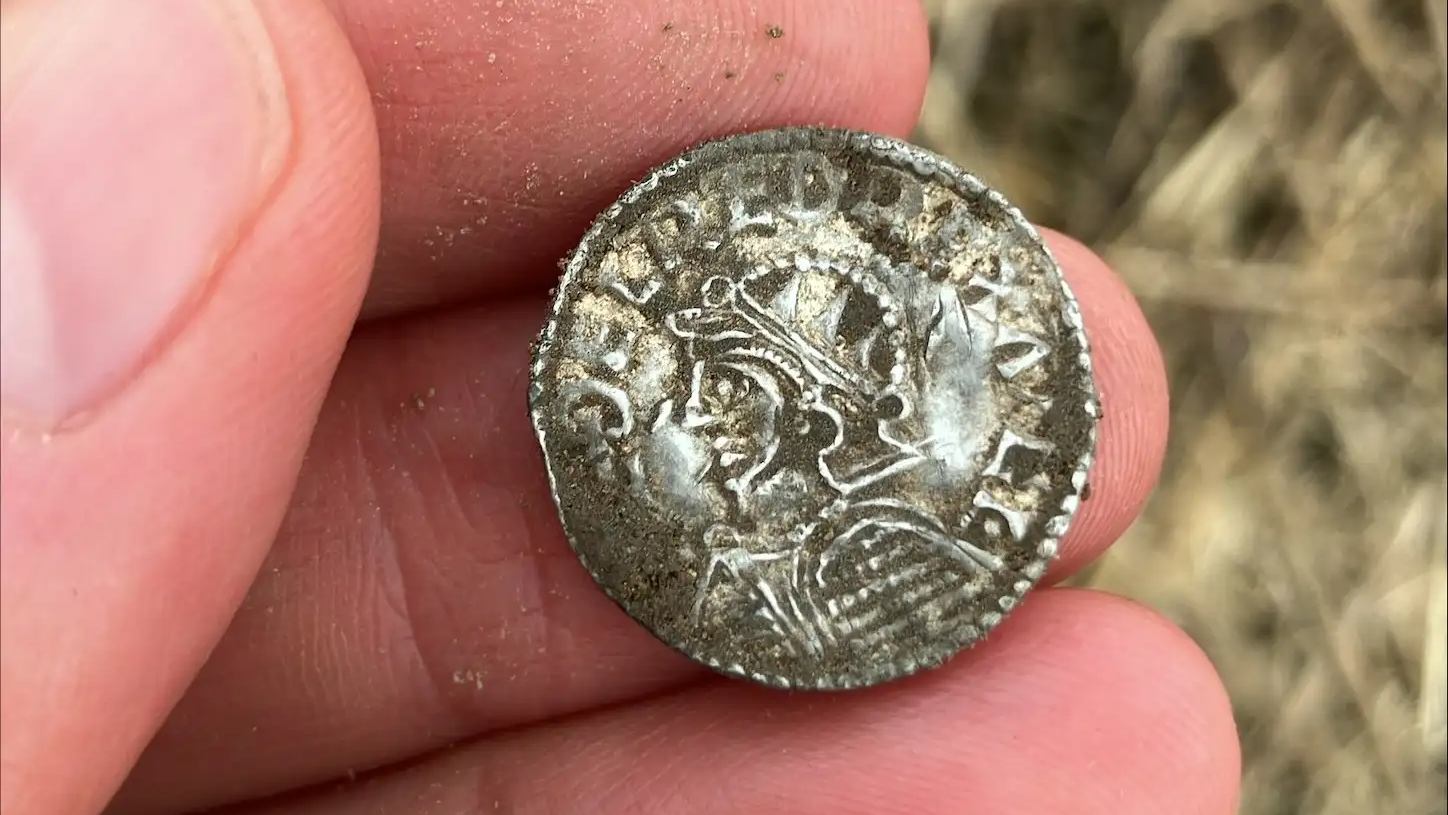
Archaeologists in Norway are studying what has already been identified as the largest Viking coin hoard ever found in the country. The cache, known as the Mørstad Hoard after the farm where it was uncovered near the village of Rena in eastern Norway, contains 2,970 silver coins minted in England, Germany, Denmark, and Norway.
The discovery began on April 10, when two metal detectorists found the first 19 coins. They alerted local archaeologists, who joined the search the next day. What followed quickly exceeded expectations. As one archaeologist, May-Tove Smiseth of the Innlandet County Municipality, told Science Norway in comments cited by Live Science, the detectors “never stopped beeping.”
The dig is still not complete, which means the final count could change. Even at the current total, however, the discovery stands out as a major contribution to Viking Age archaeology in Scandinavia.
What the coins reveal about a changing monetary world
The hoard includes coins minted under several rulers, among them England’s Æthelred II, Cnut the Great, and Holy Roman Emperor Otto III. According to the report, experts at the Museum of Cultural History in Oslo are already examining the material.
The geographic spread of the coins is important. It reflects a monetary environment in which foreign coinage played a dominant role in Norway. Numismatist Svein Gullbekk said that foreign coins dominated the circulation of money in Norway until Harald Hardrada established a national coinage. The presence of a smaller number of coins minted under Hardrada helps date the hoard to around 1050, a period when Norwegian coinage was beginning to take off.
That timing places the hoard at a moment of transition. It sits close to the point where an economy relying heavily on imported and foreign-minted silver began moving toward stronger national monetary identity. In that sense, the find is not only large. It is historically well-positioned.

Trade, power, and mobility in the Viking world
The mixture of English, German, Danish, and Norwegian coins underscores how interconnected the Viking Age economy was. Coins moved with trade, tribute, political influence, and personal wealth. A hoard of this scale indicates access to substantial resources, but it also raises questions about how that wealth was assembled and why it was buried.
The Live Science report notes that the deposit may represent Viking wealth accumulated not from raiding but through trade. That matters because public imagination often narrows Viking history to warfare and plunder. Archaeological evidence like this can broaden the picture by emphasizing commerce, exchange networks, and monetary behavior alongside conflict.
Rulers represented in the hoard reinforce that wider story. Æthelred II and Cnut connect the find to an era when England and Scandinavia were tightly entangled politically and economically. Otto III’s presence reflects links reaching into the Holy Roman world. Even without yet knowing the precise path of each coin, the collection maps a broad northern European system of movement and value.
Why hoards matter to archaeologists
Coin hoards are more than treasure finds. They are time capsules. Because they are often buried within a relatively narrow period, they can preserve a snapshot of circulation patterns at a specific moment. The newest identifiable coins in a hoard can help establish when it was deposited, while the wider mix can illuminate trade routes, monetary adoption, and regional connectivity.
In this case, the hoard may help scholars better understand the overlap between imported silver circulation and the emergence of Norwegian minting under Harald Hardrada. It may also offer clues about savings behavior, insecurity, inheritance, or crisis. People do not usually bury nearly 3,000 silver coins without a reason.

An unfinished discovery with broad implications
One striking detail in the report is that archaeologists are not finished excavating the site. That means both the size and the interpretive significance of the find could grow. Additional coins, associated artifacts, or context from the soil and deposition pattern may sharpen explanations of who buried the hoard and under what circumstances.
Even now, though, the Mørstad Hoard has clear importance. It enlarges the known archaeological record for Viking Age Norway, anchors discussion of monetary transition around the mid-11th century, and offers a vivid reminder that the Viking world was shaped by exchange as much as conquest.
A discovery that links local land to continental history
Finds like this matter because they connect a single field to a much larger historical landscape. The buried silver traces routes between kingdoms, imperial centers, and local communities. It shows how money traveled before modern states standardized currency and before national economies were fully bounded in the way they are often imagined today.
For Norway, the hoard is a national record. For historians of medieval Europe, it is a new data point in the story of how value, sovereignty, and long-distance networks evolved in the 11th century. For now, the coins are still being examined, but the discovery has already done something rare: it has forced a revision of scale while opening new questions about one of the most dynamic periods in northern European history.
This article is based on reporting by Live Science. Read the original article.

Originally published on livescience.com