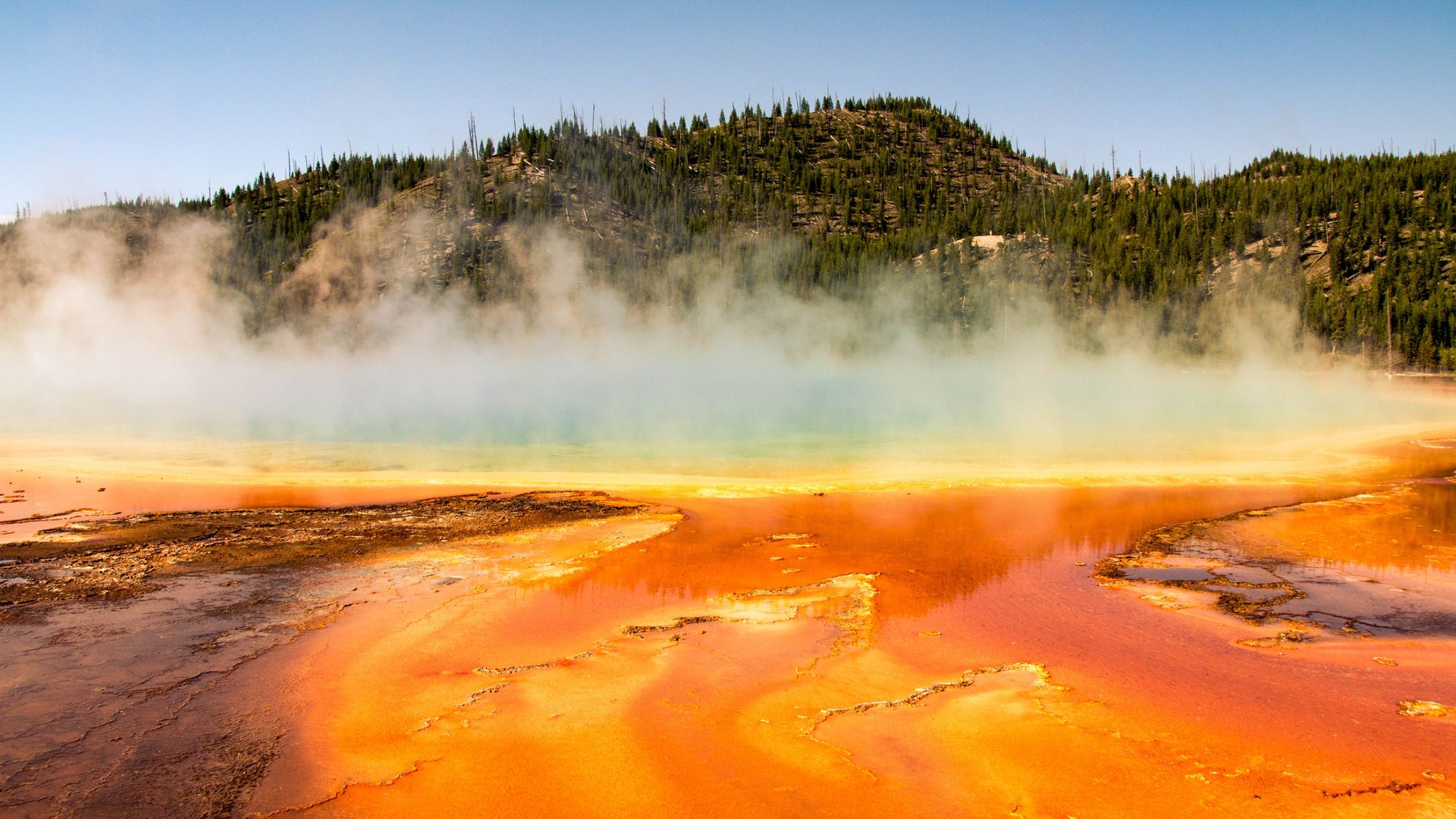
A new model for one of Earth’s most watched volcanic systems
Yellowstone’s famous volcanic system may work differently than many scientists have assumed. According to the supplied source material, new research suggests the region’s eruptions are driven more by shifts in Earth’s crust than by a deep well of magma rising from below. If that interpretation is correct, it would change how researchers think about Yellowstone’s internal plumbing and how future eruption models should be constructed.
The study enters a long-running debate over the source of Yellowstone’s volcanism. One view holds that a deep mantle plume beneath the region sends very hot material upward, heating the crust and feeding volcanic activity. Another view argues that the more important forces lie within the crust and upper mantle themselves, where pressure, structure, and tectonic behavior shape how magma is generated, stored, and mobilized.
The new research, as summarized in the source text, leans toward the second explanation. That does not make Yellowstone less important or less complex. It makes the system more dependent on the behavior of the crust than on a simple image of a deep vertical pipeline.
Why this matters for hazard science
Yellowstone is not just a scientific curiosity. It is one of the most closely observed volcanic regions on Earth because of both its history and its potential consequences. The source text notes that the area has experienced three major eruptions in the last 2.1 million years, with the most recent occurring 631,000 years ago and producing the caldera that now spans more than 30 miles.
Any shift in understanding therefore matters well beyond academic geology. If the volcano is being influenced primarily by crustal shifts, then forecasting future behavior requires careful attention to the dynamics of the crust itself: its thickness, its stress state, and the ways material is redistributed over time. In the source material, study co-author Lijun Liu says future eruption models will have to account for this revised plumbing picture.
That statement is significant because hazard models are only as good as their assumptions. If scientists are using the wrong basic architecture for how heat and melt move through the system, then predictions about where pressure may build, how the ground may deform, or what unrest signals mean could all need adjustment.

The deeper debate beneath Yellowstone
The mantle plume concept has long held intuitive appeal. It offers a relatively clear explanation for why Yellowstone sits above intense volcanism despite being far from a plate boundary of the type associated with many other major volcanic zones. But intuitive explanations are not always complete ones, especially in systems where crustal structure is unusually thin and dynamic.
The supplied source text emphasizes that Yellowstone lies in an area where Earth’s crust is relatively thin. That geological setting creates room for alternative models in which crustal processes play a larger role than previously thought. It also means the system may respond to forces distributed through the lithosphere rather than being controlled mainly by a single deep source.
This difference is not semantic. A plume-dominated system and a crust-dominated system may behave differently over long timescales, produce different patterns of melt accumulation, and generate different expectations for how unrest develops. As Jamie Farrell of the Yellowstone Volcano Observatory, quoted in the source text, notes, the consequences of these differing hypotheses shape what scientists would expect in the future from the Yellowstone volcanic system.
What the new interpretation changes
If Yellowstone is driven more by crustal shifts, the volcanic system becomes less like a simple reservoir fed continuously from below and more like a responsive network embedded within a changing crust. That could influence how researchers interpret seismicity, ground deformation, and geothermal changes. It may also affect how they connect Yellowstone’s volcanic history to broader tectonic conditions across the region.
Importantly, this does not mean a dramatic eruption is suddenly more or less likely based on the supplied text. The source material does not make such a claim, and responsible interpretation requires avoiding that leap. What it does suggest is that scientists may need to revise the physical framework they use when they model Yellowstone’s behavior.
That kind of change can be powerful even when it does not produce an immediate headline about risk. Better models improve monitoring. Better monitoring improves interpretation. And better interpretation helps officials and researchers distinguish between ordinary background unrest and the kinds of signals that deserve closer concern.

A reminder of how science progresses
Yellowstone has been studied for decades, yet its inner workings remain an active area of revision. That is a useful reminder that iconic systems are not necessarily fully understood simply because they are famous. In Earth science especially, progress often comes through replacing overly neat pictures with more complicated but more accurate ones.
The new research described in the source text appears to do exactly that. It challenges a familiar explanation and argues that the crust itself may be doing more of the work. If further analysis supports that model, future Yellowstone research will need to account for a system in which tectonic and crustal dynamics are central, not secondary.
For now, the most meaningful takeaway is not alarm but refinement. Yellowstone remains a major volcanic system with a long and consequential history. What may be changing is the map scientists use to understand why it behaves the way it does. In geology, that kind of conceptual shift can be as important as a new measurement, because it changes the questions researchers ask next.
This article is based on reporting by Live Science. Read the original article.
Originally published on livescience.com