The Sun’s past may be written into Earth’s climate record
Two NASA-funded studies are reviving a big idea in planetary science: Earth’s climate history may not be explained by terrestrial processes alone. According to research highlighted by NASA’s Goddard Space Flight Center on September 2, 2026, conditions in space around the solar system, and the Sun’s own early volatility, may have helped shape both ancient ice ages and the emergence of a habitable planet.
The studies focus on two very different periods of Earth history. One examines how the heliosphere, the vast bubble created by the solar wind, changed as the Sun traveled through different regions of the Milky Way. The other looks much farther back, asking how early Earth remained warm enough for liquid water when the young Sun was substantially dimmer than it is today.
Taken together, the work does not replace established climate drivers such as greenhouse gases, orbital cycles, ice cover, or tectonic change. Instead, it suggests that solar and galactic context may belong in the larger explanation for why Earth’s environment changed across deep time.
A protective bubble that does not stay constant
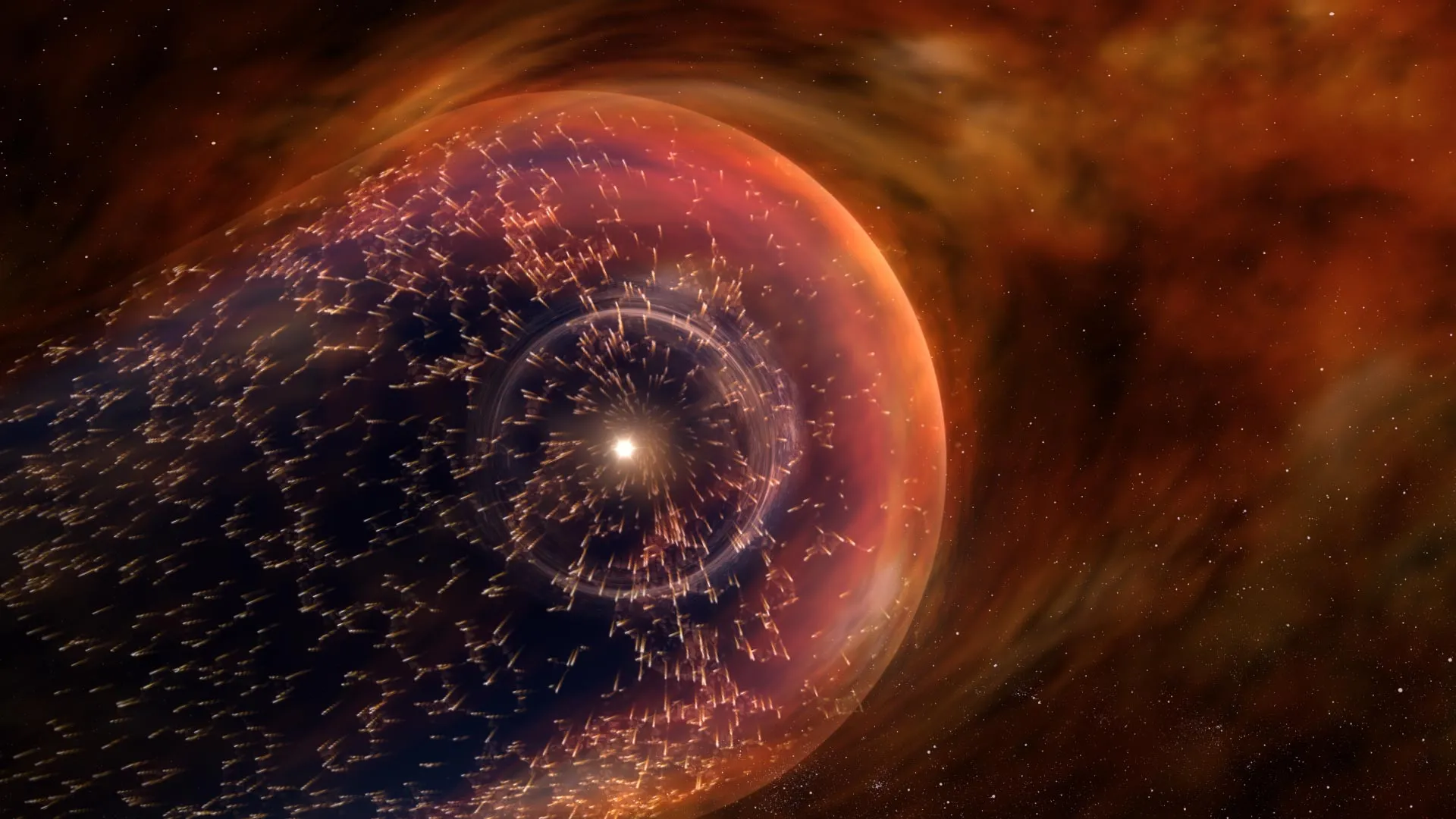
The heliosphere acts as a protective envelope around the solar system, generated by charged particles streaming outward from the Sun. That shield helps regulate how much interstellar material reaches the planets. The new work from NASA’s SHIELD center explores what happens when the Sun, carrying the heliosphere with it, moves through denser or more complex regions of the galaxy.
The central idea is straightforward: if the galactic environment around the heliosphere changes enough, the size, shape, or protective strength of that bubble can change too. In some periods, Earth may have been more exposed to interstellar matter or different space-weather conditions than it is now.
That possibility matters because Earth’s climate record contains large swings over tens of millions of years. Scientists have long explained those changes through familiar planetary mechanisms, but the NASA-backed research argues that the Sun’s galactic path may have been another contributing factor. In other words, Earth’s climate may at times have been nudged not only by what happened on the planet or in its orbit, but also by the solar system’s changing neighborhood in the Milky Way.
The source material does not claim a single definitive cause-and-effect chain for specific ice ages. What it does support is a broader conclusion: changes in the space environment surrounding the heliosphere may have influenced conditions on Earth and deserve more serious consideration in climate reconstructions of the distant past.

Revisiting the faint young Sun problem
The second study addresses one of planetary science’s oldest puzzles. Early in its history, the Sun was dimmer, which should have left Earth too cold for persistent liquid water. Yet geological evidence indicates that water was present and that conditions were compatible with the eventual rise of life.
The NASA-led explanation highlighted in the release points to the young Sun’s violent behavior. Powerful solar eruptions may have interacted with Earth’s early atmosphere in ways that helped generate strong greenhouse gases. If correct, that process could have provided an additional warming mechanism, helping offset the lower brightness of the young Sun.
This is an important distinction. The study does not suggest the young Sun was calm and simply insufficiently luminous. It suggests the opposite: that a more explosive young star may have indirectly helped make the early Earth more clement. That reframes solar activity from a purely hazardous force into a potentially constructive one in the story of habitability.
For astrobiology, the implication is notable. If stellar eruptions can help build or sustain warming chemistry under some conditions, then assessments of habitable worlds around other stars may need to consider a more complicated balance between stellar danger and planetary opportunity.
Why this matters beyond Earth history
These studies land at a moment when heliophysics, climate science, and exoplanet research are increasingly overlapping. Understanding how the Sun’s behavior affects Earth is no longer just a matter of forecasting solar storms for modern infrastructure. It also informs how scientists think about long-term planetary stability, atmospheric chemistry, and the odds that life can persist on worlds around other stars.
The NASA summary emphasizes that the Sun does much more than supply heat and light. Its wind creates a shield around the solar system. Its eruptive youth may have altered atmospheric chemistry on the early Earth. Its motion through the galaxy may have changed the external conditions acting on that shield. Each of those effects operates on a different timescale, but all point to the same larger conclusion: Earth’s environment is connected to astrophysical systems far beyond the planet itself.
That framing is especially relevant for modern models that attempt to reconstruct the past with greater precision. The more accurately researchers can estimate the solar system’s galactic history and the Sun’s early activity, the better they may be able to test whether these external influences align with known transitions in Earth’s climate record.

An expanding view of climate drivers
The immediate value of the new work is not that it settles long-running debates. It does not. Instead, it expands the set of plausible influences scientists should investigate. Climate history is already understood as the product of layered systems interacting across immense timescales. The NASA-funded studies suggest the astrophysical layer may be richer than previously assumed.
That makes the findings meaningful even in their provisional form. They invite researchers to connect planetary science with heliophysics and galactic modeling more tightly, and they push habitability studies to think beyond simple star-distance calculations. A planet’s environment may depend not just on where it sits around its star, but also on how that star behaves over time and where its solar system travels through the galaxy.
For a field that often treats Earth and space as separate domains, that is the deeper shift. The studies propose that some chapters of Earth’s climate story may have been written partly in interstellar conditions and solar violence long before humans existed to measure either one.
This article is based on reporting by Science Daily. Read the original article.
Originally published on sciencedaily.com