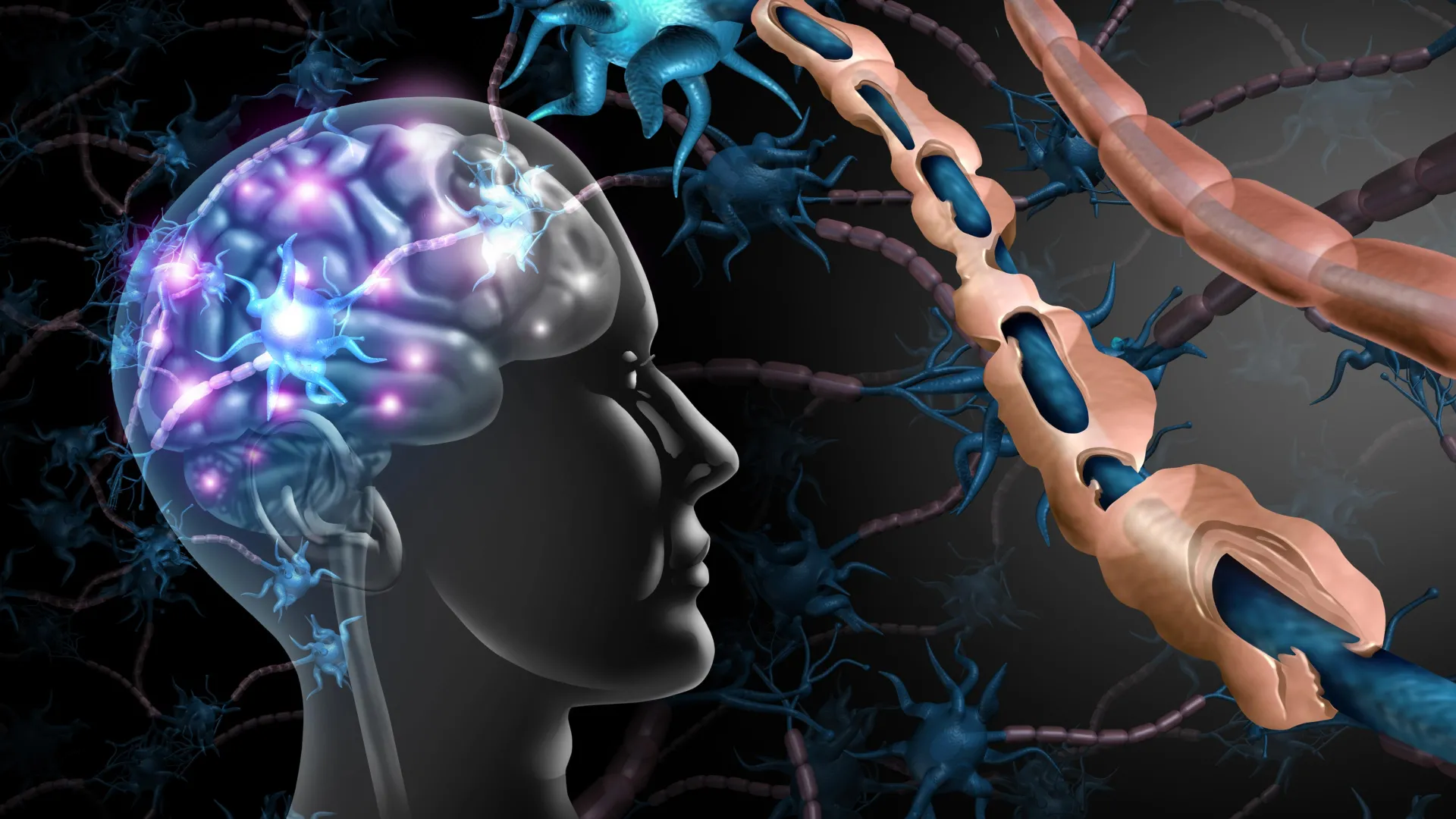
Brain cells that ordinarily help preserve the insulation around nerve fibers may become part of the problem in aging brains, according to research from the University of Edinburgh and the UK Dementia Research Institute. The study, published in Nature Medicine, links dysfunction in myelin-maintaining cells with damage to nerve fibers and with differences in how quickly cognitive abilities decline later in life.
The finding challenges a straightforward assumption about these cells: that more activity maintaining myelin must be beneficial. Myelin is the protective coating that surrounds nerve fibers and helps signals travel efficiently through the nervous system. The researchers found evidence that, with age, the cells involved in maintaining that coating can produce abnormal amounts of myelin. Rather than strengthening communication, that dysfunction may disrupt nerve fibers and contribute to worsening memory and thinking skills.
The work does not mean that myelin or the cells that support it are inherently harmful. It instead identifies a possible failure mode in a process that is normally essential to brain function. That distinction matters for researchers searching for ways to protect cognitive function as people age.
A long-running view of cognitive aging
The researchers drew on the Lothian Birth Cohort 1936, a group whose cognitive abilities have been followed from childhood into old age. The breadth of that record gave the team an unusual opportunity to examine how differences in later-life brain biology relate to changes in thinking and memory over decades.
Between ages 70 and 82, participants completed assessments of memory, information-processing speed and spatial ability. Of 1,091 people enrolled in the cohort, 866 completed additional cognitive testing after age 70. Almost all participants showed some degree of decline, but the pace differed considerably from person to person.
That variation was central to the study. Instead of treating aging as a single, uniform pattern, the researchers could ask what might distinguish brains associated with more rapid deterioration from those associated with more gradual change. The supplied report says the scientists examined human brain tissue and also conducted experiments in mice to investigate the role of the normally supportive cells.

When support cells become dysfunctional
Myelin is often described as insulation for the nervous system. Nerve fibers depend on it to transmit signals effectively. The cells examined in the research are responsible for maintaining that protection, so their role has generally been viewed as beneficial.
The new research suggests that aging can alter that relationship. The report says dysfunctional cells can make abnormal amounts of myelin, disrupting nerve fibers. This provides a potential biological link between age-related changes in brain tissue and the differences researchers observe in cognitive performance.
The study’s importance lies in connecting several levels of evidence. It combines long-term human cognitive data, examination of human brain tissue and experiments in mice. Each has different strengths: the cohort shows how cognitive abilities change across later life, tissue analysis can reveal biological associations, and animal experiments can help probe mechanisms.
- Researchers studied cognitive changes from age 70 to 82 in a long-running birth cohort.
- The work focused on cells that maintain myelin around nerve fibers.
- Age-related dysfunction was associated with abnormal myelin production and disrupted nerve fibers.
- The research points to a pathway that could become a target for future investigation.
A possible route to treatment research
The researchers say drugs acting on the biological pathway involved are already used for other neurological conditions. That creates the possibility that existing treatments could someday be studied for age-related cognitive decline. It is a promising research direction, not evidence that any current drug should be used for that purpose now.
Repurposing an existing medicine can shorten some parts of development because its safety profile and clinical use may already be understood. But a therapy appropriate for one neurological condition is not automatically safe or effective for another. Researchers would still need to establish the correct target, dose, timing, patient group and benefit through dedicated clinical studies.
The result is therefore best understood as a mechanism study with translational implications. It identifies a pathway worth testing rather than offering an immediate treatment for memory loss or dementia. The distinction is especially important in a field where many biological findings do not ultimately become successful therapies.

Why it changes the research question
Age-related cognitive decline has many possible contributors, including changes to blood vessels, inflammation, neurodegenerative disease and the health of nerve cells themselves. The study adds another potential contributor: the aging behavior of cells that support nerve fibers.
That reframes an important question. Rather than asking only how to preserve myelin with age, researchers may need to ask how to preserve its normal regulation. Too little maintenance could be damaging, but the study indicates that abnormal production may also be harmful. Understanding that balance could help explain why people of similar ages experience very different cognitive trajectories.
The Lothian cohort is particularly useful for this kind of question because it does not rely solely on a single snapshot of older adulthood. The record of cognitive testing allows researchers to focus on change over time. That makes it easier to separate a person’s later-life performance from the rate at which their abilities have shifted.
What comes next
Future work will need to clarify whether the pathway identified in this research is a driver of cognitive decline, a response to other age-related brain changes, or both. It will also need to determine whether targeting it can preserve nerve-fiber health and improve meaningful outcomes such as memory, processing speed or everyday functioning.
Clinical research must also establish who might benefit. Cognitive aging is highly variable, and the mechanisms in people with no diagnosed neurodegenerative disease may differ from those in people with conditions such as dementia. A treatment strategy shaped around myelin regulation may prove useful only for particular biological profiles.
For now, the study offers a sharper account of one possible source of vulnerability in the aging brain. Cells designed to protect neural connections may, when their normal behavior goes awry, help erode the efficiency of those connections. That insight gives brain-aging research a concrete target: not merely preserving the brain’s protective systems, but ensuring they remain properly controlled over time.
This article is based on reporting by Science Daily. Read the original article.

Originally published on sciencedaily.com