A Planet Without a Category
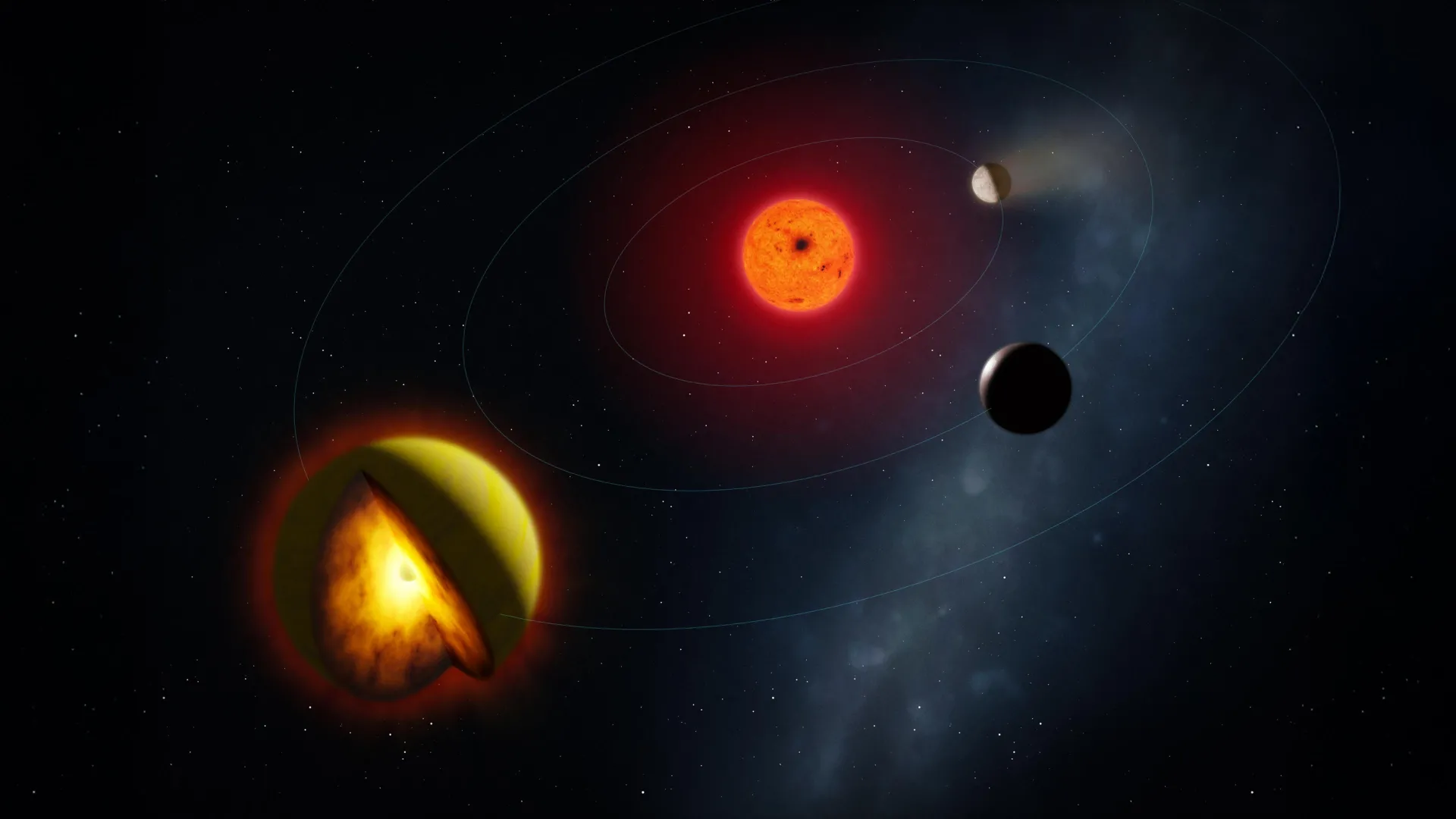
Astronomers have spent decades building classification systems for planets — rocky terrestrials, gas giants, ice giants, hot Jupiters — but the cosmos continues to produce objects that refuse to fit neatly into any box. The James Webb Space Telescope has now returned observations of L 98-59 d, a nearby exoplanet that appears to represent a genuinely new class of world: one defined primarily by the behavior of sulfur at extreme pressures and temperatures deep within its interior.
Published in a new study by an international team of astronomers, the findings describe a planet whose atmosphere carries an unusually high abundance of sulfur-bearing molecules, whose density is lower than would be expected for its size, and whose internal structure appears to include a vast magma ocean that actively traps and cycles sulfur compounds through volcanic processes operating at a scale without solar system precedent.
The Target: L 98-59 d
L 98-59 d is one of three planets orbiting L 98-59, a nearby red dwarf star located approximately 35 light-years from Earth. The system has been a subject of significant astronomical interest since its discovery by NASA's TESS mission because the planets offer some of the best opportunities for atmospheric characterization of small rocky worlds. At roughly 1.5 times Earth's radius and twice its mass, L 98-59 d sits in the boundary region between small rocky planets and larger ocean worlds or sub-Neptunes.
Its proximity to its host star means it receives intense radiation and orbits in just a few days. These conditions make its atmosphere hot and dynamic, ideal for spectroscopic observation by JWST's Near-Infrared Spectrograph.

What JWST Found
The telescope's atmospheric observations revealed signatures of sulfur dioxide and other sulfur-bearing compounds in concentrations that exceeded anything astronomers expected from standard volcanic outgassing models calibrated on Earth or Venus. More surprisingly, the planet's bulk density was lower than its size and composition would predict if it were composed of rock and iron alone.
The research team's explanation draws on high-pressure chemistry: L 98-59 d likely hosts a deep magma ocean — a vast layer of molten silicate rock extending thousands of kilometers into its interior. At the enormous pressures found at those depths, sulfur behaves differently than it does at surface conditions. Rather than outgassing freely into the atmosphere, much of the sulfur becomes incorporated into the molten rock itself, remaining dissolved in the magma ocean and lowering the planet's overall density relative to a fully solidified rocky body.
Volcanic Chemistry at Planetary Scale
The atmospheric chemistry observable from JWST represents only the fraction of sulfur that has escaped from the magma ocean into the gas phase. This fraction is still large enough to produce distinctive spectral signatures, but it may represent a small portion of the total sulfur inventory the planet contains. The researchers estimate that the magma ocean may hold sulfur concentrations orders of magnitude higher than Earth's interior, sustained by intense heat generated by tidal forces from the star and by radiogenic decay of heavy elements.
This kind of sulfur cycling has no direct analog in our solar system. Earth has a sulfur cycle, but it operates through plate tectonics, biological processes, and moderate volcanism. The scale of sulfur processing implied by L 98-59 d's observations would represent geochemical activity on a fundamentally different magnitude.
Implications for Planetary Science
The identification of L 98-59 d as a potential sulfur world carries several important implications. First, it suggests that magma ocean planets may be far more common than previously recognized, and that they produce chemical signatures detectable by JWST at distances of tens of light-years. Second, it challenges existing classification schemes that group planets by size or composition without accounting for the dominant role that volatile chemistry — including sulfur — can play in determining observable properties.
Third, it raises questions about the boundaries of habitability. Sulfur-rich environments on Earth support extremophile life. Whether the sulfur chemistry on L 98-59 d could ever permit biology is deeply speculative, but the discovery broadens the chemical parameter space that astrobiologists must consider.
JWST's Growing Exoplanet Portfolio
The L 98-59 d results add to a rapidly growing catalog of surprising exoplanet atmospheric observations from JWST. Since beginning science operations, the telescope has detected carbon dioxide, methane, and water vapor in exoplanet atmospheres across a range of planet types, systematically building the empirical foundation for a new science of comparative planetology. Each discovery refines understanding of what kinds of worlds exist, how common different chemical regimes are, and what signatures future missions might need to detect life beyond our solar system.
This article is based on reporting by Science Daily. Read the original article.
Originally published on sciencedaily.com


