A sharper view of the universe’s large-scale skeleton
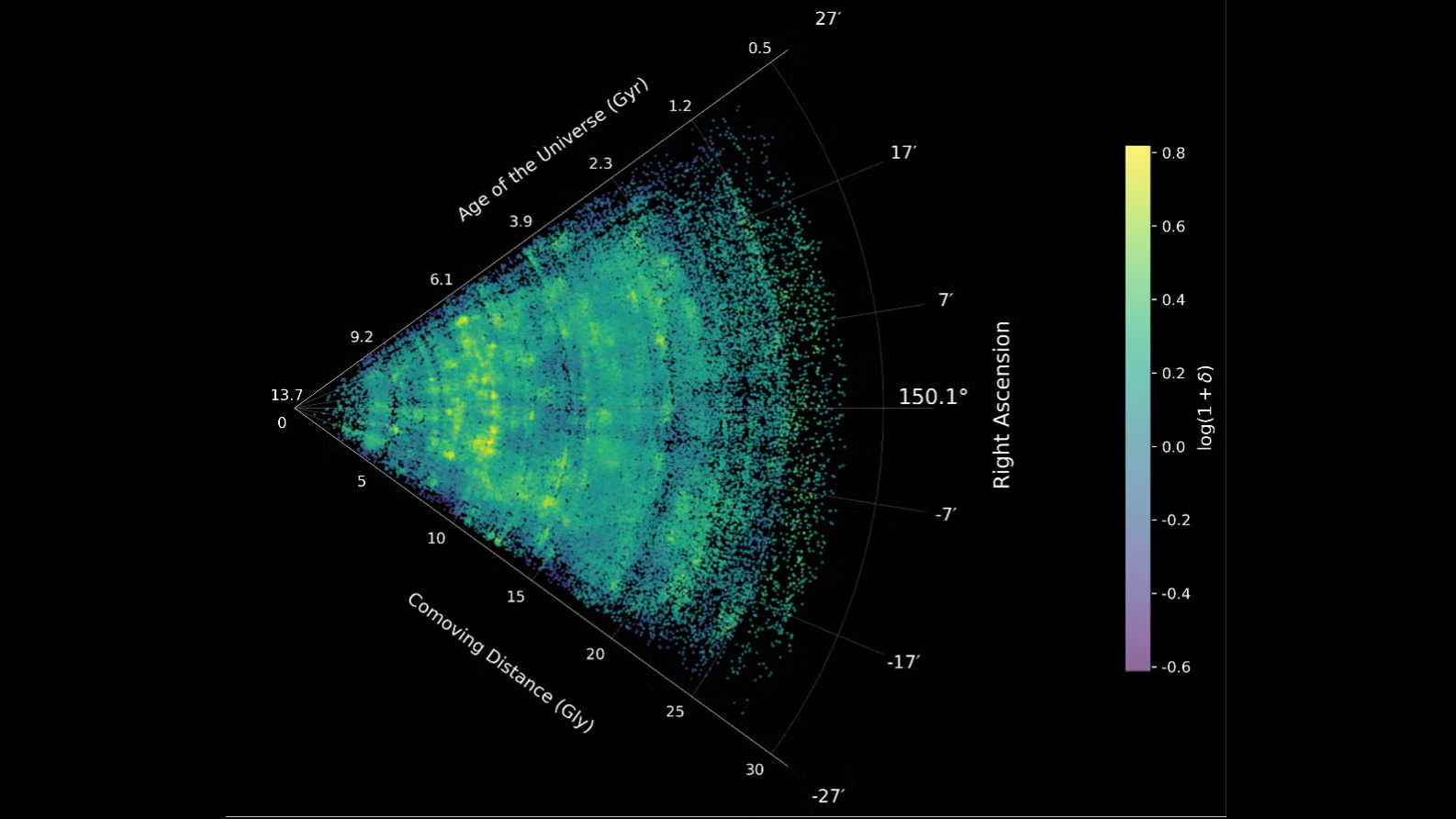
Astronomers working with data from the James Webb Space Telescope have produced what the source describes as the most detailed map yet of the cosmic web, the enormous large-scale structure that organizes matter across the universe. The reconstruction draws on the COSMOS-Web survey and was reported in a paper published May 6 in The Astrophysical Journal by an international team led by researchers at the University of California, Riverside.
The result is significant because the cosmic web is not just a visual curiosity. It is the framework along which galaxies, clusters, and still larger structures assemble. Dense filaments, voids, gas, stars, and dark-matter-dominated regions together form the scaffolding that shapes where matter gathers and how galaxies evolve. With JWST’s data, astronomers are now seeing that framework in far greater detail over a much deeper span of time.
Why the map matters
The new reconstruction follows the universe back toward its earliest billion years and forward toward the present. That gives researchers a better way to ask one of cosmology’s biggest questions: how much of galaxy evolution is driven by internal processes, and how much is driven by environment. If galaxies are embedded in a giant web whose dense regions encourage rapid growth and later quenching, then mapping the web is a way of mapping the conditions under which galaxies live their lives.
The source text emphasizes that the work helps explain how the universe moved through and beyond its peak era of star formation. That peak lies billions of years in the past. The new analysis suggests the cosmic web itself helped shape what happened before, during, and after that period. Dense regions appear to have fostered especially active galaxy growth earlier on, while later conditions helped produce the slowdown in star formation that characterizes the modern universe.
What JWST adds
James Webb’s strength is not only sensitivity but reach. It can capture faint, distant objects from deep cosmic history, allowing researchers to infer structure across immense distances and timescales. In this case, the telescope’s largest-ever survey underpins a reconstruction of the cosmic web that is both broad and historically deep. That combination is what turns the result from another pretty astronomy image into a meaningful scientific tool.
The map also helps connect observational astronomy with theoretical cosmology. Models of structure formation describe a universe where matter collapses into filaments and nodes while other regions empty into vast voids. Better observations let astronomers test whether those models line up with the actual distribution of galaxies and the environments they inhabit. A more precise map of the web is therefore a more precise test of how the universe built itself.
Environment, growth, and decline
The supplied source highlights a key idea from the researchers: galaxy growth is shaped by both intrinsic and extrinsic forces. Intrinsic forces include what happens inside galaxies themselves, such as star formation and the processes that eventually shut it down. Extrinsic forces include the surrounding environment, meaning whether a galaxy sits in a dense region of the web or in a more isolated stretch of space.
That distinction matters because astronomers have long debated how much cosmic environment influences a galaxy’s fate. A map like this does not end the debate, but it gives it a stronger observational basis. If the densest regions consistently line up with earlier or faster growth, then the web becomes more than a structural metaphor. It becomes a physical driver of galactic history.
A milestone, not a final answer
Even a record-setting map leaves major questions open. The cosmic web includes dark matter, which cannot be observed directly in ordinary light. Researchers infer much of the structure from the galaxies and other matter they can see. That means every reconstruction involves interpretation as well as measurement. Still, richer data improves those inferences, and JWST is providing exactly that kind of leap.
The deeper importance of this work is that it ties together scale and history. Astronomy often forces a choice between seeing far and seeing fine detail. Here, Webb is helping scientists do both at once. It is revealing a universe whose largest structures are not static backdrops but active participants in the rise and decline of galaxies over billions of years.
- The map is based on the largest survey yet conducted with JWST.
- The work was reported in The Astrophysical Journal on May 6, 2026.
- Researchers say the data shows how the cosmic web influenced galaxy growth across cosmic time.
For the public, the appeal is obvious: the universe’s hidden architecture is coming into view. For astronomers, the value is even greater. A better map of the web means a better map of cosmic history itself.
This article is based on reporting by Live Science. Read the original article.
Originally published on livescience.com