A possible first in the history of stellar explosions
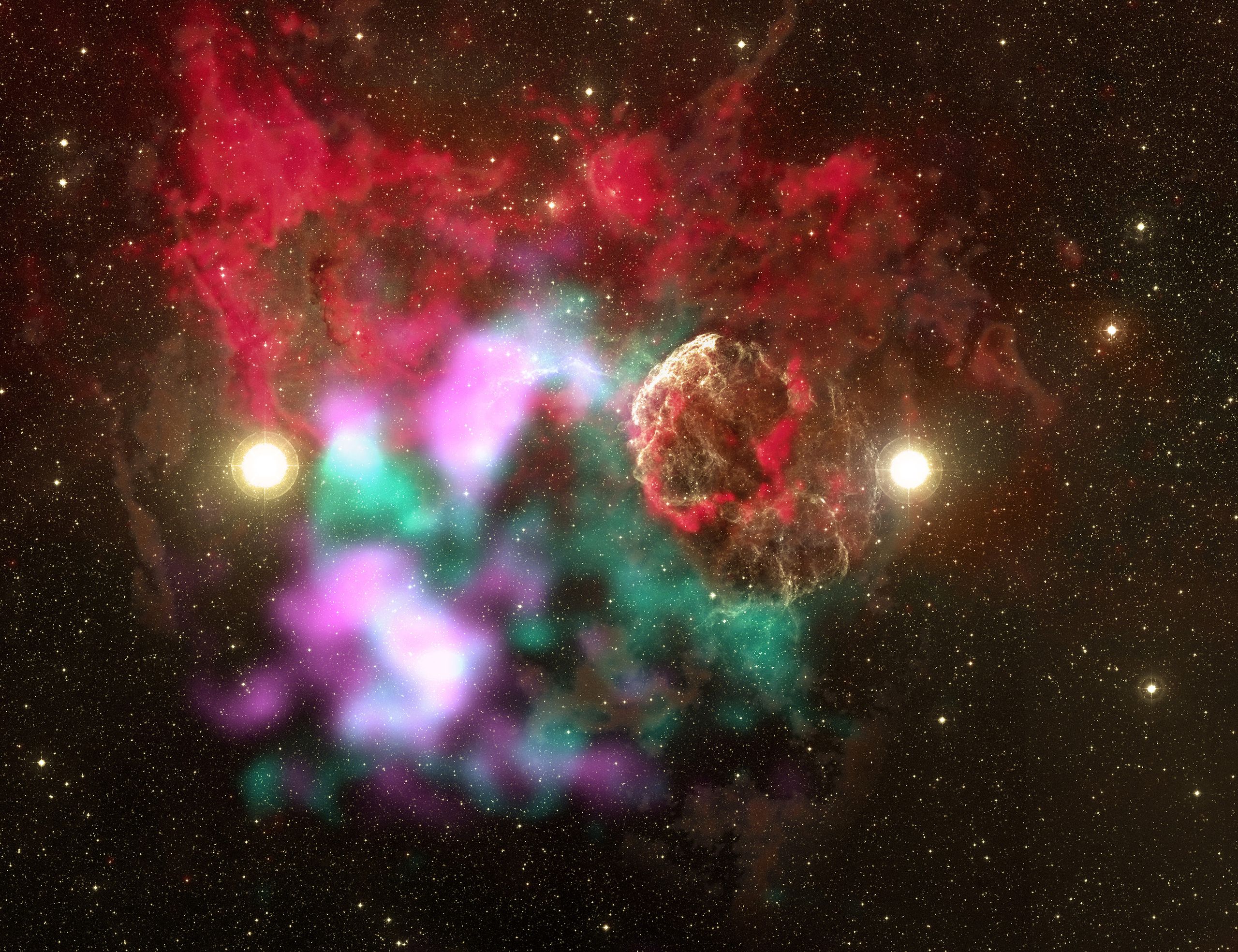
Astronomers studying a faint object beside the well-known Jellyfish Nebula say they may have identified the first confirmed pair of supernova remnants produced by two stars that once orbited each other. If the interpretation holds, the discovery would add a rare new category to the catalog of stellar death: not just one exploded star, but a binary system whose members each ended in separate supernovas and left neighboring wreckage behind.
The finding, described in the supplied source text as published on July 21 in Nature Communications, centers on two remnants in the Milky Way. One is IC 443, the Jellyfish Nebula, already famous as one of the best-studied supernova remnants in the galaxy. The other, G189.6+3.3, is fainter and had long been overshadowed by its brighter neighbor. By analyzing 16 years of data from NASA’s Fermi Gamma-ray Space Telescope and combining it with observations across multiple wavelengths, researchers argue that the two structures are not simply adjacent by chance.
Why IC 443 matters in the first place
IC 443 has been a major object of study because it is among the earliest supernova remnants confirmed to accelerate protons, a key ingredient in the production of cosmic rays. Cosmic rays constantly strike Earth’s atmosphere, but tracing where and how they are accelerated remains a central astrophysical problem. Any neighboring remnant showing related high-energy behavior is therefore scientifically interesting even before questions of shared origin enter the picture.
That is part of what makes G189.6+3.3 notable. The team was not, according to the supplied report, initially searching for evidence of a binary-origin supernova pair. Instead, researchers set out to characterize a neglected remnant sitting next to a famous one. In the process, they found signals suggesting a deeper connection between the two structures.

How the researchers separated the faint signal
The challenge in cases like this is disentangling a weak source from a much brighter environment. The researchers used Fermi gamma-ray data together with X-ray, radio, ultraviolet and optical observations to isolate the faint signature of G189.6+3.3. That multiwavelength approach matters because supernova remnants do not reveal the same physics at every wavelength. Radio can trace charged particles and structure, X-rays can illuminate hot shocked material, and gamma rays can point to extreme particle acceleration.
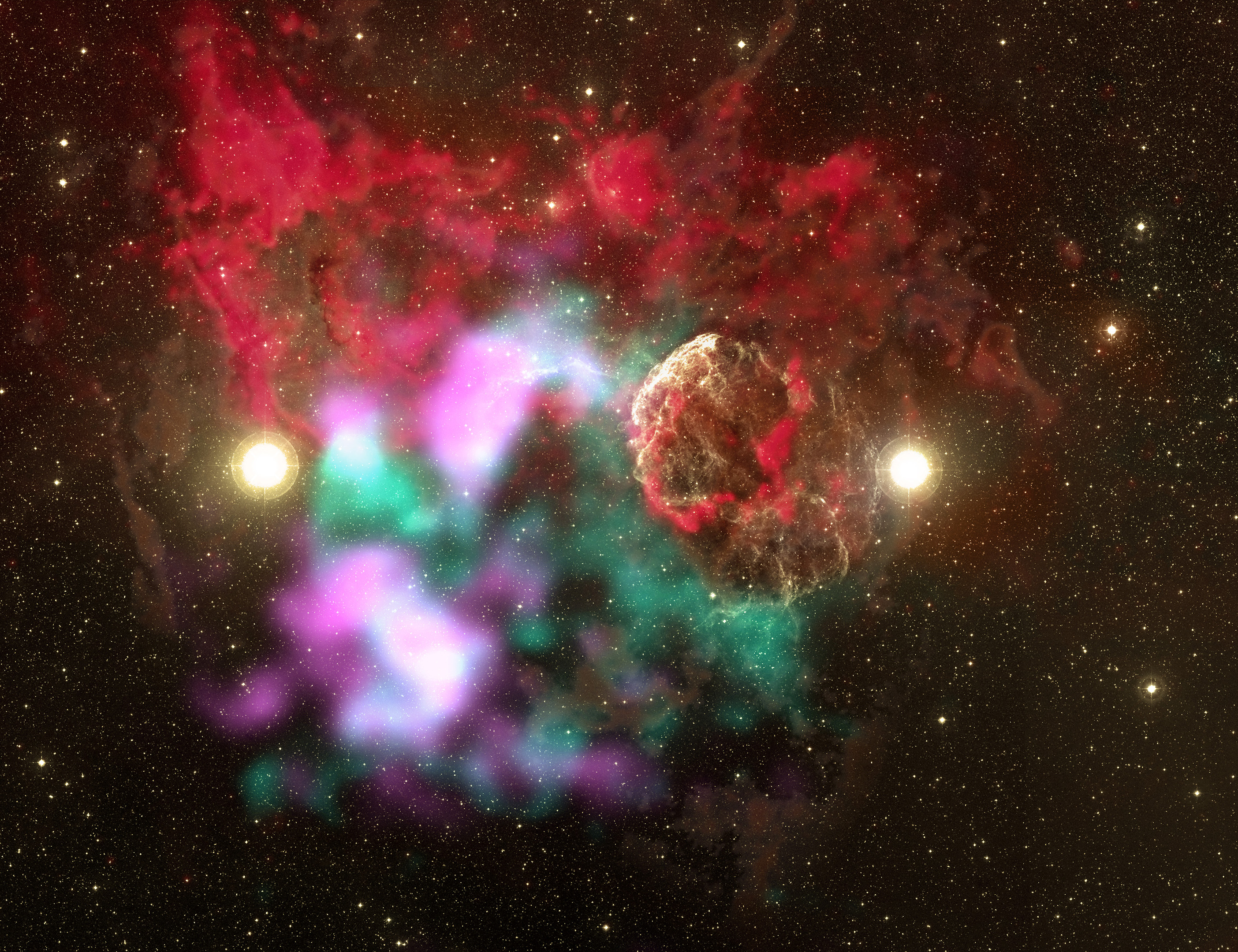
Once the team separated the remnant’s emission, they found an uneven pattern. The supplied source text says the northern half of G189.6+3.3 appeared dominated by accelerated protons, while the southern half was dominated by electrons. That asymmetry is not just a visual curiosity. It can encode clues about the local environment, magnetic fields, shock conditions, and the history of how the blast wave propagated through surrounding material.
More importantly for the headline claim, the researchers concluded that the spatial relationship between G189.6+3.3 and IC 443 is unlikely to be accidental. Their interpretation is that the two remnants may be the remains of stars that once formed a gravitationally bound binary system, living together for millions of years before dying in separate explosions.
What makes a binary-supernova remnant so unusual
Binary stars are common in the galaxy, and many massive stars are born with companions. Supernovas are also not rare on cosmic timescales. What is rare is finding surviving evidence that two stars in the same binary system both exploded and left behind remnants that can still be identified as a pair. Over time, supernova debris disperses, interacts with interstellar gas, and becomes difficult to trace cleanly. The remnants may also evolve at different rates depending on local conditions.
That means astronomers are often left with fragments of a story rather than the full sequence. A confirmed binary-origin remnant pair would therefore be valuable because it provides a natural laboratory for comparing two stellar explosions that share an origin environment yet may have evolved differently. It would also offer a new way to study how companion stars influence mass loss, timing, and the final conditions leading up to a supernova.

Why the result matters beyond classification
This is not only about naming a cosmic first. The result could help researchers understand how supernova remnants generate and distribute high-energy particles, how shock fronts interact with nearby matter, and how binary evolution shapes the deaths of massive stars. If two remnants from one original stellar pair can be studied side by side, astronomers gain a controlled comparison that is usually unavailable in the messy reality of galactic archaeology.
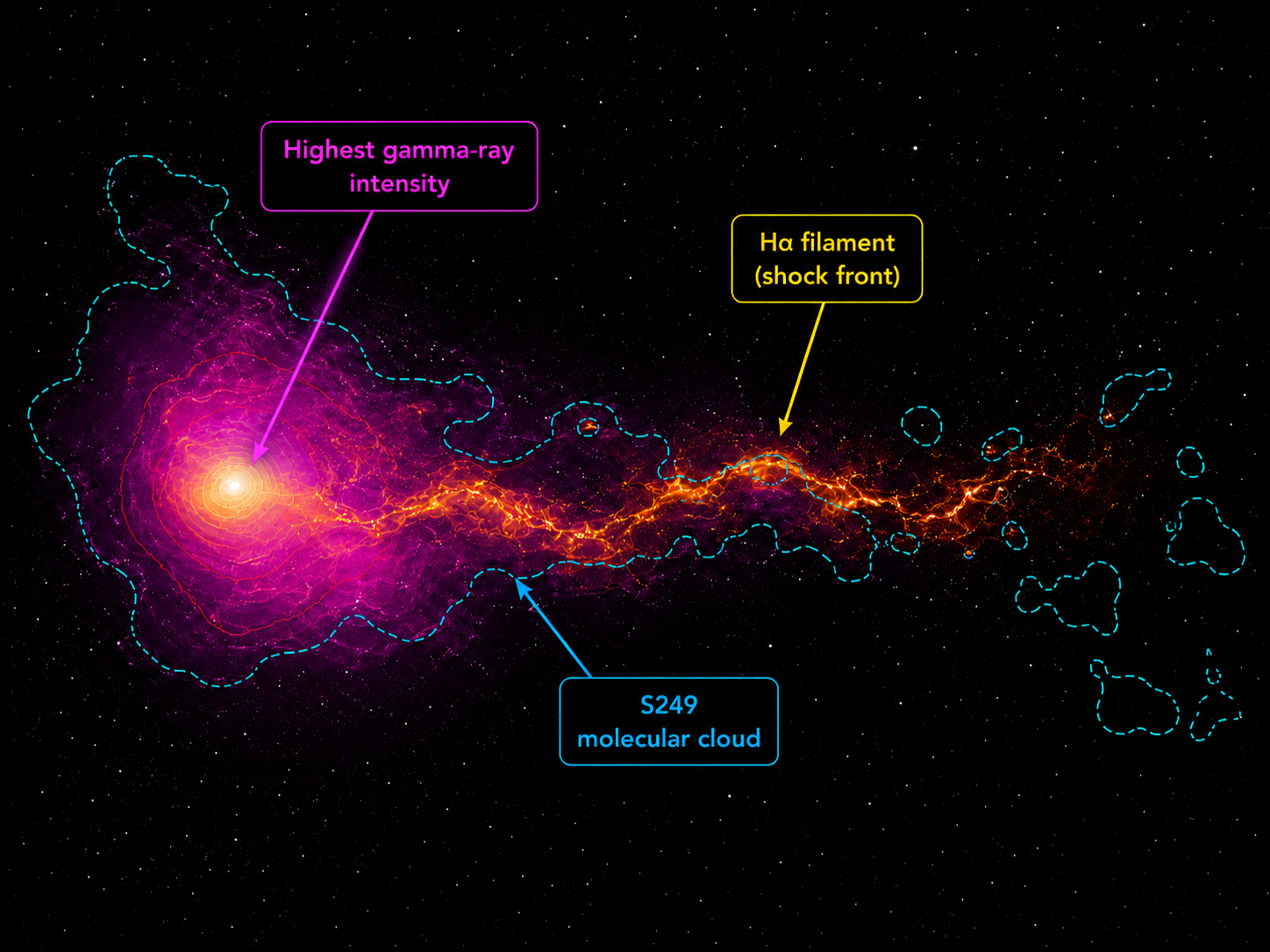
The work also underscores the value of long-duration sky surveys. The Fermi telescope’s 16-year dataset made it possible to pull out a signal that had remained buried next to a brighter and more famous remnant. Discoveries like this often emerge not from a brand-new instrument alone but from the cumulative power of sustained observation combined with better analysis across datasets.
A reminder that familiar regions can still hold surprises
One of the striking aspects of the claim is that it arises in a region astronomers already know well. IC 443 is hardly obscure. Yet a candidate first-of-its-kind system may have been sitting beside it in plain sight, hidden not by absence but by contrast. In astronomy, bright objects can sometimes conceal rather than reveal, especially when neighboring structures are faint, extended, or difficult to separate from background emission.
That makes the discovery a useful reminder that the sky is not exhausted simply because major landmarks have names and long publication histories. Even around famous remnants, there can still be new structure to identify and new relationships to infer.

What comes next
The binary-remnant interpretation will likely invite follow-up work, including more detailed modeling of the geometry, ages, and surrounding interstellar medium of both remnants. The central question is whether alternative explanations can be ruled out strongly enough to make the sibling-supernova case durable. In astrophysics, firsts matter most when they survive attempts to break them.
For now, the study offers an unusually compelling possibility: two stars born and bound together may have ended their lives in separate cataclysms, leaving behind adjacent scars that modern instruments can still read. If confirmed, that would turn a famous corner of the Milky Way into the clearest known record of a binary partnership that survived all the way to double destruction.
This article is based on reporting by Live Science. Read the original article.
Originally published on livescience.com