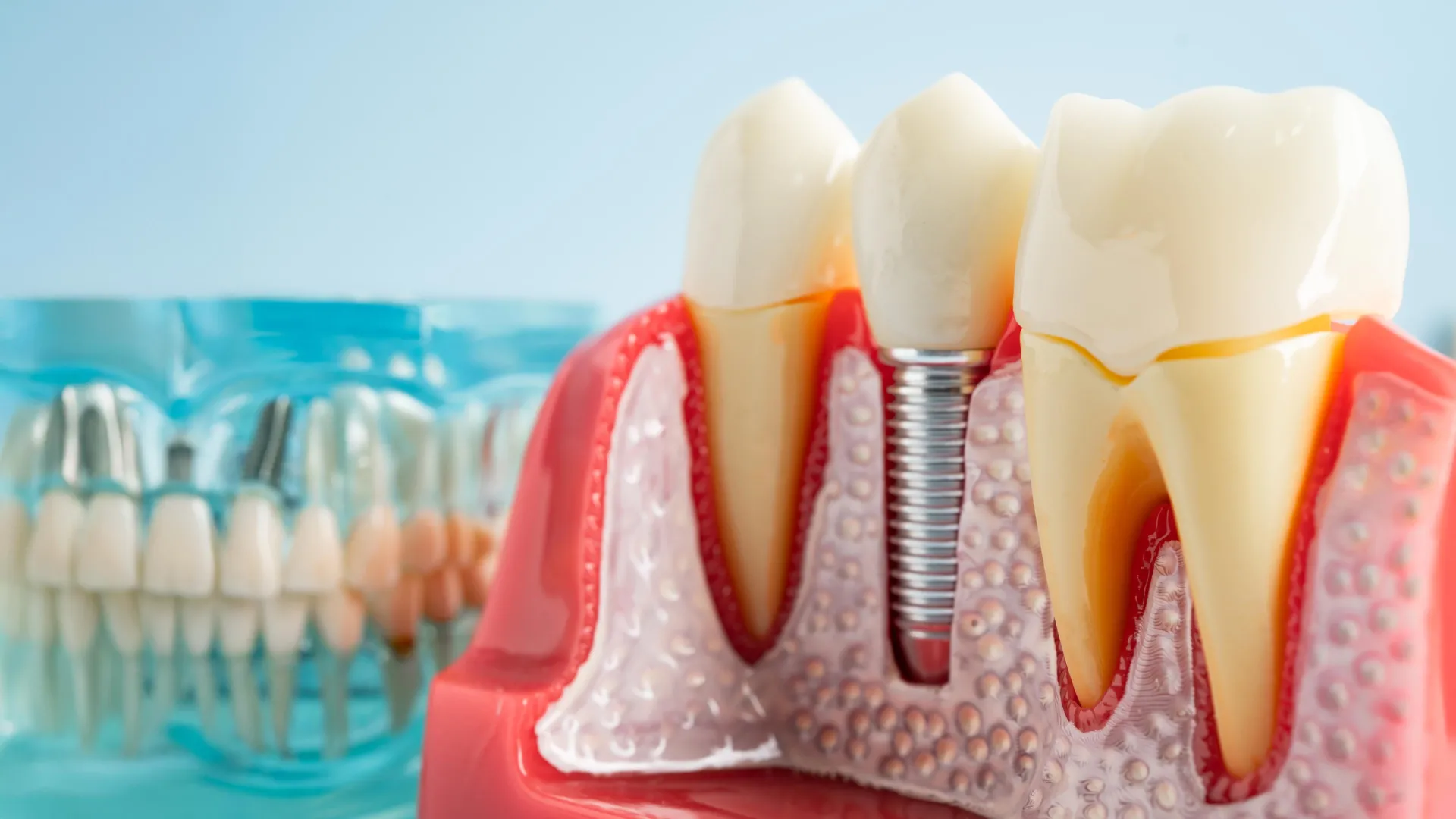
Dental implants are designed to restore function for people who have lost teeth, but a serious complication can develop around them: peri-implantitis. The condition involves infection and progressive damage to the jawbone surrounding an implant, and it often proves difficult to control with antibiotics. A new Rutgers University study points to a possible reason why—and identifies a molecular pathway that could eventually become a treatment target.
The research, published in PNAS Nexus, describes how bacteria can corrode titanium dental implants and release microscopic particles into nearby tissue. Rather than being an inert byproduct, the particles appear to alter the behavior of macrophages, immune cells that normally help engulf bacteria. The result, according to the researchers, is an excessive inflammatory state that can accelerate jawbone destruction.
Why antibiotics may fall short
Peri-implantitis has long presented a clinical puzzle. It begins with bacteria similar to those implicated in periodontitis, the gum disease that affects natural teeth. Yet infections around implants often respond poorly to treatments that can work around teeth.
The Rutgers findings suggest that bacteria are only part of the problem. As bacteria gradually corrode an implant, titanium particles can enter the surrounding tissue. Those particles interfere with the immune response, leaving macrophages in a prolonged inflammatory state instead of allowing them to resolve the infection and tissue damage.
That mechanism could help explain why simply targeting bacteria with antibiotics may not be enough. If implant-derived particles continue to drive inflammation, the tissue environment can remain harmful even when antibacterial treatment is used.

Evidence across tissue, cells and mice
The researchers investigated the proposed mechanism through several approaches. They examined human tissue samples, studied human immune cells in laboratory experiments, and used genetically engineered mice. Across those methods, the work linked titanium particles with immune disruption and jawbone loss.
A central finding involved a calcium channel in macrophages. The study found that titanium particles activate this channel, contributing to the damaging immune response. When the channel was disabled in mice, the disease was prevented in the experimental setting.
That result does not mean a new therapy is ready for patients. Animal-model findings must be tested further, and researchers will need to determine whether a drug can safely and effectively target the same pathway in people. But the work offers a clearer biological target than broad attempts to suppress infection alone.
A significant clinical problem
Dental implants have become a widely used option for replacing missing teeth, offering fixed restoration rather than removable dentures. The benefits are substantial, but the risk of peri-implantitis is consequential. Rutgers researchers cited estimates that 10% to 20% of implant patients eventually develop the condition.
As jawbone around an implant is damaged, treatment can become more complex and the implant itself may be jeopardized. The study also places the issue in a broader health-system context, noting that the condition costs healthcare systems worldwide more than $1 billion annually.
For clinicians and patients, the research reinforces that implant complications are not necessarily explained by an ordinary infection model. The interaction among bacteria, the implant material and the immune system may be decisive. Titanium has been valued for its compatibility and durability, but this work highlights the importance of what can happen when its surface is altered in an infected oral environment.

From mechanism to potential therapies
The immediate value of the study is mechanistic: it identifies a route by which titanium particles may turn an immune response into sustained, destructive inflammation. Its longer-term value could be therapeutic. A drug that interrupts the calcium-channel pathway in macrophages might complement, rather than simply replace, antibacterial approaches.
Researchers will still need to establish how broadly the mechanism applies across patients and implant types, and whether targeting the channel changes outcomes once disease is established. The current findings nevertheless give peri-implantitis research a more specific direction. Instead of treating the infection as a bacteria-only problem, future strategies may be able to address the inflammatory response set off by corrosion products.
For a complication that affects a meaningful share of implant recipients and has resisted standard antibiotic treatment, identifying that distinction is an important step. It suggests that preserving the tissue around an implant may depend not only on eliminating microbes, but also on preventing the body’s own immune cells from being pushed into a damaging response.
This article is based on reporting by Science Daily. Read the original article.
Originally published on sciencedaily.com