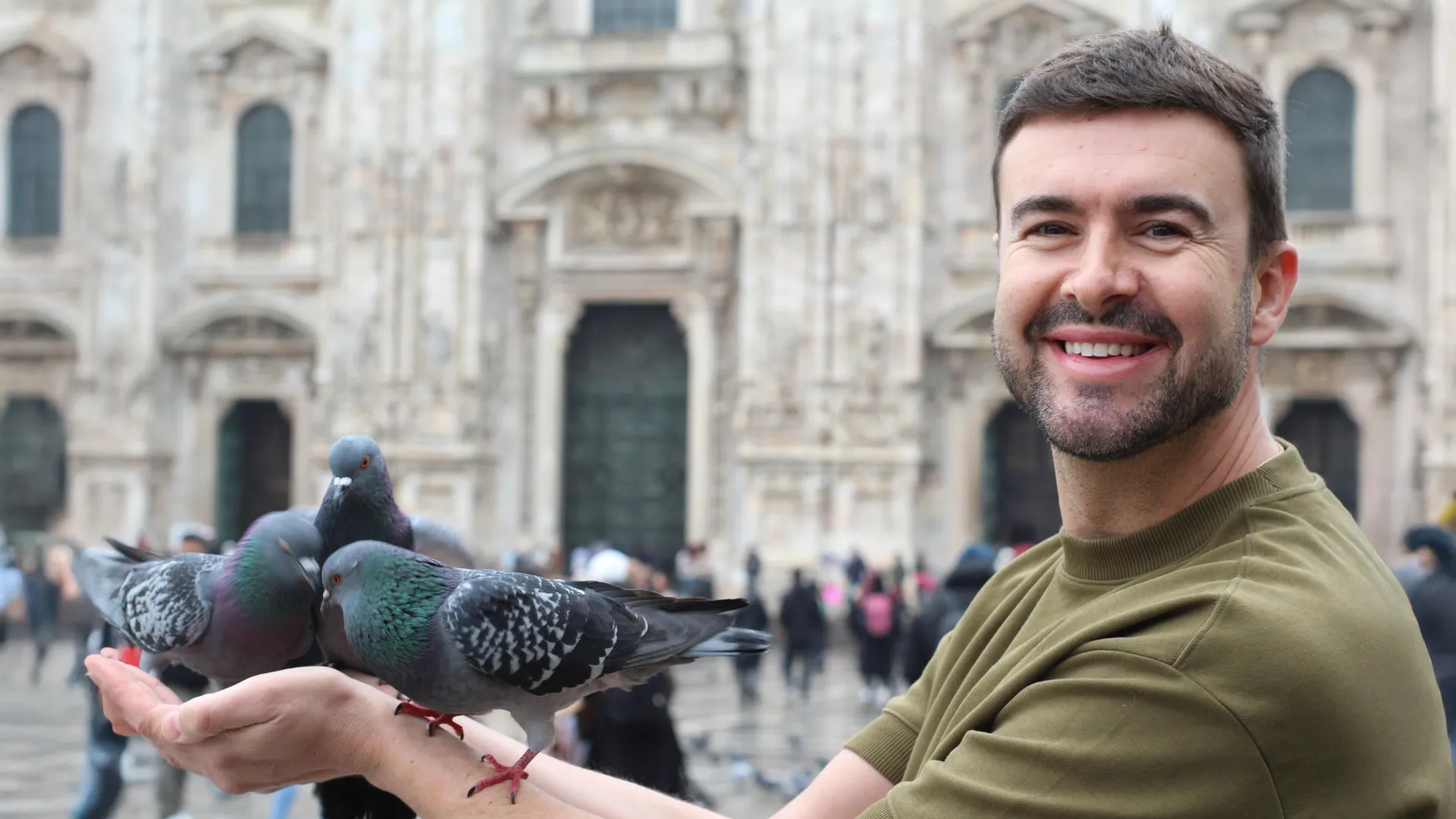
Urban birds in five European countries consistently took flight sooner when approached by women than by men, according to a study published in the British Ecological Society journal People and Nature. The researchers found the pattern across 37 species, but they do not yet have a conclusive explanation for it.
The result is notable because city birds encounter people constantly and are often assumed to respond mostly to broad cues such as distance, speed and perceived threat. Instead, the new research suggests that birds may distinguish between male and female human approaches in ways scientists have not yet identified.
A consistent difference across countries and species
An international research team conducted the study in urban green spaces in Czechia, France, Germany, Poland and Spain. Male and female participants, matched for height and clothing, walked directly toward birds. Researchers recorded the point at which each bird fled, a measure known as flight initiation distance.
On average, men could approach about one meter closer than women before the birds flew away. The pattern appeared across every species examined, including great tits, house sparrows and blackbirds. It also extended from species that are readily startled to birds such as pigeons that often tolerate close contact with people.
That breadth is important. A difference confined to one location or one particularly wary species might have been easier to attribute to a local condition. Instead, the researchers reported a result that was consistent across cities, countries and a diverse group of urban birds.

What the study does and does not show
The finding indicates that birds responded differently to the sex of the person approaching them under the study conditions. It does not explain why they did so. The participants were matched for height and clothing, but the researchers have not determined which other characteristics the birds may have recognized.
Possible cues could include differences in movement, posture, gait, facial features, voice or other signals not resolved by the experiment. The study does not establish any of those explanations, and the researchers stressed that the cause remains unknown.
Daniel Blumstein of the University of California, Los Angeles, who helped conduct the work, said the result was convincing despite the absence of an explanation. He said the team used comparative analysis techniques that showed the finding was consistent across cities and species, while acknowledging that there was no conclusive account of the mechanism.
Why urban wildlife behavior matters
Flight initiation distance is more than a curiosity. It is a widely used way to study how wildlife assesses risk and how animals coexist with people. When a bird flees earlier, it can lose time feeding, resting or caring for offspring. When it delays escape, it may face a greater perceived risk. The distance at which that decision occurs can therefore reveal something about an animal’s behavior in human-dominated settings.
Cities are natural laboratories for this kind of research because birds repeatedly encounter walkers, cyclists, pets, vehicles and other sources of disturbance. Over time, some species become relatively tolerant of people. Yet tolerance is not necessarily uniform. The new study suggests that even in urban environments, birds’ responses may depend on attributes of the particular person approaching.
The research also complicates the common shorthand that wildlife simply becomes “used to humans.” Birds may learn or react to more detailed features of their surroundings than a broad category of human presence captures. Understanding those distinctions could improve future studies of wildlife disturbance, urban habitat design and public behavior around animals.

Questions for follow-up research
The next task is to separate the potential cues. Researchers could test whether birds respond differently when variables such as walking speed, body movement, voice or visual appearance are controlled independently. Repeating the work in additional settings could also show whether the effect changes with local bird communities, human behavior or the amount of daily contact birds have with people.
There is also a larger behavioral question: whether the pattern arises from learned experience, innate perception, or some combination of the two. The study itself does not answer that question. Its value is in identifying a robust and unexpected pattern that warrants a more targeted search for the cause.
For now, the clearest conclusion is limited but striking. In the study’s urban settings, birds tended to permit male participants to come closer than female participants before fleeing. The effect appeared across five countries and 37 species, even though scientists cannot yet say why.
A reminder to resist easy stories
Unexpected behavioral findings can invite quick cultural or biological explanations. This research offers no basis for them. The authors’ own position is that the result needs explanation, not that one is already available.
That uncertainty is part of what makes the work useful. It highlights a gap in scientists’ understanding of how birds perceive humans and sets a clear agenda for future experiments. In an era when urban wildlife is increasingly part of everyday life, even a one-meter difference in how animals judge approaching people can open a much larger scientific question.
This article is based on reporting by Science Daily. Read the original article.

Originally published on sciencedaily.com