A companion may be stirring Betelgeuse from within
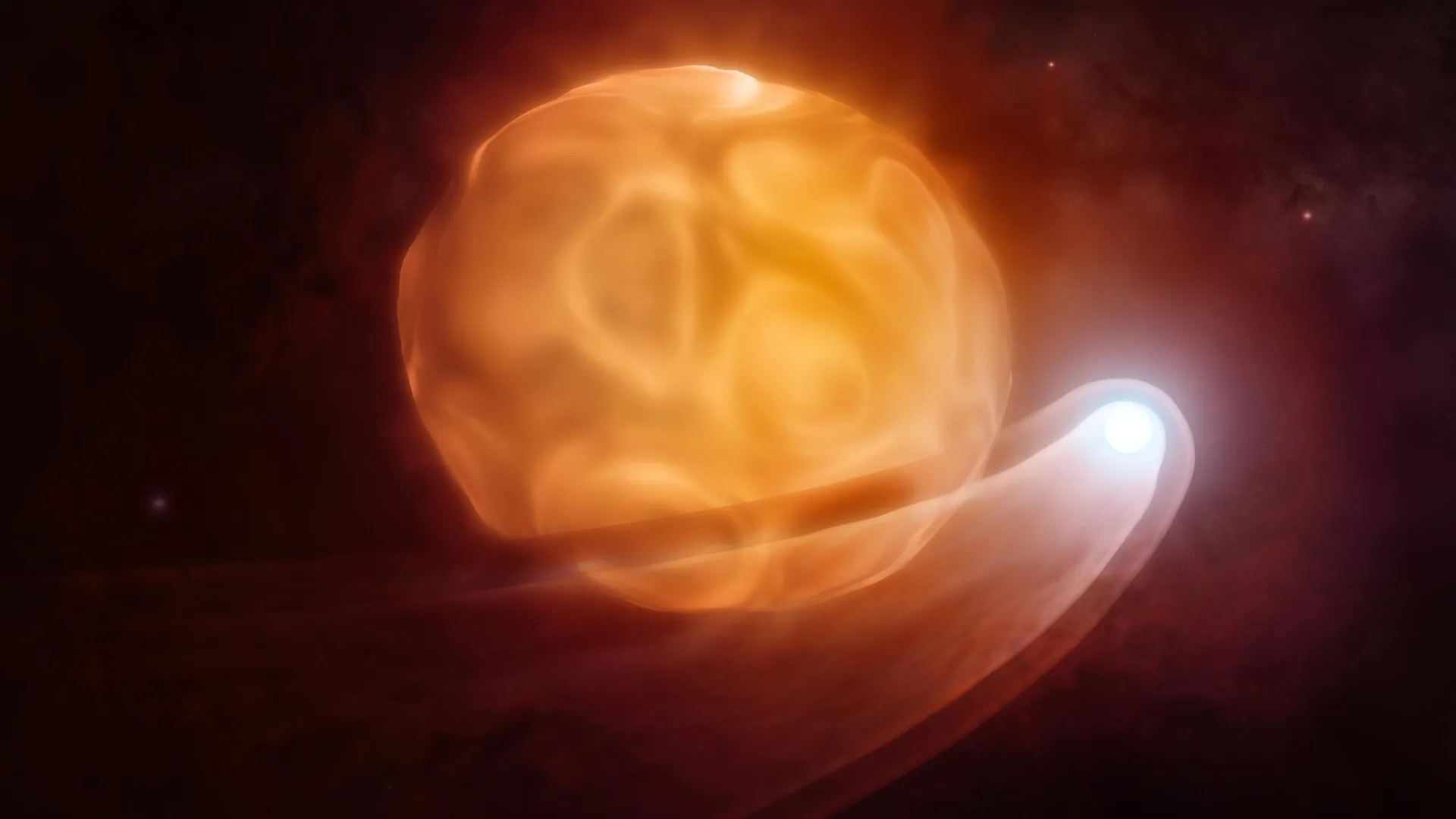
New radio observations are strengthening the case that Betelgeuse, the bright red supergiant in Orion, has a nearby companion star whose orbit passes through the giant star’s extended outer atmosphere. The proposed companion, called Siwarha, may be creating a wake-like disruption in the gas around Betelgeuse and contributing to subtle changes in the star’s apparent shape.
The finding offers a possible explanation for behavior that has made Betelgeuse one of the most closely watched stars in the sky. Its dramatic fading in late 2019 and early 2020, known as the Great Dimming, brought renewed attention to the aging supergiant and to the complex processes taking place in and around its immense atmosphere.
The new work does not describe a direct view of the smaller star moving through Betelgeuse. Instead, it relies on measurements of the giant star’s atmosphere at several radio wavelengths, which probe different depths in the surrounding gas. Together, those observations reveal structural details consistent with a companion disturbing the outer layers.
Radio telescopes look through different atmospheric layers
The research team analyzed observations collected from 2021 to 2026 using the U.S. National Science Foundation’s Karl G. Jansky Very Large Array and the Atacama Large Millimeter/submillimeter Array. The data span seven radio frequencies, from 22 GHz to 485 GHz.
That wide frequency range matters because different radio frequencies can examine different depths in a star’s atmosphere. Combining the measurements allowed researchers to reconstruct aspects of Betelgeuse’s atmospheric structure rather than relying on a single surface-level view.
According to the reported results, much of Betelgeuse’s vast outer atmosphere has returned toward normal following the unusual period surrounding the Great Dimming. But the radio data also show evidence of an asymmetry: the star appears subtly stretched or distorted rather than perfectly round. The researchers interpret that shape as evidence that a companion is perturbing the gas.
In the proposed picture, Siwarha is smaller and hotter than Betelgeuse. Its path takes it directly through the red supergiant’s enormous atmosphere, where its motion could alter the distribution of material and leave an extended disturbance behind it. The comparison is not to a collision between compact objects, but to an object moving through a very diffuse, extended envelope of gas.

Why Betelgeuse is an unusual laboratory
Betelgeuse is a red supergiant in the constellation Orion, where it marks the hunter’s shoulder. Stars at this late evolutionary stage have expanded atmospheres and can lose large amounts of material, making their outer layers dynamic and difficult to model. A companion embedded in, or moving through, that environment would add another source of complexity.
The Great Dimming illustrated that complexity vividly. Betelgeuse’s brightness fell to its lowest recorded level in more than a century during late 2019 and early 2020. The event prompted intense scrutiny of whether changes inside the star, material around it, or a combination of both could account for the change.
The latest observations focus on the star’s later recovery and on the continuing shape of its outer atmosphere. They therefore do not reduce Betelgeuse to a single explanation for every observed change. Rather, they add evidence that a companion star could be an important part of the system’s ongoing behavior.
What the evidence could change
If confirmed, Siwarha would make Betelgeuse a particularly valuable system for studying how a companion affects the atmosphere of an evolved giant star. The radio measurements already demonstrate the usefulness of observing at multiple frequencies: each range samples a different layer, and the combined result can reveal disturbances that would be difficult to infer from a single observation.
The work also points toward the need for continued monitoring. The observations analyzed so far span five years, and the team’s interpretation depends on tracking how atmospheric structure changes over time. Additional measurements can test whether the observed distortion persists, evolves in a pattern consistent with an orbit, or has another origin.
For skywatchers, Betelgeuse remains a familiar point of light. For astronomers, it has become a changing laboratory: a huge star with an extended, shifting atmosphere and now stronger evidence for a hidden neighbor moving through it.
This article is based on reporting by Science Daily. Read the original article.

Originally published on sciencedaily.com