Thwaites is approaching another dangerous threshold
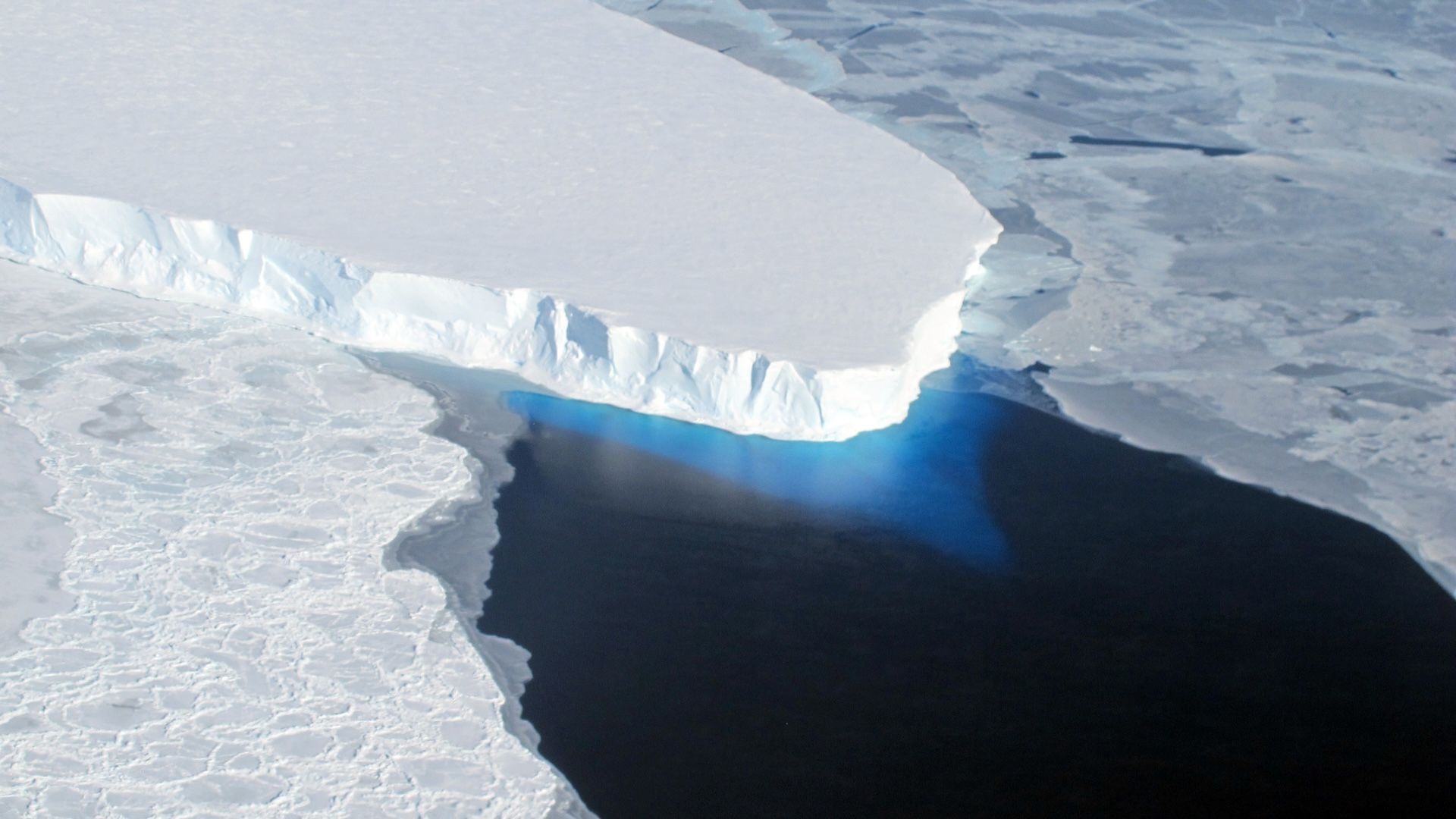
The eastern ice shelf attached to Antarctica’s Thwaites Glacier is likely to break up in 2026, according to researchers cited in new reporting on the glacier’s rapidly changing condition. The warning does not mean the full glacier will collapse this year, but it does point to the likely loss of an important stabilizing feature that has helped restrain the flow of inland ice into the ocean.
Thwaites is often called the Doomsday Glacier because of the scale of sea-level rise associated with its eventual collapse. The glacier itself sits on land, while the eastern ice shelf is a floating extension attached at its seaward front. That shelf acts like a buttress. It does not stop melting or eliminate instability, but it slows the seaward movement of the glacier behind it. Once that support weakens or disappears, the inland ice can move faster.
Researchers monitoring the system say satellite observations show that the shelf is poised to detach. Robert Larter of the British Antarctic Survey said the last remaining piece of ice shelf in front of the glacier is very likely to break up in 2026. The mechanics of the breakup are still uncertain, but the direction of travel is not.
Why the shelf matters
Ice shelves are easy to misunderstand because they already float. Their loss does not by itself add a large new volume to sea level in the way land ice does. Their importance lies in what they hold back. In the case of Thwaites, the eastern shelf helps regulate the discharge of the enormous glacier behind it.
That makes the coming breakup significant even if the glacier’s complete collapse unfolds over far longer timescales. A faster outflow from Thwaites would deepen concern about one of West Antarctica’s most vulnerable sectors. The glacier is already melting rapidly, and scientists have spent years trying to understand how warm ocean water, grounding-line retreat, fracture development, and ice dynamics interact there.
The source material notes that Thwaites is roughly the size of Florida and in places more than 2,000 meters thick. It is not a marginal or isolated ice feature. It is one of the major ice masses in West Antarctica, and its instability has global consequences because of the amount of land-based ice it contains and helps support.

The long-term threat remains enormous
The immediate warning about the eastern shelf can be easy to confuse with the longer-term scenario attached to Thwaites itself. The most dramatic number associated with the glacier is about 65 centimeters, or 2.1 feet, of global sea-level rise if Thwaites were to collapse. That is not expected to happen instantly. The source text makes clear that such a collapse could take centuries.
But long timelines do not make present changes less important. In systems like Thwaites, the concern is that once structural supports are lost and retreat advances into more vulnerable geometry, future change becomes harder to stop. The breakup of the shelf is therefore less a standalone event than a marker in a larger destabilization process already underway.
That is one reason scientists treat shelf integrity seriously. It can provide an early indication of how quickly a glacier may enter a new phase of retreat. Even if the next steps unfold over years or decades, the loss of the shelf removes a form of resistance that has mattered in the present climate state.
Antarctica’s warning signal
Thwaites has become a symbol of the difficulty of forecasting ice-sheet change in a warming world. Researchers know enough to identify serious risks, but the exact timing and pathways of breakup remain hard to pin down. That uncertainty is not reassuring. In glaciology, uncertainty often means the system is complex, not safe.
The latest assessment underscores the value of sustained observation. Satellite images are central to recognizing structural change in remote areas like West Antarctica, where direct field access is limited and conditions are extreme. The ability to see fracture evolution, shelf thinning, and detachment risk in near real time is one reason scientists can now speak more concretely about what 2026 may bring for Thwaites’ eastern shelf.
It also shows how climate risk often advances through thresholds rather than smooth, easily digestible trends. One year’s headline is not necessarily the final disaster, but the loss of another stabilizing feature that shifts the baseline for future change. That is how large ice systems can move from chronic concern to escalating hazard.

What this means now
No single breakup event can explain the future of Antarctic sea-level rise on its own. But the likely failure of Thwaites’ eastern ice shelf this year would be an unmistakable sign that one of the planet’s most consequential glaciers is losing yet another layer of protection.
The world has heard warnings about Thwaites for years. What makes this moment different is the specificity. Scientists are no longer speaking only about an abstract future vulnerability. They are pointing to a concrete structure, visible from space, that appears likely to disintegrate in 2026.
If that happens, the most immediate effect will be to increase concern about how quickly the glacier can unload more ice into the ocean. The broader effect will be to sharpen an uncomfortable reality: some of the most dangerous consequences of polar warming do not arrive all at once, but through a sequence of losses that make the next loss easier. Thwaites may be entering exactly that kind of sequence.
This article is based on reporting by Live Science. Read the original article.
Originally published on livescience.com