A rare family link emerges from an early medieval grave
An unusual Anglo-Saxon double burial has become more poignant and more scientifically valuable after ancient-DNA analysis confirmed that the two children interred together were brother and sister. According to the supplied report, the burial dates to roughly 1,400 years ago and may reflect a shared death caused by a fast-acting infectious disease.
That biological identification is important because confirmed familial relationships are rare in Anglo-Saxon burials. Archaeologists often work with grave goods, positioning, and skeletal evidence to infer social ties, but direct genetic confirmation remains comparatively uncommon. In this case, DNA evidence anchors the interpretation of a grave that was already striking for the way the two children were laid to rest.
Why the burial stands out
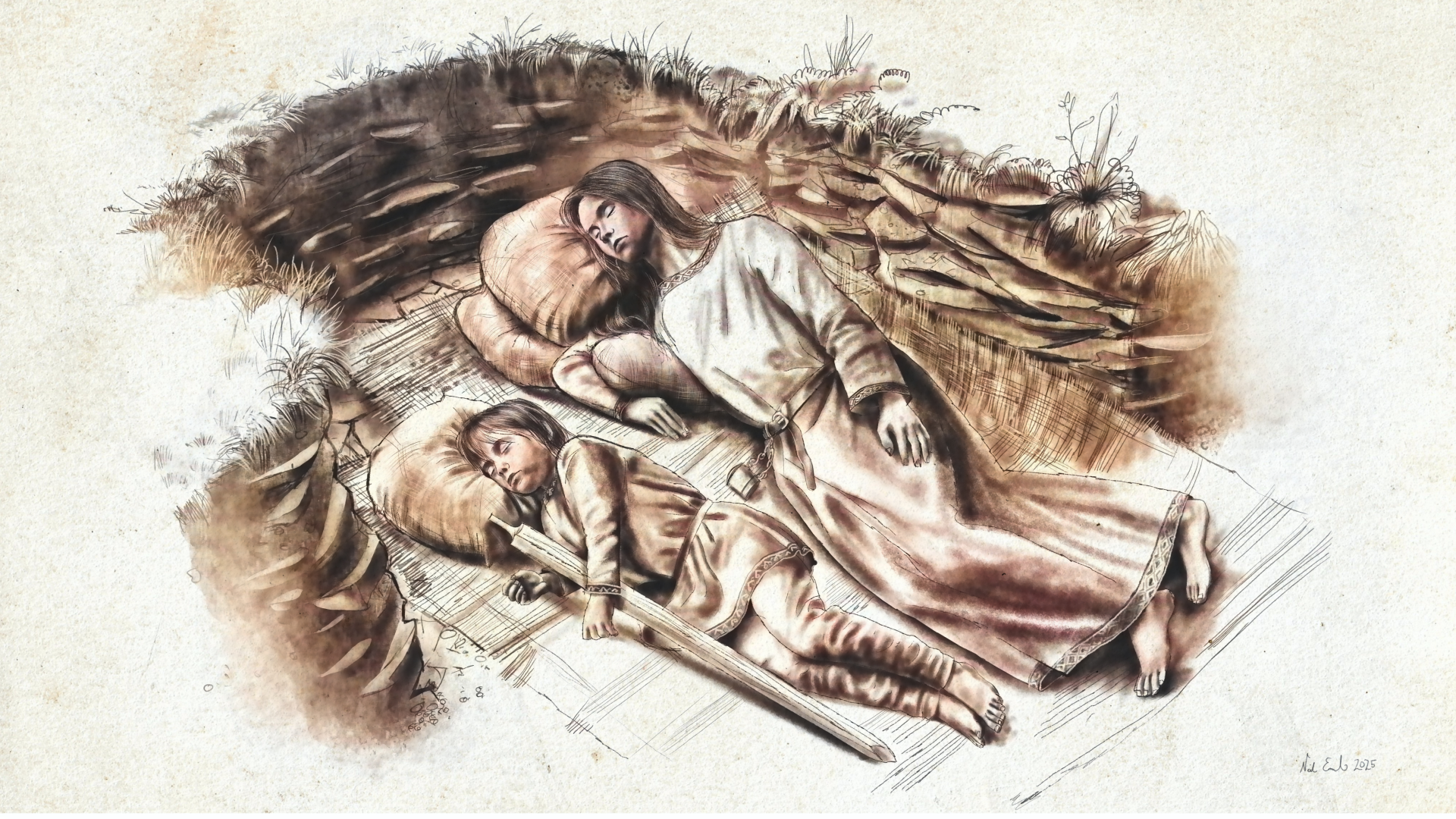
The report describes the burial as one in which an older sister appears to be cradling her younger brother. Even without overextending the interpretation, that arrangement suggests care in burial practice and offers a moving glimpse of social meaning in death. Archaeology rarely preserves emotion directly. What it can preserve are choices made by the living, and here those choices appear deliberate.
Because early medieval cemeteries often contain isolated individuals without written records, each confirmed kinship link helps refine how researchers understand household structures, childhood, and mortuary customs. The confirmation that these children were siblings gives more weight to the idea that their joint burial reflected a family event rather than a coincidental placement.
The possibility that both died at the same time from an infectious disease, as noted in the report, adds another layer. It suggests the burial may have been shaped not only by kinship but also by crisis.
What ancient DNA adds to archaeology
Ancient DNA has steadily changed the range of questions archaeologists can answer. Instead of relying only on artifact style, burial orientation, or skeletal morphology, researchers can now test biological relationships directly in many cases. That does not eliminate interpretive uncertainty, but it narrows it substantially.
For Anglo-Saxon archaeology, this matters because burials are among the richest surviving sources for the period. Written documentation is uneven, and everyday family relationships are often invisible in the historical record. DNA evidence can therefore illuminate social life at a scale that chronicles and elite texts usually miss.
In this burial, the genetic result does more than identify two individuals. It reinforces the interpretation of the grave as a relational act. The children were not simply buried in the same place. They were buried as siblings, and likely recognized as such by the community that performed the burial.
Infectious disease and early medieval life
The report’s suggestion that the children may have died of a fast-acting infectious disease is necessarily cautious, but it fits a broader reality of the period. Early medieval communities lived with recurrent mortality risks from infections that could spread quickly and leave limited traces in the historical record.
If the siblings did die close together, the burial becomes a small but vivid reminder of how disease could abruptly reshape families. Such episodes would have been socially devastating even when they left only faint archaeological signatures. Double burials, especially of children, may preserve some of the clearest evidence of those ruptures.
Importantly, the supplied material does not claim that a specific pathogen has been identified. The value of the case lies instead in how multiple lines of evidence converge: grave context, body positioning, chronological dating, and now DNA-confirmed kinship.

The science of intimacy in the archaeological record
There is a tendency in popular coverage to treat ancient graves either as technical datasets or as sentimental stories. The strength of this case is that it is both scientifically useful and emotionally resonant. The biological confirmation of sibling status strengthens the human interpretation rather than reducing it.
That is one reason the burial has drawn interest beyond specialist archaeology. It offers a rare point where molecular methods and human history meet cleanly. The genetics are not replacing the archaeology; they are clarifying it. The result is a more reliable reconstruction of how these children were related and how their community responded to their deaths.
For researchers, such cases can help calibrate broader models of burial practice. If genetic ties can be confirmed in a set of graves with unusual arrangements, archaeologists may better judge when spatial closeness or paired burial in other cemeteries likely reflects family relationships.
Why this find matters now
The scientific importance of the discovery lies in its precision. Ancient DNA is most powerful when it answers a specific question cleanly, and here it does exactly that. Two children long known to have been buried together are now known to have been siblings. That single fact improves interpretation of the grave and enriches understanding of Anglo-Saxon mortuary behavior.
The cultural importance lies in something simpler: the story preserves a recognizable family bond across fourteen centuries. Archaeology often works at scales so large that individual lives blur into pattern. This burial pulls the focus back to two children, one family, and one carefully made grave.
For Developments Today, it is a reminder that some of the most meaningful scientific advances are not only about new tools, but about what those tools allow us to say with confidence. In this case, ancient DNA has turned a moving image from the past into a documented biological relationship, giving one small corner of early medieval life unusual clarity.
This article is based on reporting by Live Science. Read the original article.
Originally published on livescience.com